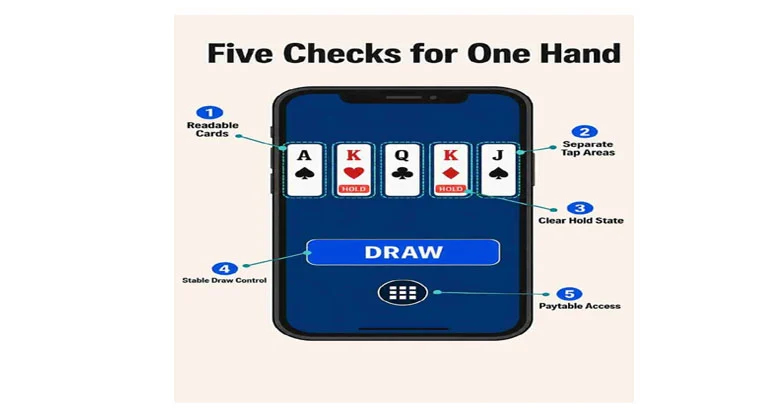
Video poker asks a player to read five cards, choose which to keep, and complete a draw. On a phone, those actions compete for space with the main control and the paytable. Simply shrinking a cabinet or desktop layout makes ranks harder to read, tap areas easier to miss, and held cards easier to confuse with unselected ones. A clear phone screen preserves the order of one hand: recognize the cards, mark the holds, confirm the draw, and see the result without reconstructing what happened.
The visible card and the area that responds to a tap do not have to be identical. A 2026 Siteimprove analysis reports that common guidance uses 44 by 44 points for Apple interfaces and 48 by 48 density-independent pixels for Android, although both figures are starting points, rather than guarantees. A compact card can therefore sit inside a larger, invisible tap area. Five adjacent cards still need enough separation to prevent one intended hold from activating the neighboring card. Tight spacing cancels much of the benefit of a generous target.
Seeing Which Cards Will Stay
The opening deal should leave all five cards in the same neutral state. No card has been selected, so none should carry a border, movement, symbol, or label. After a tap, the chosen card needs a persistent marker, while the other four remain neutral.