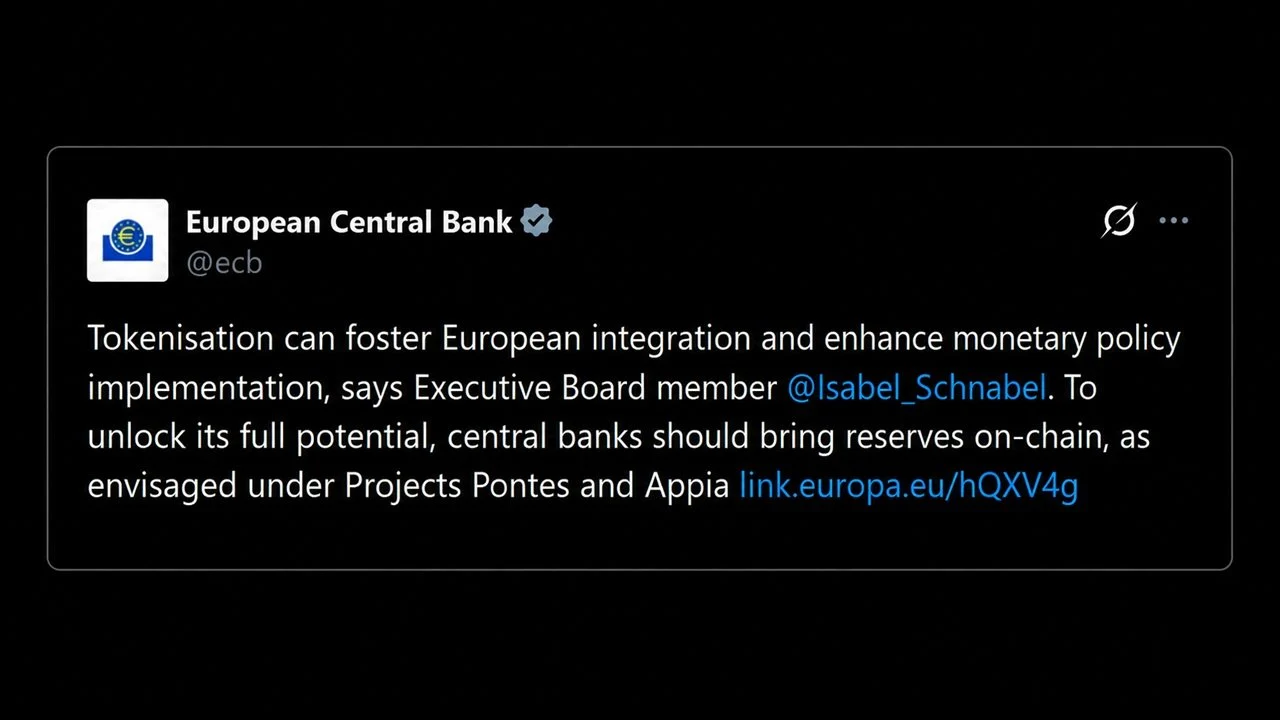
The European Central Bank isn’t just watching the tokenisation wave from the shore. It’s wading in, with board-level backing for putting central bank reserves directly on-chain.
Piero Cipollone, a member of the ECB’s Executive Board, has laid out the case that tokenisation of financial assets through distributed ledger technology could deliver meaningful efficiency gains across European financial markets, promote deeper integration, and actually strengthen monetary policy. The catch: all of that only works if central bank money itself goes on-chain.
The case for tokenised reserves
As financial assets increasingly migrate to DLT platforms, the settlement layer needs to keep up. If private stablecoins or commercial bank tokens become the default settlement mechanism on-chain, central banks lose a critical lever of control over the financial system.
The ECB ran more than 50 trial projects across nine jurisdictions in 2024, and the results pointed clearly in one direction. Market participants want risk-free central bank money for settling DLT-based transactions. Not stablecoins backed by commercial paper. Not synthetic dollars pegged by algorithms. Actual central bank liabilities.