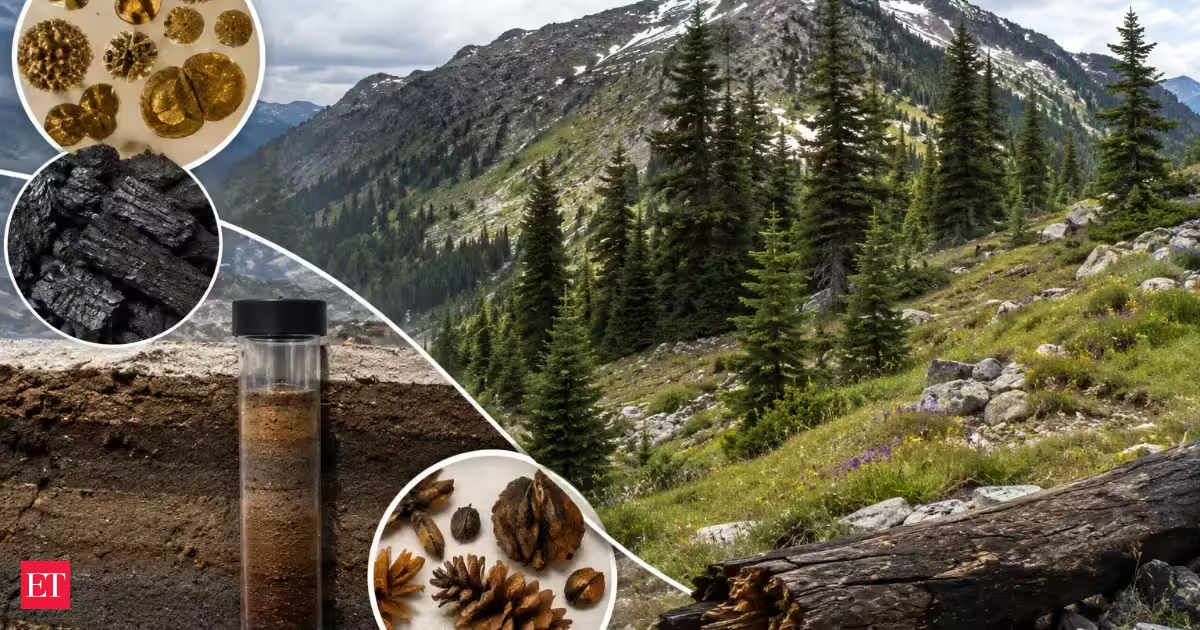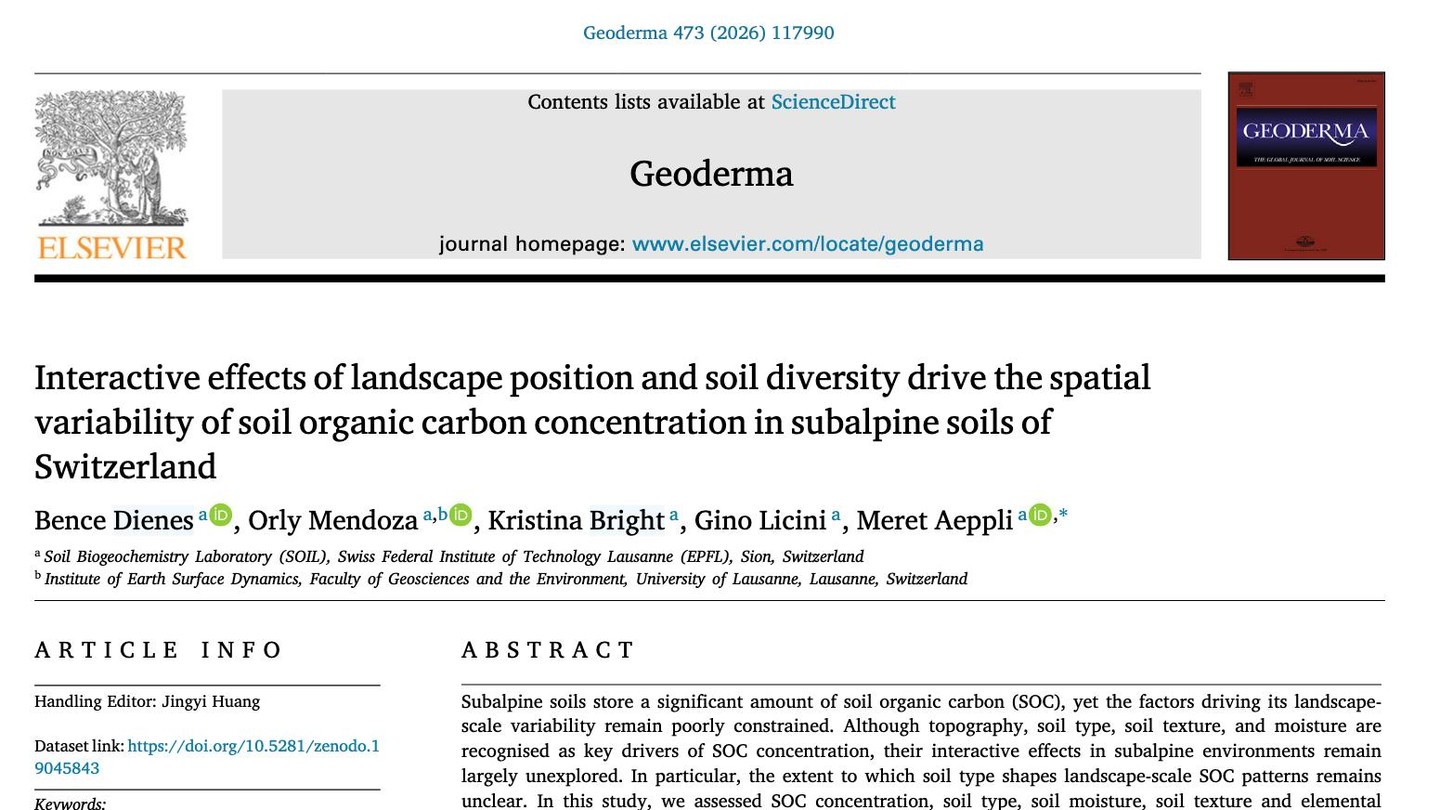
Why does soil organic carbon vary so much across a mountain landscape? In his new study published in Geoderma, Bence finds answers to this question.Subalpine soils store large amounts of organic carbon, but predicting where that carbon accumulates at the landscape scale has remained difficult. In a new study published in Geoderma, Bence Dienes and colleagues from the SOIL lab sampled 100 plots across two subalpine sites in the Swiss Alps (Blatt in the Binntal and Ar du Tsan in the Vallon de Réchy) to disentangle the roles of topography, soil moisture, soil texture, and soil type in controlling soil organic carbon (SOC) concentration.The team found that soil type diversity was far greater on valley plains than on slopes, reflecting greater hydrological variability. Plains ranged from organic-rich Histosols to mineral-rich Fluvisols, while slopes were dominated almost uniformly by Cambisols. SOC concentrations were correspondingly higher and more variable on the plains, driven by waterlogging that limits oxygen availability and slows decomposition.Using factor analysis, the authors distilled their soil physicochemical data into three predictors: mineral content, texture index, and sedimentary rock influence. Mineral content, which captures the gradient from organic-rich to mineral-rich soils, was by far the strongest predictor of SOC concentration, ahead of soil texture and sedimentary rock inputs. Notably, topographic position itself was not a significant predictor once these factors were accounted for, since a single "plain" position can encompass very different hydrological and pedogenic settings.The results suggest that SOC accumulation in these landscapes is governed primarily by oxygen limitation under waterlogged conditions rather than by stabilization on clay minerals. For SOC assessments in subalpine terrain, the study argues that simple slope-versus-plain classifications are not enough. Combining topographic position with soil type mapping gives a more robust picture of where carbon accumulates and why.Congratulations, Bence, on this great piece of work!FundingSwiss National Science Foundation (Grant No. 212056)ReferencesDienes, B., Mendoza, O., Bright, K., Licini, G., Aeppli, M. (2026). Interactive effects of landscape position and soil diversity drive the spatial variability of soil organic carbon concentration in subalpine soils of Switzerland. Geoderma, 473, 117990. https://doi.org/10.1016/j.geoderma.2026.117990.
New paper: what drives soil carbon in subalpine landscapes?
Why does soil organic carbon vary so much across a mountain landscape? In his new study published in Geoderma, Bence finds answers to this question.
343 words~2 min read