(Image credit: Getty Images / Bloomberg)
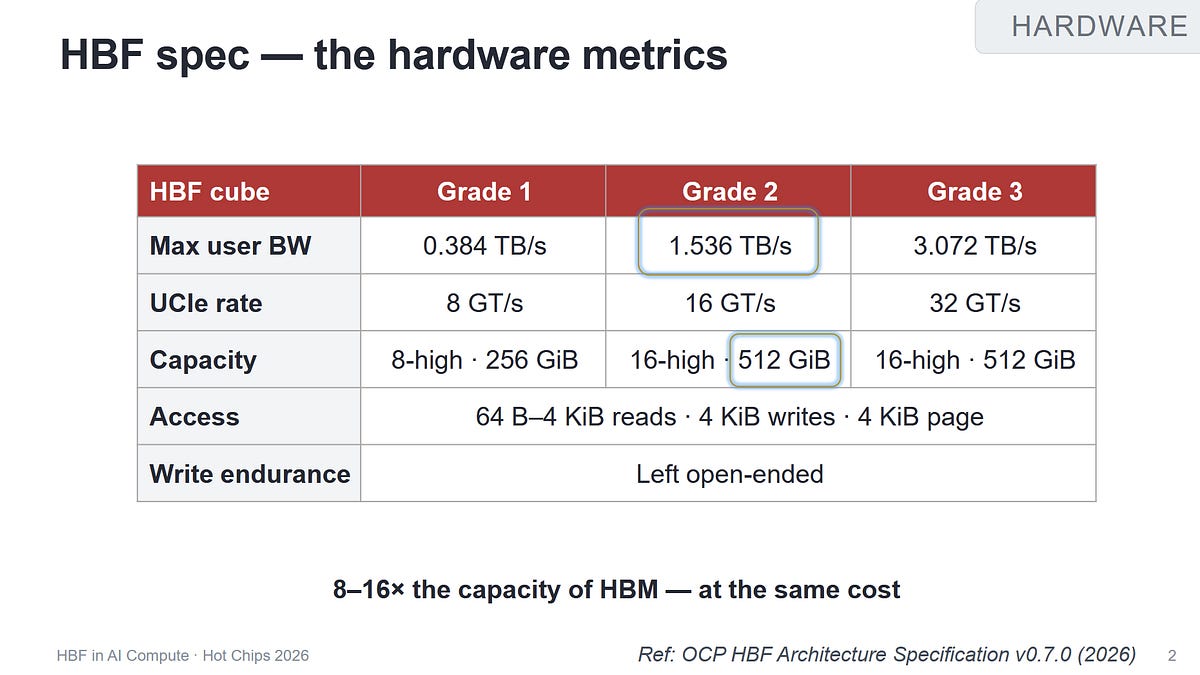
OXMIQ Labs, a GPU IP company, revealed at Hot Chips 2026 that High Bandwidth Flash (HBF) cannot replace High Bandwidth Memory (HBM) across the vast majority of workloads. For some, HBF could emerge as a specialized memory tier for huge but relatively cold datasets. For others, HBF can do more harm than good.When SanDisk unveiled its High-Bandwidth Flash (HBF) concept in early 2025, the technology pledged to equip AI accelerators with terabytes of relatively inexpensive memory and reduce the need for traditional High-Bandwidth Memory (HBM), a promise that raised a number of doubts from the very beginning.The emerging HBF specification includes three performance grades. Grade 1 uses an 8-Hi 256GB NAND stack with an 8 GT/s UCIe interface and 384 GB/s bandwidth. Grade 2 uses a 512GB NAND stack with a 16 GT/s UCIe interface and supports 1.536 TB/s bandwidth. Grade 3 reaches 3.072 TB/s using 32 GT/s UCIe 2.0 while retaining the same 512 GB capacity.Since HBF relies on 3D NAND, it supports read block sizes between 64 bytes and 4 kilobytes, 4KB writes, and 4KB page sizes. While HBF Grade 1 can barely compete against contemporary HBM, HBF Grade 3 can compete against HBM4E, though we have no idea when such memory will be available. However, the main feature of HBF is not necessarily performance per se, but 8 – 16 times more capacity than HBM at roughly the same cost.