Artificial intelligence is widening football’s scouting map. Predictive models can search hundreds of leagues and project how a player might perform somewhere else. Uefa now regards the technology as reshaping how talent is identified and evaluated. At Al Kholood, a Saudi Pro League club with far less spending power than the division’s giants, this technology, they believe, ensures they can compete. Gareth Jennings, group sporting director of the Harburg Group, the American ownership company that bought Al Kholood last year, explained how the club uses Teamworks Player ID to find undervalued players whose projected performance matches the squad’s requirements. “Anyone that falls outside of those data metrics is not considered,” he told The National. Based in Ar Rass, around 450km west of Riyadh, Al Kholood only reached the Saudi top flight in 2024. American investor Ben Harburg bought the club outright in July 2025, making it the first Saudi Pro League side under foreign ownership. Eleven months later, Al Kholood reached their first King’s Cup final, losing 2-1 to Al Hilal. Coba da Costa, a winger signed from Getafe for around €2 million, represents the club's biggest transfer this summer. Seven Saudi Pro League clubs have already outspent them in this transfer window. Jennings said he wants that number to climb even higher. “Hopefully it'll be more than seven. We want clubs to spend more than us and probably build on some of the inefficiencies that exist, we feel, in the game.“In any industry, the playing field is never level. And it's then trying to find ways that you can utilise and be really smart against your competitors, and one of the ways that we feel that we can do that is the use of data.”Edgaras Utkus, in red, was signed in the January transfer window from Belgian club Cercle Brugge. Getty ImagesShow caption: Edgaras Utkus, in red, was signed in the January transfer wi…Jennings is uncompromising about how that information enters Al Kholood’s recruitment process. For each role, the club sets its own benchmarks, with different requirements for local and foreign players, and weighs the metrics it considers most important. “Anyone that falls outside of those data metrics is not considered,” he said. If several players fit the model, Al Kholood begin distinguishing between them by character and future value, while an injury history or disciplinary problem can also end their interest. Ultimately, it's the data that decides who merits a discussion.The technology behind that approach comes from Teamworks. Rich Byrne, commercial director of Teamworks Player ID, spoke to The National about the predictive models Al Kholood use and the limits of what they can present to a club. Teamworks searches far beyond the markets a club of their size could realistically scout in person. Byrne says its models cover more than 200 leagues and about 100,000 players, adjusting for the standard of the competition and the style of the team in which a player has performed. “So let's just try and remove all the noise around this player and isolate for true player skill. Is this a good player or a bad player?” he asks. The important leap is from description to prediction. “If I'm Gareth Jennings at Al Kholood and I give this player a three-year contract, what can I expect his output to be? And that's the hardest question in football and that's the one that we're trying to help answer, I suppose.”The obvious objection to this type of technology is that footballers cannot be whittled down to their averages. Romelu Lukaku is an example of a player who has performed admirably well under one coach and has looked somewhat diminished under others. Put to Jennings that a model could miss some of that nuance, he points to examples of players whose level has remained consistent across different clubs and coaches as evidence that adaptability can itself be measured. “The realism is that the data is then telling us this player has the capability to cope with different coaches that come and manage within our clubs. They're able to self-correct,” Jennings said. That explains how the model can recognise adaptability once a player has demonstrated it. It is less clear how reliably it can predict the opposite case, when the same footballer performs very differently according to his surroundings. Human judgement therefore still matters, but, as Jennings makes clear: “From a performance perspective, the data will always override.”Gareth Jennings, group sporting director of the Harburg Group, the American ownership company that bought Al Kholood last year. Photo: Harburg GroupShow caption: Gareth Jennings, group sporting director of the Harburg Grou…Uefa’s recent Elite Scout Programme has placed the same balance at the centre of its teaching, presenting AI as a powerful accelerator while insisting that judging potential still requires human intuition.Not every model deserves that faith, and Byrne is candid about the dangers. Clubs have rushed towards analytics and some, he says, are “building naive models because they haven't been iterated enough. They haven't been through the transfer market, proven and validated enough”. Teamworks has refined its own model across 22 transfer windows over 11 years, yet Byrne does not pretend it has solved recruitment. For those trying to extract maximum value from limited resources, recruitment efficiency can mean survival.“This is not a silver bullet. Most clubs are operating at less than 50 per cent success rate on transfers. We're helping clubs operate closer to 70-80 per cent," Byrne said. "We're still getting a couple, two out of every 10, three out of every 10 wrong, but we're still giving them that edge.”There is a wider problem in making recruitment more efficient. If clubs become better at rewarding the same measurable qualities, do they eventually start buying the same players, robbing the game of the mavericks who draw people to it? Byrne thinks the pendulum may already be preparing to swing the other way. Clubs, he argues, have spent too long recruiting for a manager’s particular style even as managerial tenures have shortened. A centre-back bought to play in a back five can look suddenly unsuitable when the next coach wants a back four. “Squad quality is a much better indicator of success than style,” Byrne said. QuoteI think you're going to actually see a shift back, kind of a counter-shift of what you've seen over the last decade, maybe towards more individual skills coming to the fore again, if we have our way with it anyway.Rich Byrne, commercial director of Teamworks Player IDRather than forcing every player into the same tactical mould, he believes clubs will increasingly have to trust coaches to create room for individual strengths. “I think you're going to actually see a shift back, kind of a counter-shift of what you've seen over the last decade, maybe towards more individual skills coming to the fore again, if we have our way with it anyway.”For Al Kholood, the longer test will be whether those projections translate into a profitable trading model, but when it comes to their sporting targets, they have already begun to make waves. Their run to the King’s Cup final was a reminder that they are there to compete. “A young player comes in and scores a wonder goal late in the game to equalise and then we won on penalties. Those things are the fairytale pieces,” Byrne said.
'The data will always override': How AI is helping Al Kholood outsmart Saudi Pro League’s big spenders | The National
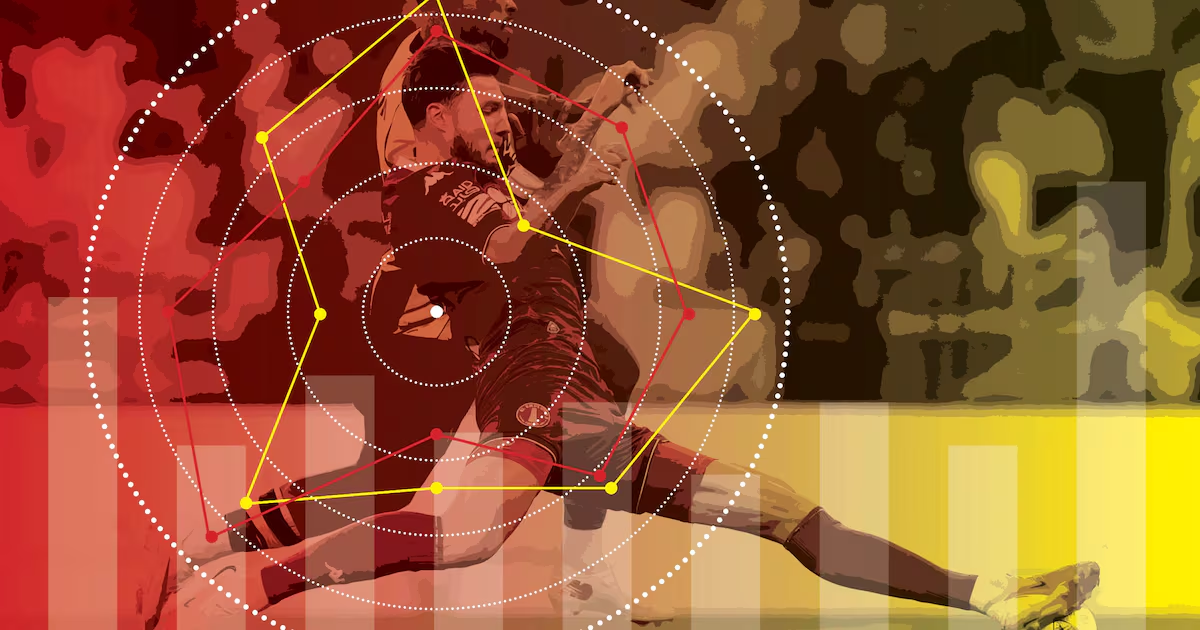
Teamworks Player ID assesses about 100,000 players across more than 200 leagues as club searches for talent beyond the obvious markets
1,217 words~6 min read