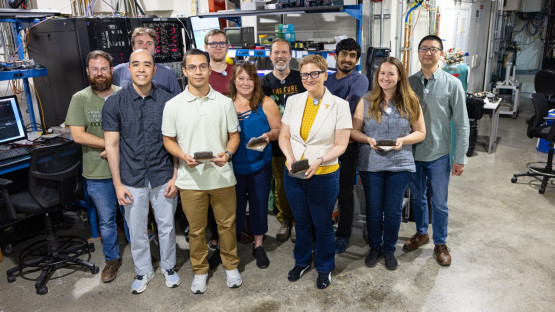
An X-ray experiment at Cornell recently did something unusual: It decided for itself where to take its next measurement.In a demonstration led by researchers at the Cornell High Energy Synchrotron Source (CHESS), in collaboration with Oak Ridge National Laboratory (ORNL), the University of Tennessee and the University of Utah, data collected at a CHESS beamline were analyzed in real time at ORNL (800 miles away in Tennessee) and new measurement instructions were automatically sent back to the instrument on the Cornell campus. The process repeated continuously until the experiment was complete, marking a significant step toward synchrotron experiments that adapt as they run, make more efficient use of valuable beamtime and accelerate scientific discovery.The demonstration took place at CHESS's Structural Materials Beamline (SMB), where scientists use high-energy X-rays to probe the internal stresses of engineering materials. Understanding those stresses is critical for developing stronger, more reliable components for manufacturing, transportation, energy systems and other industries. “At these instruments, time is a scarce resource,” said Amlan Das, staff scientist at the CHESS beamline where the experiment took place. “Researchers often have only a limited amount of time to collect the data they need. The question we're asking is: How can we make the best possible use of every x-ray photon?”
Where the Beam Points Next: Autonomous Experiments Take Shape at CHESS | Cornell Chronicle
An X-ray experiment at Cornell recently did something unusual: It decided for itself where to take its next measurement.
1,143 words~5 min read