Insider Brief
Researchers used entangled electrons in helium atoms to produce higher-energy X-rays beyond the limit predicted by standard theory, potentially opening a new approach to quantum sensing.
Two correlated electrons returned to the same ion simultaneously and released their combined energy as a single X-ray photon, an effect observed for the first time.
The method could help detect paired-electron correlations in gases and materials, with possible applications in quantum computing and advanced nanomaterials.
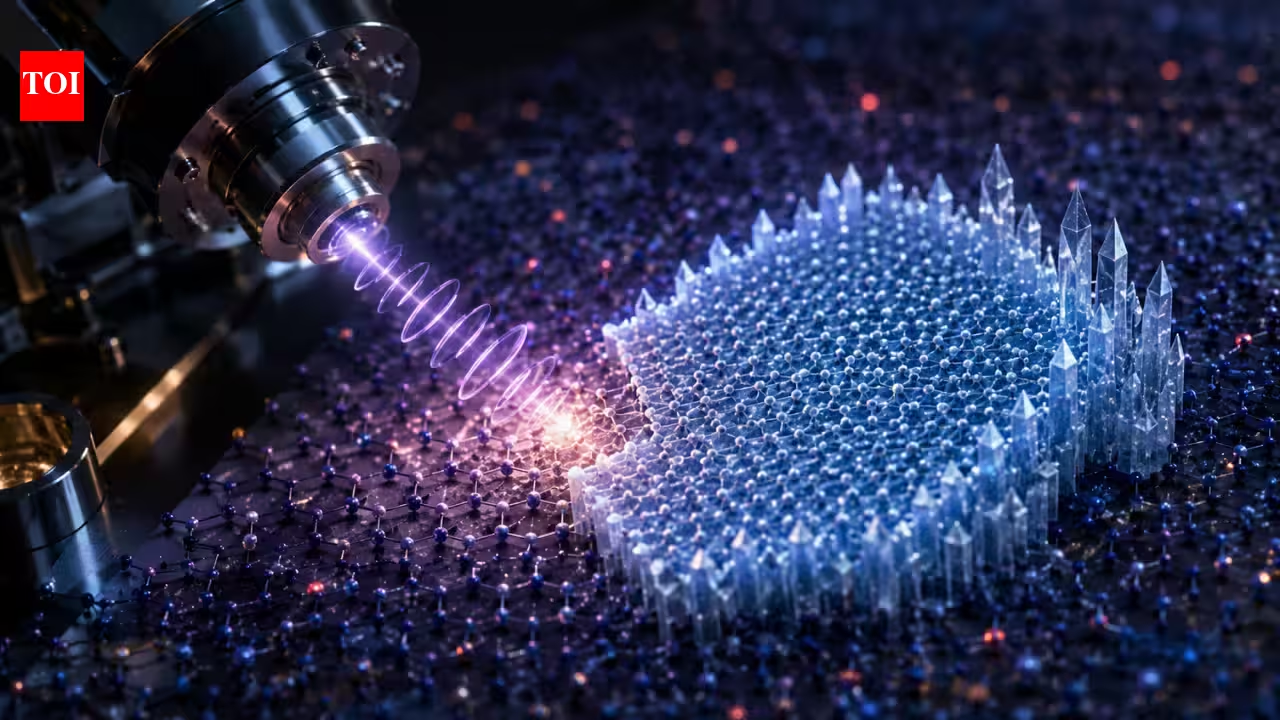
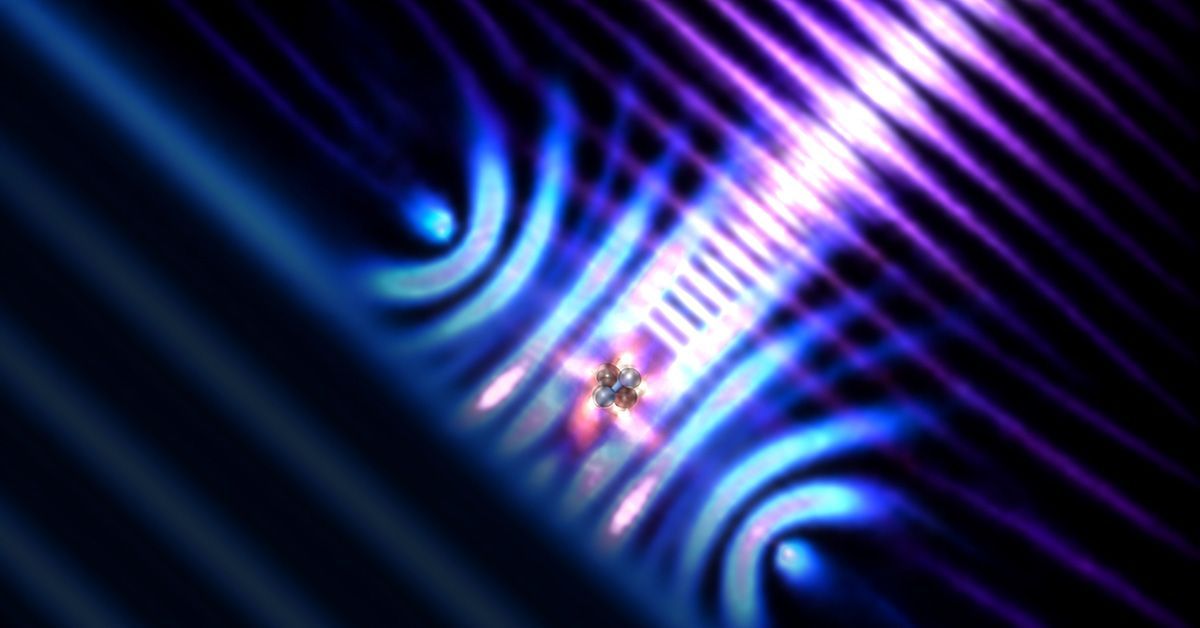
Artist’s rendering of an ultraviolet laser pulse (dark blue waves in foreground) acting on a helium atom (center). Two electrons are pulled away and driven back (pale blue spiral waves trace their return). When they recombine, they emit light at extreme ultraviolet frequencies (violet waves) and X-rays (white). (Tenio Pompmintchev lab / UC San Diego)