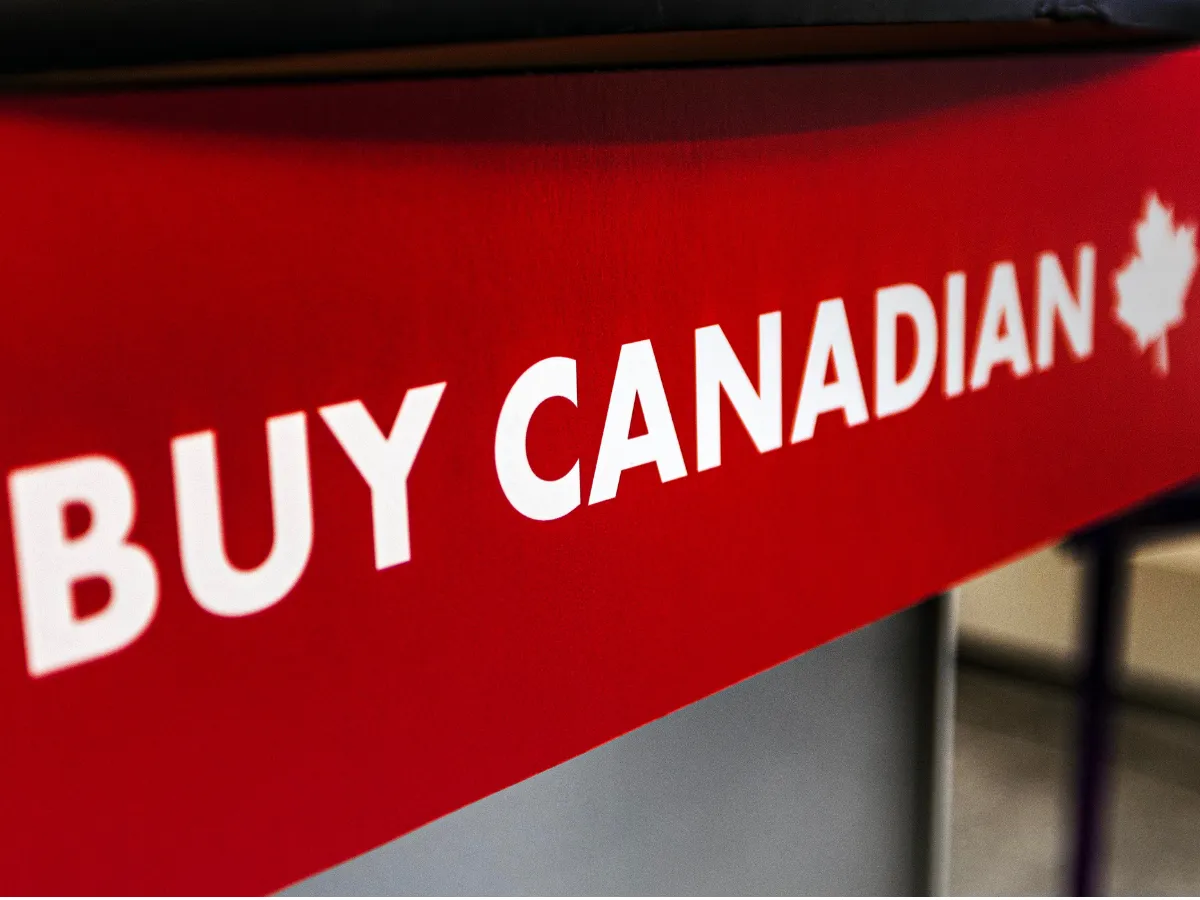
Skip to Content News Archives Economy Energy Oil & Gas Renewables Electric Vehicles Mining Commodities Agriculture Real Estate Mortgages Mortgage Rates Finance Banking Insurance Fintech Cryptocurrency Work Wealth Smart Money Wealth Management Investor Personal Finance Family Finance Retirement Taxes High Net Worth FP Comment Executive Women Puzzmo Newsletters Financial Times Business Essentials More Innovation Information Technology FP500 Podcasts Small Business Lives Told Tails Told Shopping Financial Post Store Obituaries Place a Notice Advertising Advertising With Us Advertising Solutions Postmedia Ad Manager Sponsorship Requests Classifieds Place a Classifieds ad Working Profile Settings My Subscriptions My Offers Newsletters Customer Service FAQ News Economy Energy Mining Real Estate Finance Work Wealth Investor FP Comment Executive Women Puzzmo Newsletters Financial Times Business Essentials HomeEntrepreneurSmall BusinessNewsRetail & MarketingA ‘Buy Canadian’ consumer's guide to fighting Trump's 50% tariffsAs Canadian outrage grows over a hardline U.S. trade stance, here are several hard-hit small-business to buy fromLast updated 11 minutes ago Canadian shoppers channelling their consumer frustrations into a 'Buy Canadian' sentiment could help soften the tariff blow for many small businesses. Photo by Andrew Francis Wallace/Toronto Star via Getty ImagesFifty per cent tariffs on billions of dollars of Canadian goods went into effect over the weekend after Canada-United States trade talks collapsed on Friday. The list of targeted goods features a diverse range of items, from natural honey to hockey sticks, jewellery, cut flowers, wine and a variety of other goods, many produced by smaller businesses. Subscribe now to read the latest news in your city and across Canada.Exclusive articles from Barbara Shecter, Joe O'Connor, Gabriel Friedman, and others.Daily content from Financial Times, the world's leading global business publication.Unlimited online access to read articles from Financial Post, National Post and 15 news sites across Canada with one account.National Post ePaper, an electronic replica of the print edition to view on any device, share and comment on.Daily puzzles, including the New York Times Crossword.Subscribe now to read the latest news in your city and across Canada.Exclusive articles from Barbara Shecter, Joe O'Connor, Gabriel Friedman and others.Daily content from Financial Times, the world's leading global business publication.Unlimited online access to read articles from Financial Post, National Post and 15 news sites across Canada with one account.National Post ePaper, an electronic replica of the print edition to view on any device, share and comment on.Daily puzzles, including the New York Times Crossword.Create an account or sign in to continue with your reading experience.Access articles from across Canada with one account.Share your thoughts and join the conversation in the comments.Enjoy additional articles per month.Get email updates from your favourite authors.Create an account or sign in to continue with your reading experience.Access articles from across Canada with one accountShare your thoughts and join the conversation in the commentsEnjoy additional articles per monthGet email updates from your favourite authorsSign In or Create an AccountorCanadians expressed outrage at reports of U.S. economic bullying in the talks, with 76 per cent of respondents to an Angus Reid Institute poll Sunday saying the government was right to walk away.For the businesses affected, the tariffs are expected to bring real economic pain. “It’s going to be devastating … if this continues,” Toronto retail analyst Bruce Winder said Monday.Breaking business news, incisive views, must-reads and market signals. Weekdays by 9 a.m.By signing up you consent to receive the above newsletter from Postmedia Network Inc.A welcome email is on its way. If you don't see it, please check your junk folder.The next issue of Posthaste will soon be in your inbox.We encountered an issue signing you up. Please try againDan Kelly, president of the Canadian Federation of Independent Business, said the new tariffs hit “smack in the centre of small-business trade,” adding that 20 per cent of CFIB members export to the U.S. and at least 40 per cent of those businesses are in the line of fire from the new tariffs.Winder said channelling consumer outrage into Buy Canadian sentiment could soften the blow.“We’re pretty angry right now,” he said.Kelly also urged Canadian consumers to buy local as much as possible — by purchasing Canadian-made items from a Canadian retailer, or as a second option, foreign-made goods (outside of the U.S.) sold by a Canadian retailer.Here’s a look at some Canadian producers and retailers affected by the new tariffs and the Buy Canadian opportunities they present for consumers.Summer’s Gold Honey Co., which sells honey and beeswax products out of Merlin, Ont., was still reeling from the effect of Trump’s 2025 “Liberation Day” tariffs when the new 50 per cent tariffs hit this weekend.Owner Mike Davidson said he was “livid” when he heard. Last year’s tariffs and the elimination of the de minimis exemption effectively ended his U.S. sales, putting a $50,000 dent in revenues that typically ranged from $300,000 to $500,000. Now he expects the new levies could eliminate the approximately 12 million pounds of honey that get exported from Canada into the U.S. annually, creating the potential for an over-saturated market here. Merlin, Ont.-based Summers Gold Honey Co. sells honey and beeswax products. Photo by Andrew WilliamsonHe worries that larger Western Canadian producers will try to sell their product in Ontario, the biggest domestic market for honey, which would put downward pressure on prices and impact smaller businesses such as his.Davidson is working to get Summer’s Gold honey into more major grocery stores, and its products can also be found at some local retailers, as well as the company’s online store.He encouraged people to buy Canadian: “We’re being attacked, and fighting back is the only option.”Cindy Lou Baldassi has been running a handmade jewellery business out of Calgary for nearly 18 years. The CindyLouWho2 website and Etsy shop feature a variety of unusual pieces, from labradorite pendant necklaces to fossil and dinosaur bone jewellery — including her popular dinosaur poop charms — and manage about 1,000 orders each year.Her online shop will be taking a sizable hit from the 50 per cent tariffs, which cover sterling silver and imitation jewellery, after her stainless-steel keychains were already affected by steel tariffs. While Baldassi expects some jewellery exporters could potentially find loopholes around the new levies (depending on what they sell), businesses that operate solely online depend disproportionately on the U.S. customer, she said. Calgary jewellery maker Cindy Lou Baldassi’s cindylouwho2 products include fossilized dinosaur stool earrings. Photo by cindylouwho2As of now, about 75 per cent of her sales are from American buyers, though she said this has come down from 90 per cent last year since the trade war forced her to diversify into other countries.Baldassi has already expanded her business into Australia, New Zealand and a few countries in Asia.She said she is seeing an outpouring of support from Canadian customers online who told her they have been promoting her in group chats and forums and checking out sites that have compiled lists of Canadian businesses to buy from.“People are renewing their interest in buying Canadian,” she said.Cosmic Plants Inc. is one of the four largest orchid growers in Canada. On average, the Lincoln, Ont., company grows about a million plants a year and about one in three of those are exported to the United States.But owner Connor van Steekelenburg said the new tariffs have compelled the company to sell its flowers at discounted rates in the past three weeks, to move as much inventory as possible.“We wanted to be proactive,” he said. “So, we have been trying to keep things moving, because these flowers are perishable.”For flower growers, finding an alternative foreign market to the U.S. is not feasible at this point, according to Andrew Morse, executive director of the association Flowers Canada Growers. Cosmic Plants Inc.’s orchid greenhouse in Lincoln, Ont. Photo by Cosmic Plants Inc“The products are really tuned for the U.S. market,” he said. “They are made specifically to travel by truck across North America. They are not ideal for shipping to other foreign destinations. So, trade diversification is not really a solution.”For now, Steekelenburg is ensuring he does not lose his clients in the U.S. and is prepared to absorb some of the tariff costs. However, in the long run, he doesn’t think that will be viable. He hopes to be able to sell more in Canada.“We have seen the power of Canadian support in the past and it really does have the ability to influence positive change,” he said.“If Canadians continue to shop with intention, that would probably be the thing that helps the most.”Cosmic Plants orchids are sold in many flower shops, garden centres, grocery stores and big box and hardware chains. Steekelenburg suggested flower consumers look for “Grown in Canada” labels.While much of the hockey equipment sold in Canada is made in China, certain specialized products will be affected by the latest tariffs, said Joey Walsh, founder and chief executive of HockeyStickMan Inc., a Belleville, Ont.-based retailer that sells hockey equipment from brands including CCM, Bauer and its in-house line, Pro Blackout.Walsh estimates the new tariffs will affect around five to 10 per cent of his company’s sales, covering made-in-Canada items such as wooden sticks, refurbished sticks and pro stock equipment manufactured for professional, minor league and collegiate players, particularly goalie gear.About half of HockeyStickMan’s sales are to customers in the U.S., and Walsh said he anticipates it will be the “perception” of tariffs that hurts sales, more than the tariff itself. Pro stock goalie equipment for sale at HockeyStickMan in Belleville, Ont. Photo by HockeyStickMan“We do several hundreds of thousands of dollars in sales in the United States every week, so the court of public opinion is absolutely going to hurt us,” he said. “Many of our customers are going to hear that hockey sticks have tariffs and they’re not going to question the country of origin.”Walsh said his company won’t raise prices yet, and plans to absorb the new tariffs over the coming weeks.HockeyStickMan employs 80 people, all based in Canada, with stores in Belleville and Toronto. Walsh said supporting Canadian retailers is a good idea for consumers who want to buy local, even if their products are manufactured elsewhere.“But at the same time, I encourage people to look after themselves and to get the best deal that they can for their families, because hockey is not a cheap sport,” he said. Join the Conversation This website uses cookies to personalize your content (including ads), and allows us to analyze our traffic. Read more about cookies here. By continuing to use our site, you agree to our Terms of Use and Privacy Policy.
A ‘Buy Canadian’ consumer's guide to fighting Trump's 50% tariffs
As Canadian outrage grows over a hardline U.S. trade stance, here are several hard-hit small-business to buy from. Find out more here
1,745 words~8 min read