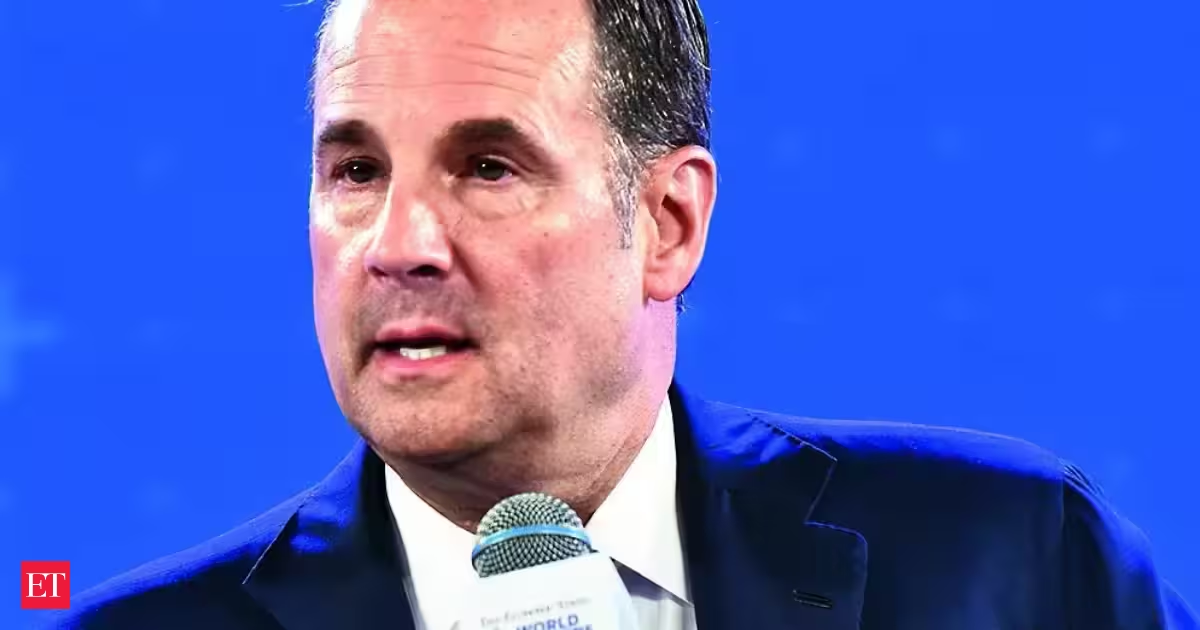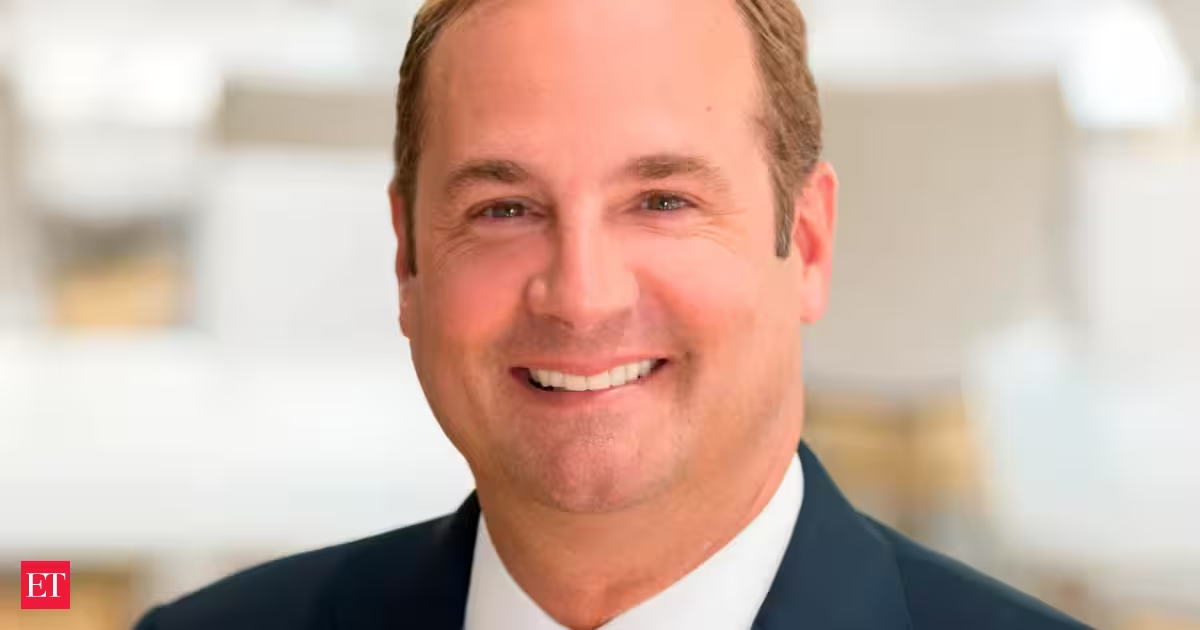
New Delhi: In an interview with ET, Anthony Capuano, president and CEO of Marriott International talks about the rising focus on India and the chain's expansion strategy here, the geopolitical developments impacting business, how AI could shape travel and hospitality and what India could do to attract more tourists. Edited excerpts: Q: Marriott’s topline in India crossed $1.5 billion in 2025, up from $1 billion in 2023. The chain has also said India is on track to become its third-largest market globally and is expected to overtake Mexico. How has this year been so far in India, and do you have any topline targets for the market for the next two to three years?A: I would guess that, probably in the next three or four years, India will be our second-largest market, and we have no intention of slowing down. We signed more than 60 deals in India, the highest in the Asia Pacific Excluding China (APEC) region, in the first half of this year.Also Read: Marriott sees India becoming its second-largest market in 3-4 yearsWe've got over 200 projects in the pipeline, which represents more than 30,000 incremental new rooms and will almost double our footprint across the country.One of the things that's really exciting is that we're in almost 80 cities today. Next year is Marriott's centennial year, and it will likely coincide with us opening in our 100th city in India as well.Just in the last year or two, think about how we have demonstrated our belief in India. We chose Ranthambore to announce the launch of our 10,000th hotel globally. We established our tech accelerator in Hyderabad. We decided that the global launch of the Series by Marriott portfolio would be here in India, and we made a minority equity investment, which is atypical for our business model.So, you think about all the things we are doing that are tangible illustrations of our belief in the market and our commitment to extend our lead here.From a macro perspective, am I happy? Certainly not satisfied. One of the favourite phrases of our founder was, “Success is never final,” and that certainly guides how we think about the business here in India.We are pleased with our pace of growth, but we'd like to grow faster. We're pleased with our pace of revenue growth, but we'd like to see even stronger RevPAR and average rate growth across the country.One of the things that will add a layer of complexity is that a significant portion of our growth is in the select-brand and now mid-scale tiers, which by definition are lower-rated tiers.But it's not a binary decision. It's not as if we've abandoned our growth in luxury and premium in pursuit of select-brand and mid-scale growth. Quite the contrary. In fact, the company's 10,000th hotel that we just celebrated was a beautiful new JW in Ranthambore.Q: Marriott is doing things differently in India. You talked about the equity investment in Concept Hospitality. Do you think that India is also becoming a kind of a crucible for innovations across brands, product and product fit for the chain?A: I think when you look at the diversity of domestic demand across quality tiers, it is a terrific laboratory for us. We have 19 of our brands deployed here in India today, and we're about to launch our 20th brand, City Express, which is an acquisition deal we did in Latin America.So, when we think about testing new brands, for all the reasons we've discussed, India is a perfect place to do that. But it actually goes beyond brands. I think it's a country ripe for innovation across many facets of our business.Also Read: ET World Leaders Forum: Global business rewires for a world of geopolitics, AI and energy shiftsIn fact, we launched our tech accelerator in Hyderabad, which is another good example of the way we view India as a testing ground for many of the things we're trying to do on a global basis.Q: How are you looking at adapting AI internally in your processes and systems? If you could talk about some of the recent AI-linked projects that you might have rolled out internally.A: So maybe I'll talk broadly, and then I'll give you a few specific examples.I am a firm believer that these emerging technologies are going to impact every industry, but in unique ways. The unique challenge for the hospitality industry, and therefore for Marriott, is preserving the idea that we are in the human connection business.When I think about how AI will impact Marriott, I think about it in four broad categories.First, and maybe the most interesting, will be the impact that AI has on the distribution landscape. If you fast-forward a year or two, where most frequent travellers have an agentic AI platform that they're using to research and potentially book travel, what are the implications of that for the big global brand companies? What are the implications for the travel intermediaries? I think it will be quite impactful.As a result, we're spending lots of time and doing lots of experimentation with Google, Anthropic and OpenAI, as they try to figure out how to enter the travel vertical and how to monetise that entry. So that's the first category.The second category would be what we call above property. There are certainly opportunities to drive efficiency in processes that have been done manually historically.I think about my old discipline, development. Rather than having an army of lawyers or paralegals generating the first draft of contracts, that's probably something that can be done with these emerging technologies, freeing up capacity for those professionals to work on higher-impact work.The third category would be on property, but not in a guest-facing way, figuratively behind the front desk. I'll give you an example.At the Marriott Marquis in New York City, a 2,000-room hotel, there used to be six full-time associates whose sole job was rooming assignments for the next day, which is a giant jigsaw puzzle of preferences, requests and Bonvoy loyalty status. Today, the bulk of that work can be done using AI tools.The night audit function, which historically was a more manual process, is another area where I think there are efficiencies.And then maybe the most intriguing is the fourth category, which is in the guest-facing elements of our business.Think about a front desk agent, and I'm quite enthusiastic about this, not necessarily in terms of creating efficiency, but in terms of creating capacity.Because we are in the human connection business, if Rajeev (Rajeev Menon) and his team can deploy these technologies in a way where we create a minute or two of incremental capacity, where that front desk agent, rather than staring at a screen or tapping away at a keyboard, can look you, the arriving guest, in the eye, listen to what you're really saying, pick up on visual cues and, as a result of that data, enhance your stay in some way, I think it's a massive opportunity for us.We just launched something called Ask Bonvoy within the Bonvoy app. It's now been rolled out globally, and it is plain-language search. I think it speaks really well to the growing level of sophistication of our guests and our members.Q: We’ve had a war in the Middle East, geopolitical flux and, basically, a lot of uncertainty around travel. How are you managing to give guidance and numbers when travel is so uncertain and analysts and investors are looking for certainty?A: It’s not just these big events, such as natural disasters and conflict. One of the tougher complexities, as I and the other leaders try to forecast the business, is that, particularly in a post-pandemic world, we’ve seen the booking window shrink to almost historic lows.Our transient booking window on a global basis is about three weeks. So, as I’m trying to forecast and provide guidance to the investment community for the second half of 2026, I always feel the necessity to provide that caveat and say, based on the booking trends we’re seeing now.It varies by segment. The group segment books further out, so we’ve got more visibility into the group trends.We provide forecasts, but we also remind the investment community that the booking window is short, so the nature and the underpinnings of that forecast can shift quite quickly.And then there are planned events like the World Cup and the like that are going to move beyond the normal parameters. And then, sadly, there are these unanticipated events: natural disasters, hurricanes, earthquakes and regional conflicts.In the second quarter, we saw RevPAR in the Middle East go down 43%, right? And that’s despite the fact that January and February were the strongest January and February start we’d ever seen in the region.So, we had quite high hopes for what the Middle East business would look like for the balance of 2026, and then obviously the conflict had a material impact on those plans.Now, to your original question, there are many benefits of our industry-leading scale, of having more than 10,000 hotels and being in nearly 150 countries. One of those is that, while you’ll have these impacts, many of those impacts are more localized.Think about the conflict in the Middle East. The Middle East, while a critically important set of markets for us, represents 3% of our global rooms inventory and about 3% of our global fees. So, while it is quite impactful, you’ve still got 97% of the global room inventory, where most of the markets are seeing really positive growth trends.Q: The board meeting agendas would be very different these days compared to last year…A: Yes, although, you know, David Marriott is our chairman of the board. He's only our third chairman in the last 100 years, and he's built a terrific board.A board that understands our industry is cyclical by its nature, and a board that understands and embraces the idea that we don't make decisions to optimise performance for the next quarter or the next two quarters.We've always approached the business with a lens of making decisions that are to the long-term benefit of the business. It served us well for 99 years, and I don't see us or the board pushing us to deviate from that perspective.Q: Domestic travel is driving growth for the company in India. How big is the outbound Indian traveller opportunity for Marriott?A: More than 70% of our demand in India is domestic travel.Well, it'll be interesting to see. I mean, you know, the simple answer is we should all be pretty excited about the world's most populous country, with a growing middle class and an appetite for travel. At 200,000 feet, it's very compelling.Now, I think to the great benefit of India's lodging industry, the travelling Indian consumer is quite intrigued with exploring their own beautiful country, and that's what's driving the sort of domestic travel trends that we've seen.But over some period of time, whether that's the next five years, the next 10 years, or the next few decades, the combination of the sheer size of the population, the growth of the middle class, and what we're seeing around the globe, which is a middle class with a growing, and in some cases ravenous, appetite to explore the world, I think that bodes really well.And Rajeev and his team do such a fabulous job in partnering with our owners here in India that I feel really good about Indian travellers' perception of what Marriott stands for, what our brands stand for, and what a reasonable expectation of product and service quality will be if and when they decide to spread their wings a bit and explore travel outside of India.Q: Are you considering expanding into branded residences in India?A: Yeah, in fact, the world's largest Western-branded residence project is underway here in India, so absolutely.You know, there's some parallel to our branded credit card business in that we have very loyal Bonvoy members. When you look at their propensity to spend and their propensity to concentrate their travel with us once they get that branded credit card, and hopefully have it top a wallet that grows exponentially, we see the same thing in branded residences.If you are now not just a guest but an owner of a Marriott product, your loyalty to our family of brands, your propensity to concentrate your travel within the Bonvoy ecosystem grows dramatically.Q: In the near future, are there any segments that you could consider entering in India? Any segments that you may not be present in currently, or any brands that you'd like to talk about that you could consider launching in India?A: We're constantly evaluating the breadth of the portfolio, and Rajeev (Menon) and his team are listening to our Indian consumers, which will drive how we think about deployment of additional brands.We're getting ready to bring our 20th brand here to India, the City Express brand, which is a transient mid-scale brand that we brought into the portfolio through a small M&A transaction in the Caribbean and Latin America region.But I think it will resonate very well with the Indian consumer. We are also launching the W and Marriott Marquis brands in India.Q: Marriott India has carefully launched its multiple brands across different cities and target markets, rather than simply following a standard American growth template. Given the complexity of the Indian market and the Indian consumer, who is tough to please and highly value-conscious, what kind of thinking goes into deciding which brands to launch, where to launch them and how to adapt them to the Indian market?A: What I have the privilege to do is talk to guests and members all around the world, and the two words I hear most frequently are “local” and “authentic.” That's what they want.They don't want cookie-cutter products. They don't want me to take the brand standard manual from the United States of America and ship it to India.And I think when we rolled out Fairfield here in India, that might be the best illustration. The three-meal restaurant that we offer in Fairfield is fantastic. You wouldn't find that in a Fairfield really anywhere else in the world, but because Rajeev and his team have such deep insights into the preferences of the Indian traveller, because they recognise, in many ways, the quality and the reputation of the food and beverage offerings, it has a disproportionate impact on the booking decision of the hotel.If we had just taken the U.S. prototype and brought it over here, I think it would have been disastrous. But instead, you know, in some ways, it's kind of Business 101. Make sure you're offering a product that your target consumer wants to buy.That target domestic Indian traveller wants a quality food and beverage experience at different price points. To be sure, you're not going to have the same food and beverage price point in a Fairfield that you are in a Ritz-Carlton, but you still want high quality, local, authentic service.And that's really guided our deployment of new brands across the world and across India.Q: So, if we look at the last four years, there has been a war of sorts between Indian hospitality groups and multinationals, with everyone giving very aggressive numbers for 2030. What kind of numbers are we looking at over the next year?A: Today we've got 230-ish open hotels, more than 35,000 rooms, and in the signed, confirmed pipeline, we have more than 200 additional hotels and more than another 30,000 rooms.So, in terms of the runway for growth and the speed with which we will continue to deploy our brands across the country, and ideally the manner in which Rajeev will extend our lead across India, I feel very confident given the strength of the pipeline.More than half the deals we've signed are with existing owners.And that's really the model that has served Marriott so well around the world. This idea that, from time to time, we'll do a one-off deal with an owner, but the most efficient way for us to grow is with multi-unit partners.And I think the India development team in particular has really embraced that. The vast majority of our growth is with existing owners.Q: What could India do more to attract international tourists?A: Yeah, I don't think it's just India. I think it's a partnership between India and the lodging industry or the travel sector in India.These public-private partnerships, to me, are what is desperately needed because we collectively need to do a better job telling the amazing Indian story than we've done to date.I often get questions about overtourism, and there are certainly cities and destinations that are challenged by overtourism. But to me, the solution to overtourism concerns is not limiting access; it's doing a better job telling the story of the breadth of destinations that these countries offer.And so I just had an occasion to talk to the Italian Prime Minister, and they've got some of these concerns. You've seen cities like Venice, Rome and Florence just overrun by tourism.And to me, the answer is not to limit the number of visitors that can disembark in Venice. The answer is to tell the story of all the rich destinations from Sicily to the Dolomites.And I think that same opportunity exists here in India.In fact, the first time I had the good fortune to talk to your PM, one of the first things he said to me was, “I know all about your big city hotels. I don't want to talk about that at all. Tell me what you're doing to grow in the secondary and tertiary markets, because that's where we want to drive interest from international visitors. That's where we want to provide skills training to our people. That's where we want job creation.”And I think that's the real opportunity I see for India. It is hard to find a country anywhere in the world that has the richness, the diverse richness, of history and culture and cuisine and UNESCO World Heritage sites and architecture and all these sorts of things.And I think the industry has to partner with the government to do a better job, a more proactive job, of telling that story.Q: After COVID-19, what has been the big reset in hospitality, if you feel there has been one?A: I feel this qualitatively, but I see it quantitatively. One of the great fringe benefits of these credit card partnerships we have around the world is the access it gives us to real-time consumer spending data.In a pre-pandemic world, what we saw was that the youngest demographics had already started to shift their spending away from consumption of hard goods towards investing in travel and experiences.The pandemic accelerated and broadened that trend across demographics.And in the early days of the recovery, you had the media talking about “revenge travel.” What I disliked about that term was that it suggested it was going to be a short-term phenomenon.What we were seeing in the data was a more foundational and more permanent shift.It's across every income level now. It's across every age demographic. And it is this prioritisation of disposable incomes towards travel and experiences.That permanent shift, that foundational shift, is the most significant change I've seen in a post-pandemic environment, and the most encouraging for our business.I was just with one of our credit card partners in the U.S., and they remarked that they're seeing their consumers racking up debt, not to buy things, but to travel and to explore the world.And so, this appetite for travel and experiences, I think, really gives us enormous optimism about the long-term future of the travel vertical, hospitality and Marriott.
'India is a country ripe for innovation across many facets of our business': Marriott International CEO
Marriott sees India as a key growth market, planning significant expansion and new hotel openings. The company is adapting its brands and products to suit Indian consumer preferences. Innovation is a focus, with India serving as a testing ground for new initiatives. Artificial intelligence is being integrated into operations to enhance efficiency and guest experiences. Marriott remains committed to long-term growth and adapting to evolving travel trends globally.
3,275 words~15 min read