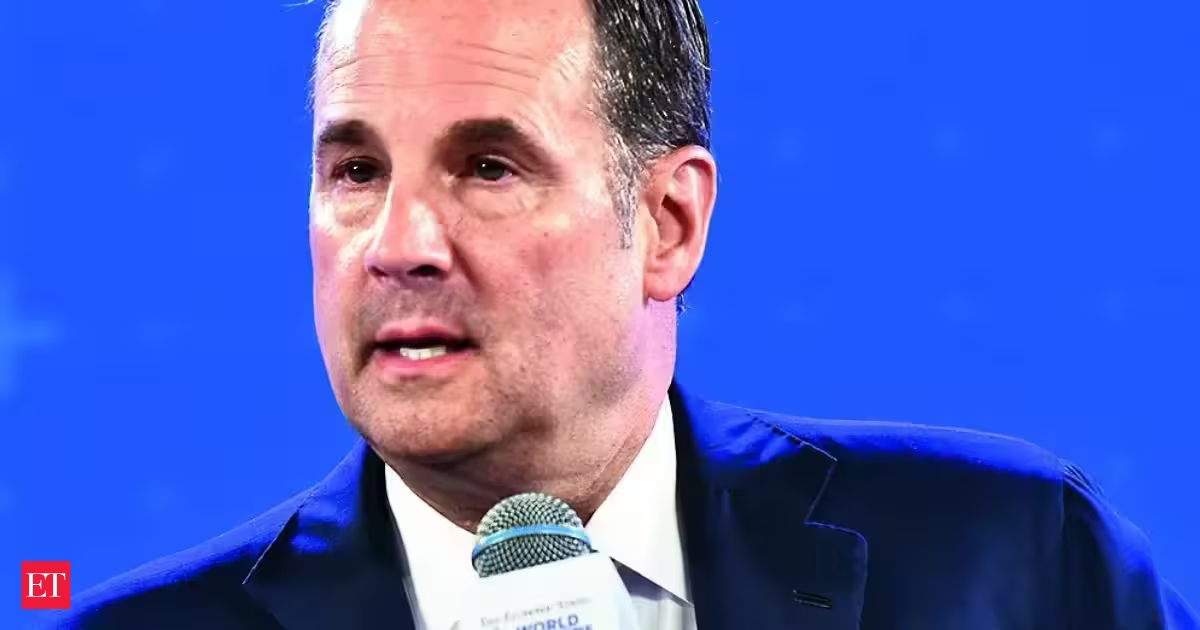
New Delhi: India could leapfrog Mexico and China to emerge as Marriott International’s second-largest market globally in the next three to four years, president and CEO Anthony Capuano told ET. The world’s largest hotel chain is expanding aggressively beyond India’s biggest cities, aiming to nearly double its room inventory by tapping a growing domestic appetite for business and leisure travel.The US is Marriott’s largest market currently, followed by China, Mexico, and India.ALSO READ | ET World Leaders Forum 2026: India Inc’s got all it takes to roll out ‘World+1’ model, says Kumar Mangalam Birla“I would guess that in probably the next three or four years, India will be our second-largest market, and we have no intention of slowing down,” said Capuano.Marriott signed more than 60 deals in India—the highest in its Asia Pacific Excluding China (APEC) region—in the first half of this year. It has more than 200 hotels in its India pipeline, covering more than 30,000 additional rooms, which will almost double its nationwide footprint over the next few years.Marriott currently operates about 230 hotels spanning more than 35,000 rooms in India and expects to enter its 100th city in the country next year, coinciding with its centennial.Capuano said the company believes ‘deeply’ in the future of the Indian market, and those aren’t ‘hollow words.’“Just in the last year or two, think about how we have demonstrated our belief in India,” he said. “We chose Ranthambore to announce the launch of our 10,000th hotel globally. We established our tech accelerator in Hyderabad.”Highlighting India’s significance, he said the company decided to make the global launch of the Series by Marriott portfolio in India, and “we made a minority equity investment which is atypical for our business model.”“So, you think about all the things we are doing that are tangible illustrations of our belief in the market and our commitment to extend our lead here,” he said.Marriott’s India revenue crossed $1.5 billion in 2025, from $1 billion in 2023, but Capuano said the company would prefer revenue to expand at an accelerated pace.“We are pleased with our pace of growth, but we’d like to grow faster,” he said, adding Marriott was also looking for stronger growth in revenue per available room and average room rates.India is also emerging as a testing ground for Marriott International. The company has 19 brands in the country and is preparing to launch its 20th, City Express, a transient mid-scale brand acquired through a Latin American deal. The technology accelerator in Hyderabad is aimed at developing and testing initiatives that could eventually be used across its global operations.The diversity of Indian consumers and the range of price points make the country a “terrific laboratory” for testing brands and new products, said Capuano.The chain’s India expansion is now increasingly moving beyond luxury and premium hotels. A significant portion of Marriott’s pipeline is in select-service and mid-scale brands, as the company enters secondary and tertiary markets.ALSO READ | PM Narendra Modi vows faster reforms, says stable India can power world stabilityCapuano however emphasised that this wasn’t a shift away from luxury. In June, Marriott announced the launch of the JW Marriott Ranthambore Resort & Spa, its 10,000th hotel globally. Other upcoming openings include the Marriott Marquis in Delhi’s Aerocity, besides a new W Hotel which will also be launched close to the airport in the national capital.On the West Asia conflict, Capuano said in the June quarter, the chain saw revenue per available room (RevPAR) in the Gulf decline by 43%.“January and February were the strongest January and February start we’d ever seen in the region,” he said. “So we had quite high hopes for what the Middle East business would look like for the balance of 2026, and then obviously the conflict had a material impact on those plans.”“But there are many benefits of our industry-leading scale, of having more than 10,000 hotels and being in nearly 150 countries,” said Capuano. “The Middle East, while a critically important set of markets for us, represents 3% of our global room inventory and about 3% of our global fees. So, while it is quite impactful, you’ve still got 97% of the global room inventory, where most of the markets are seeing really positive growth trends.”AI is likely to become a major catalyst for transformation across the hospitality sector, but Capuano said Marriott’s approach would have to preserve what he sees as the core of the business.“The unique challenge for the hospitality industry, and therefore for Marriott, is preserving the idea that we are in the human connection business,” he said.Marriott is looking at AI across four broad areas: travel distribution, corporate functions, hotel operations and guest-facing services. The first could fundamentally change how hotels acquire customers. As frequent travellers begin using AI agents to research and book trips, hotels and online travel intermediaries could face a very different distribution landscape. Marriott is experimenting with Google, Anthropic and OpenAI as the technology companies explore ways to enter and monetise the travel sector.
Marriott sees India becoming its second-largest market in 3-4 years
Marriott International expects India to become its second-largest global market within three to four years, overtaking China and Mexico. The hotel giant is rapidly expanding beyond major cities, with over 200 hotels and 30,000 rooms in its pipeline. CEO Anthony Capuano said Marriott sees strong growth potential in India's travel and hospitality market.
832 words~4 min read