The fertilizer crisis is usually framed as a natural gas problem. When gas prices rise, ammonia costs rise, fertilizer plants reduce production, and farmers become exposed to a global commodity chain they cannot control.That diagnosis is correct but incomplete.Across Europe, thousands of anaerobic digesters are already producing a methane-rich gas close to the farms and food industries that consume fertilizer. Most sites burn it in a combined heat and power unit, upgrade it to biomethane, or flare a small surplus. Very few ask a more disruptive question: could the gas become fertilizer before it ever leaves the site?At household scale, the answer is no. At the larger end of the biogas market, it is becoming technically plausible.The real opportunity is not a miniature chemical plant on every farm. It is a new industrial category between the digester and the conventional million-tonne ammonia complex.The Feedstock Is Already in the Right PlaceRaw biogas typically contains roughly 55% to 65% methane, with most of the remainder being carbon dioxide. A plant producing 1,000 normal cubic metres per hour therefore provides around 600 Nm3 of methane per hour before purification.That is not trivial.Using standard chemical relationships, this methane stream could theoretically support ammonia production on the order of 25 to 30 tonnes per day, depending on methane content, conversion efficiency, downtime and the treatment of process losses. The exact plant output requires engineering, but the scale is clear: a large digester can sit in the gap between laboratory equipment and conventional centralized production.The route is familiar. Sulphur and other contaminants are removed. Methane is converted into hydrogen through reforming. Nitrogen is separated from air. Hydrogen and nitrogen then enter an ammonia synthesis loop. The carbon dioxide already present in the raw gas, plus the CO2 created during reforming, must be separated and either used, stored or released.None of these steps is scientifically novel. The challenge is making them economic and reliable at a scale the ammonia industry has historically avoided.Small Ammonia Is No Longer Only a Laboratory IdeaConventional ammonia plants became enormous for good reason. High-temperature reforming, gas purification, compression and Haber-Bosch synthesis benefit from scale. Shrinking the process increases capital cost per tonne and leaves fewer operating hours over which to recover the investment.But modular ammonia technology has moved below the traditional scale threshold. Proton Ventures has developed decentralized NFuel concepts and is involved in a 4-tonne-per-day green ammonia pilot in Morocco using electrolysis and Haber-Bosch synthesis. Stamicarbon markets ammonia technology starting at 50 tonnes per day, while academic work has examined small-scale ammonia from biomass gasification and biogas.These examples do not prove that a 1,000 Nm3-per-hour biogas-to-ammonia plant is commercially ready off the shelf. They prove that ammonia synthesis is moving into the scale range where such integration can be seriously engineered.That distinction matters. Announced concepts are not operating references. A credible project must still demonstrate availability, catalyst performance, maintenance requirements and product quality under real biogas conditions.The Business Case Is About More Than Gas PriceA decentralized plant will struggle to beat a fully utilized world-scale ammonia facility on pure production cost in normal markets. It does not need to.Its value comes from combining advantages that centralized production does not have: an existing local feedstock, avoided biomethane-grid infrastructure, reduced fertilizer transport, possible use of process heat, proximity to agricultural customers and lower exposure to international gas shocks.The comparison also changes if the alternative is not a perfectly efficient global plant, but imported ammonia delivered inland during a volatile market. Farmers buy security as well as molecules.Still, free or cheap biogas is not enough. The plant needs high annual utilization. Ammonia synthesis does not reward intermittent operation, and a digester with unstable gas quality can create costly downstream problems. Sites must have professional gas cleaning, steady feedstock supply, competent operators and enough local demand to absorb the product.Safety is equally decisive. Ammonia is toxic, pressurized and regulated. Producing it close to agriculture reduces logistics but transfers industrial responsibility to the site. Modularization must therefore simplify operation without pretending the process is harmless.Carbon Determines Whether the Product Is Truly DifferentBiogas contains biogenic carbon, but converting its methane into hydrogen still creates CO2. If that carbon is simply vented, the ammonia may offer supply-security benefits and potentially lower fossil emissions, yet it is not zero-carbon.The strongest configuration separates a concentrated biogenic CO2 stream for use or permanent storage. That could make the plant not merely low-carbon but potentially carbon-negative at the system level, depending on feedstock, methane leakage, energy use and storage integrity.This is where biogas has an advantage over fossil natural gas. The carbon started in the short biological cycle. Capturing and storing it can create a removal, while the hydrogen becomes fertilizer.But again, the business model must come first. A remote site without affordable CO2 transport or a local user cannot assume carbon revenue. The capture unit may be technically easy compared with the logistics.Target the Niche Before Claiming a RevolutionThe wrong strategy would be to sell decentralized ammonia as a replacement for Europe’s fertilizer industry. Large plants will remain more efficient for bulk supply, and many small digesters are far below the required scale.The right first market is narrower: large agricultural or industrial biogas plants, probably around 750 to 1,500 Nm3 per hour, with clean and stable gas, concentrated nearby fertilizer demand, sufficient grid capacity and a realistic CO2 outlet. Cooperative ownership could aggregate demand and professionalize operation.Those conditions will exclude many sites. That is a strength, not a weakness. New energy technologies fail when they confuse theoretical addressable volume with investable projects.Europe does not need thousands of immediate installations. It needs a handful of well-instrumented demonstrations proving output, availability, emissions and delivered fertilizer cost across seasons. If those work, standardized modules can follow.For decades, fertilizer production moved toward ever larger plants located near cheap fossil gas. Biogas creates the possibility of reversing part of that logic: producing closer to the carbon source, the nutrient cycle and the customer.The future fertilizer factory may not always sit at a port or gas field.Some of it may already be bubbling beside the farm.By Leon Stille for Oilprice.comMore Top Reads From Oilprice.comEurope Dodges a Rhine Crisis for the Worst Possible ReasonOil Nears $100 as Trump’s ‘Economic D-Day’ Raises the StakesChina's Renewables Boom Faces Record Clean Power Curtailments
Europe’s Biogas Plants Could Become Fertilizer Factories | OilPrice.com
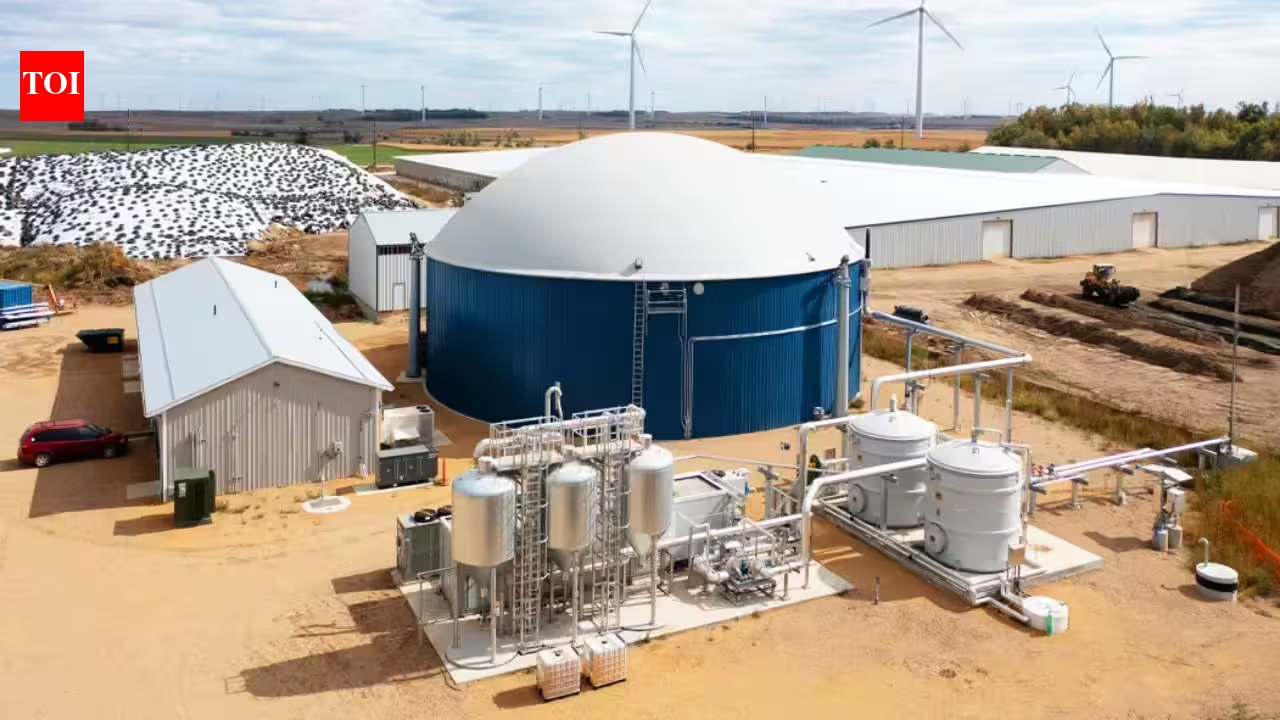
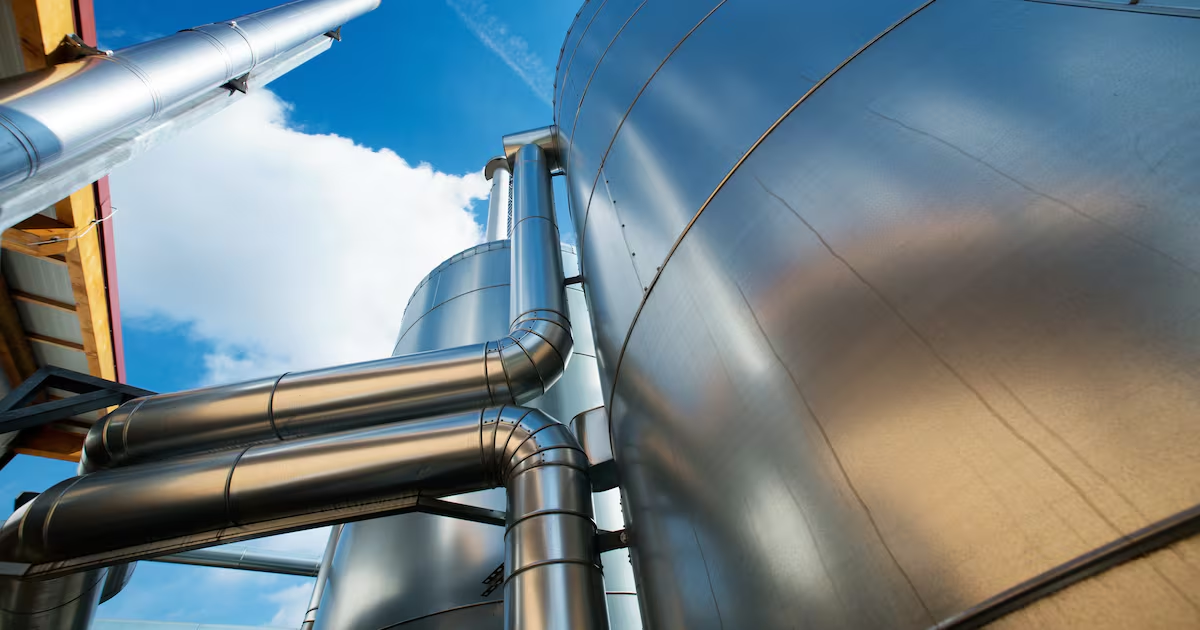
A biogas site producing around 1,000 Nm3 per hour contains enough methane to support ammonia output measured in tens of tonnes per day, not merely experimental kilograms.
1,042 words~5 min read