view more
Driven by the potential advantages in bone stock preservation and easier implant removal during revision surgery, the use of cementless short-stem implants in shoulder arthroplasty has increased in recent years. Despite this, joint replacement procedures outside of the shoulder have reported postoperative bone loss in studies using the dual-energy X-ray absorptiometry (DEXA) technique to measure bone density. In shoulder replacements, DEXA is uncommon, and assessments of bone changes around implants largely rely on qualitative evaluation using plain radiographs. However, this method has limitations and makes it difficult to objectively measure how bone density changes over time.
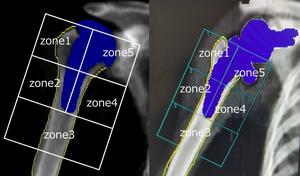
To improve postoperative assessments, a research group led by Dr. Katsumasa Nakazawa and Professor Hidetomi Terai at Osaka Metropolitan University’s Graduate School of Medicine used DEXA to compare patients who underwent anatomical total shoulder arthroplasty (aTSA) and reverse shoulder arthroplasty (RSA). The retrospective study examined changes in bone mineral density (BMD) around the humeral implant during the first two years after surgery and investigated their relationship with osteoporosis and clinical outcomes. After dividing the upper humeral area into five zones, the BMD of 94 RSAs and 43 aTSAs were analyzed.