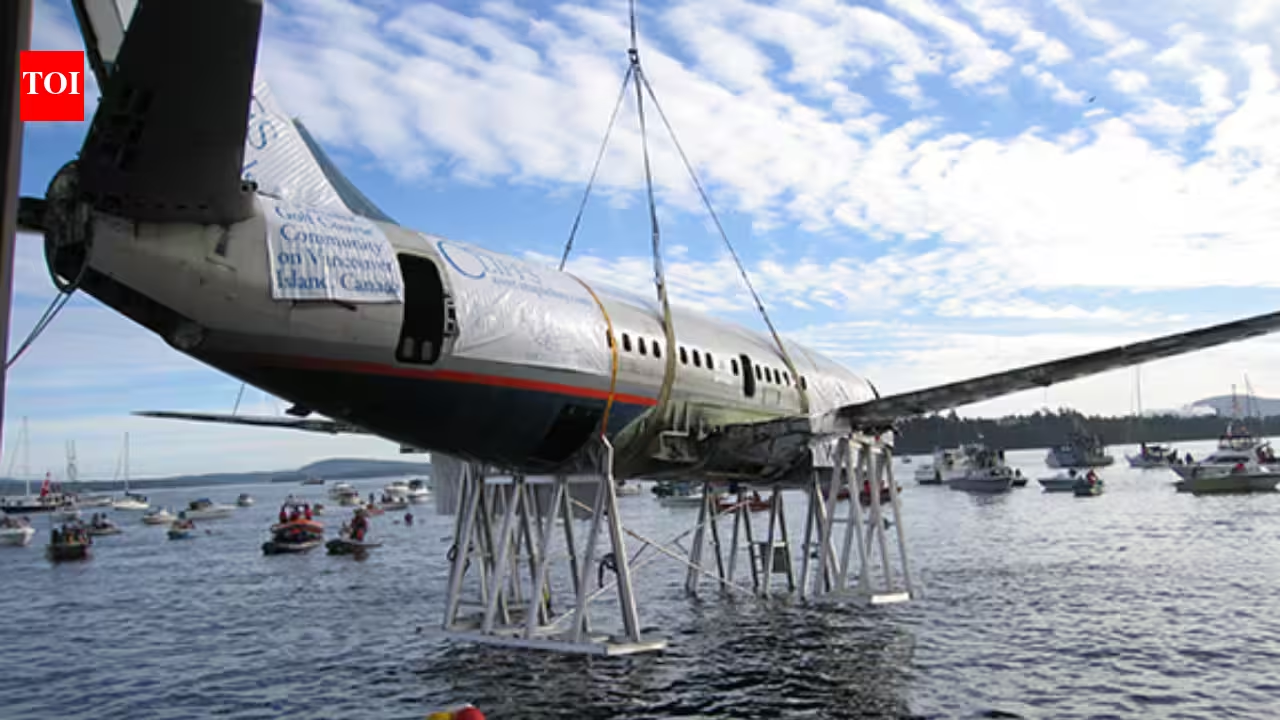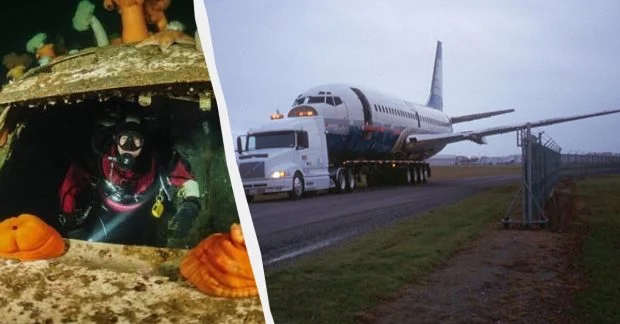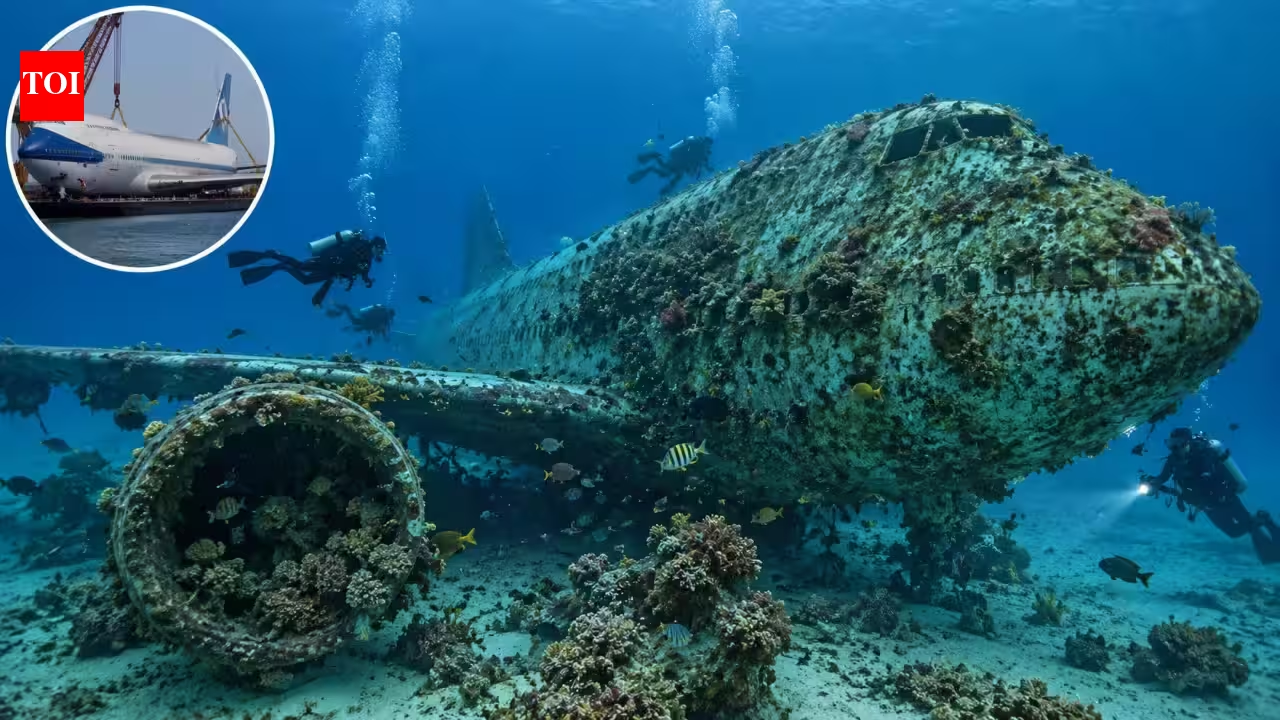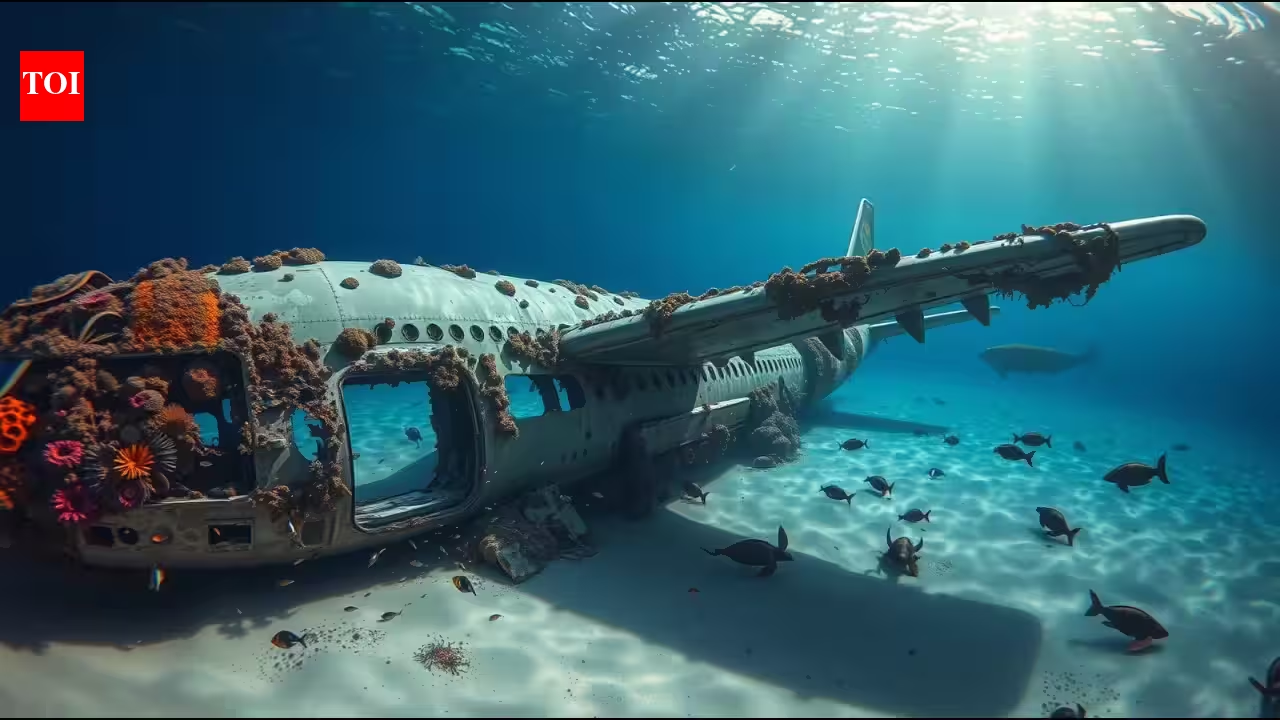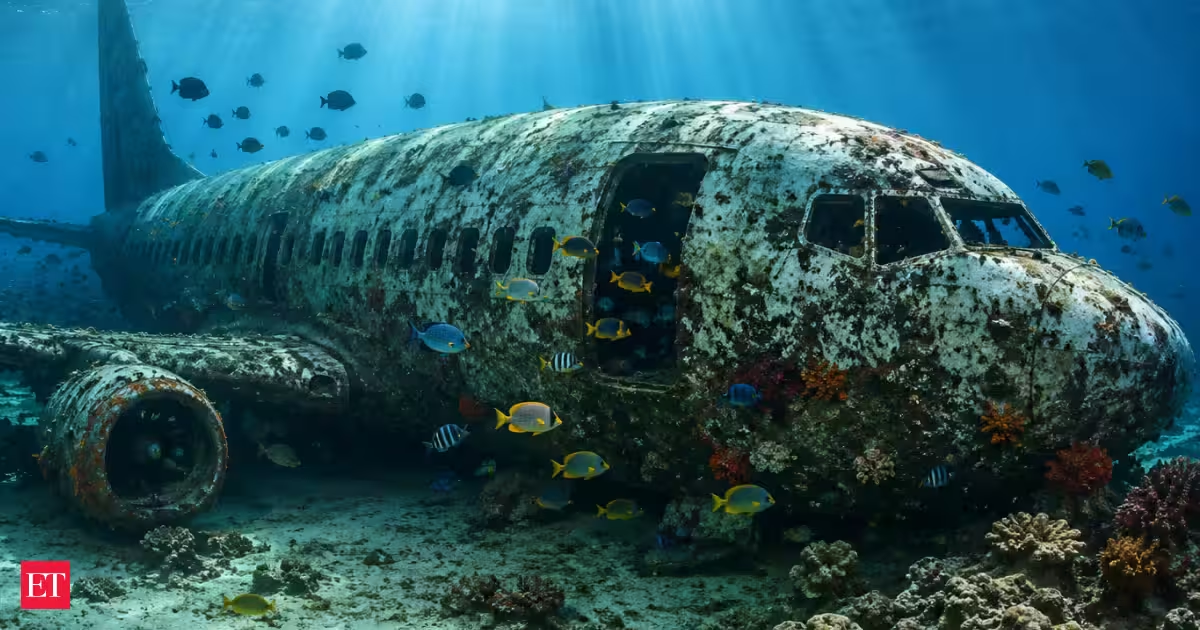
Somewhere off the coast of Vancouver Island, a retired passenger jet sits on the seafloor like it just took off. It hasn't flown in twenty-five years, but it still draws people underwater. This is the story of the Xihuw Reef, a Boeing 737 transformed into an artificial reef by Canada. But these structures are not just quirky tourist attractions, NOAA's National Centers for Coastal Ocean Science says. Research has shown that artificial reefs and shipwrecks may attract large numbers of fish, even top predators.A plane's strange path to the seafloorThe aircraft was built in 1975. It first flew with Pacific Western Airlines, then Canadian Airlines, and finally with Air Canada, which retired it in 2001 after more than 73,000 flight hours. Instead of stripping it for parts, Air Canada sold the aircraft to Qwest Air Parts of Memphis, Tennessee, for its valuable components. A crew at the Vancouver airport removed engines, landing gear, and other salvageable parts, and Air Canada then donated the stripped airframe to the Artificial Reef Society of British Columbia in 2002.Volunteers worked on the aircraft for the next several years. They removed anything that could pollute the ocean, cleaned the frame, and cut holes in the wings for marine life to settle. The 30-ton fuselage was lowered by a crane on January 14, 2006, into the water near Chemainus, British Columbia, where it came to rest upright on 11-foot support stands. The reef was named by local Hul'qumi'num First Nations for Xihuw, the red sea urchin, a species once abundant in these waters before pollution and overfishing thinned it out. According to local accounts, the name was intended as a hopeful gesture that the reef might help restore that life.A Boeing 737 like the one turned into the Xihuw Reef off Vancouver Island. Image Credits: WikipediaWhy divers actually go looking for itThe jet sits at a depth that dive guides estimate is somewhere between 60 and 100 feet, at 88 feet in its resting spot on the ocean floor. The fuselage is 100 feet long, with a 100-foot wingspan, and divers can swim right through the fuselage, entering through the forward exit and coming out some 65 feet later through the rear exit. Feather stars now cling to the support stands and small sea cucumbers, including one called Psolidium bidiscum, crawl across surfaces that were once seatbelt buckles. Today it is one of the more popular cold-water dive sites in the Pacific Northwest, drawing visitors from across the US and Canada.What science says about creating wildlife habitat from wrecksScientists have been studying sunken ships and planes as artificial reefs for years, and a pattern keeps emerging. Rather than dead junk on the ocean floor, shipwrecks are more like small, functioning ecosystems, supporting everything from microbes to large fish, according to a review published in the journal BioScience, titled ‘Shipwreck Ecology: Understanding the Function and Processes from Microbes to Megafauna.’ The paper also notes that wrecks can act as stepping stones to help marine larvae travel and settle in new areas, increasing biodiversity across a wider region.The USS Oriskany aircraft carrier, another example of a retired vessel turned into a thriving reef. Image Credits: Wikimedia CommonsNot all artificial reefs are the sameIt would be simple to think that any sunken object automatically becomes a thriving reef, but the science is more complicated than that. A meta-analysis published in Frontiers in Marine Science, titled ‘Meta-Analysis Reveals Artificial Reefs Can Be Effective Tools for Fish Community Enhancement but Are Not One-Size-Fits-All,’ found that artificial reefs can support fish communities as well as natural reefs, but the results vary a lot depending on the design, depth, and location of the reef. This study notes that artificial reefs are not a panacea and that results are highly contingent on good planning and site selection. The Xihuw Reef was no accidental success. The site it now occupies in the waters of the Salish Sea near Chemainus was chosen after years of discussion by the community, and the plane was modified with openings to help marine life colonize it.Two decades later, and still growingTwenty years is a long time for anything left in saltwater, but the Xihuw Reef has persisted, gradually changing from an empty aluminum shell into a layered habitat, part fish nursery, part invertebrate colony, part diving destination. Now it hosts sea urchins, feather stars, and visiting divers. It is an example of a deliberate human decision that appears to have helped local marine life. It suggests that, with careful planning, even a retired airplane can become part of a living habitat.
In 2006, volunteers lowered a stripped Boeing 737 into the Pacific; 20 years later, the jet has become a cold-water artificial reef
Discover the fascinating story of the Xihuw Reef off Vancouver Island, where a retired Boeing 737 transformed into a vibrant underwater habitat, supporting marine life and attracting divers from around the world.
761 words~3 min read