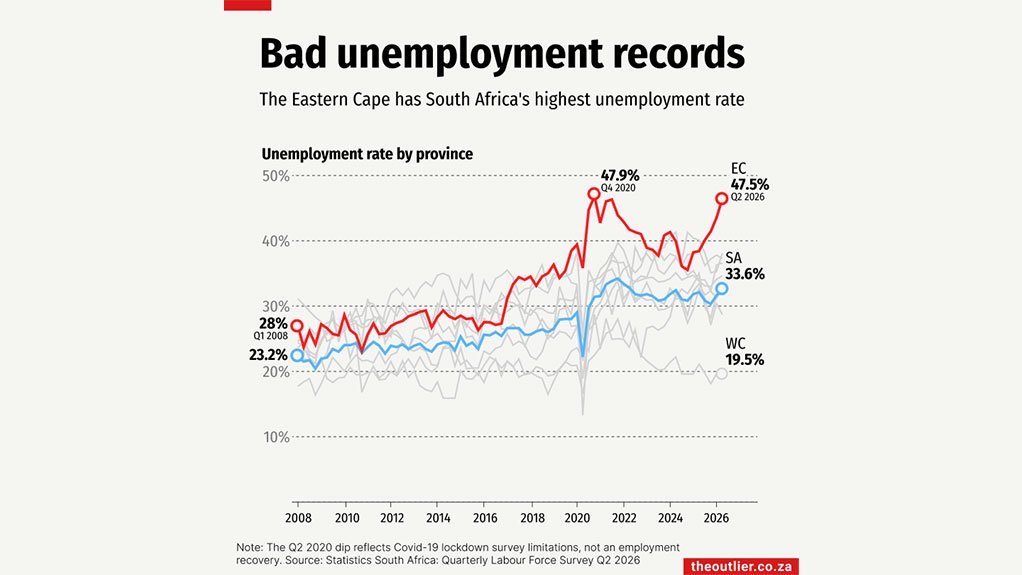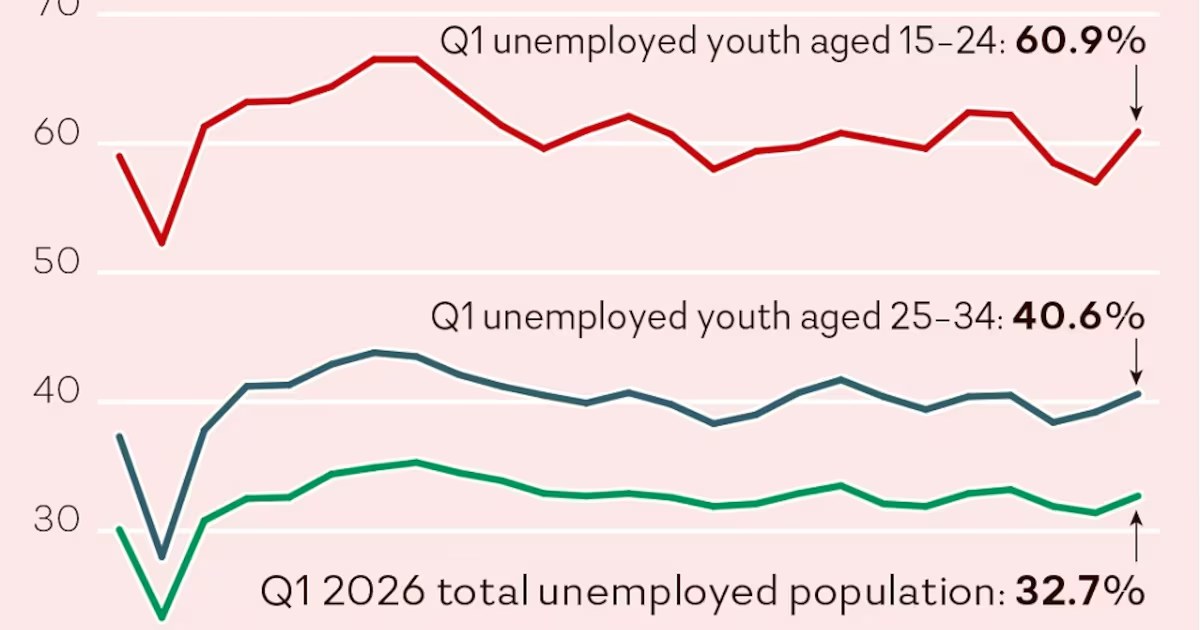
The recent unemployment figures released by Stats SA are still playing on my mind. I wasn’t expecting the national rate of 33.6% to fall significantly, but I was surprised by the extraordinary disparity in unemployment rates between provinces.In the second quarter of 2026, unemployment in the Eastern Cape climbed to 47.5%, while the Western Cape recorded the lowest rate at 19.5%. This is a huge gap for two provinces in the same country. I grew up in the Eastern Cape and I know that local entrepreneurs there do not lack ambition, talent or ideas. In fact, the reality is quite the opposite, with some top corporate talent coming from the province. The region is rich with possibility and opportunity, including being home to four fantastic universities and a strong pool of young people and graduates who should be turbocharging the economy with their skills. So why then isn’t more of this potential translating into sustainable businesses and jobs? For one, we’ve been focused on creating more entrepreneurs, thinking that this alone will solve our unemployment crisis. We look at the number of businesses registered each year, the programmes launched and entrepreneurs trained and think we are making progress — but the truth is that starting a business and building a business are two very different things. The real measure of an entrepreneurial ecosystem is not how many businesses enter it, but how many survive and become profitable enough to employ others. The real measure of an entrepreneurial ecosystem is not how many businesses enter it, but how many survive and become profitable enough to employ others. For that to happen, an SME needs: reliable infrastructure and municipal services;access to finance, customers and markets;affordable connectivity;relevant skills;functioning logistics; predictable regulation; and networks, mentors, investors, industry bodies and institutions that can open doors.In places like the Eastern Cape, some of these pieces are desperately missing, and, as always, the cost repercussions fall on the entrepreneur.A large company can absorb delays, find alternative suppliers, generate its own energy or employ specialists to navigate complex regulations, but a small, one-man operation cannot. An unreliable service provider, a delayed licence, an inaccessible market or a delay in finance can be the difference between hiring another employee and completely closing down.This is where the provincial divide becomes particularly interesting. The Western Cape has its own challenges, and its lower unemployment rate should not be interpreted as evidence that everything is working perfectly. It is the way they built layers of support around their SME ecosystem that is the big lesson. Their SME accelerator support programme, for example, connects businesses with potential funders, while the red tape reduction unit identifies and removes regulatory and administrative barriers.Approaching enterprise development largely within provincial boundaries makes zero sense when businesses operate in national and global markets. The solution is not for the Eastern Cape to simply copy and paste what the Western Cape is doing. Instead, we need a more connected South African SME ecosystem where each province identifies what works for them and then shares these successful models instead of reinventing the wheel nine times over.South Africa cannot afford nine separate experiments in enterprise development, nor can we allow provincial disparities to become barriers to entrepreneurship and job creationThis does require greater co-ordination between national government, provinces, municipalities, financial institutions, corporates, universities, chambers and business-support organisations. Most importantly though, it means changing the policy question.Instead of asking how we create more entrepreneurs, we should be focusing on how we create environments in which entrepreneurs can build businesses that survive, scale and employ. That distinction is crucial.The Eastern Cape’s unemployment crisis is because the economy is not creating enough opportunities for existing businesses to grow and for new businesses to become employers. Entrepreneurs are not failing; they are just not being given an equal chance to succeed. The Eastern Cape needs to build its own economic ecosystem around its own strengths, such as its automotive, agricultural and renewable energy sectors. The challenge is how to better connect these pieces with the local ports, universities and TVET colleges and other business stakeholders. South Africa cannot afford nine separate experiments in enterprise development, nor can we allow provincial disparities to become barriers to entrepreneurship and job creation. We need provinces that compete in a healthy way, for sure, but we also need our provinces to collaborate and share what works because, ultimately, unemployment is a national problem, and SMEs are the most important part of the solution. • Mtwentwe is MD of Vantage Advisory and host of the SAICABIZ Impact podcast
LUNCEDO MTWENTWE | We need to bridge the provincial divide for SMEs
Eastern Cape’s high unemployment highlights urgent need for SME ecosystem reform, writes Luncedo Mtwentwe
758 words~3 min read