Story audio is generated using AI
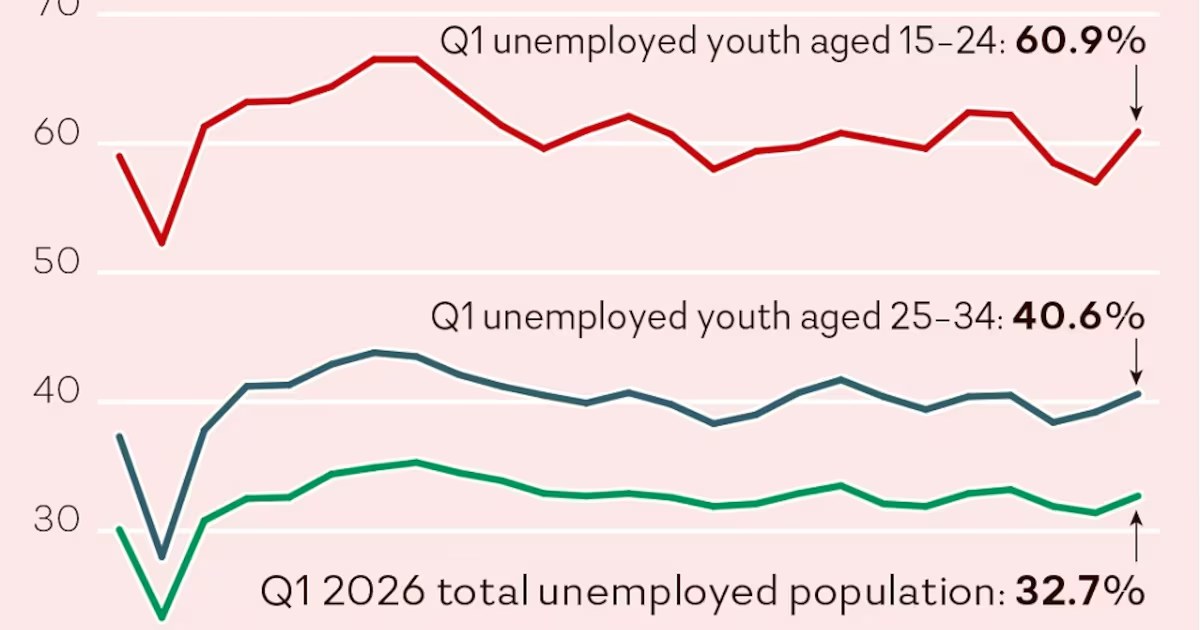
The unemployment statistics released by Stats SA for the first quarter of 2026 should alarm every South African. The country shed about 345,000 jobs in a single quarter. Expanded unemployment increased to 45.8%, while youth unemployment among those aged 15 to 24 is at about 60%. These are not merely abstract economic indicators; they are measures of despair, diminished opportunity and a growing strain on the country’s social and economic fabric. If anything should keep policymakers, business leaders and society awake at night, it is these numbers. Yet an unfortunate feature of South Africa’s unemployment discourse is that we have become deeply event-driven. Every quarter, when unemployment statistics are released, an understandable surge of commentary follows. (Karen Moolman) Labour raises concerns. Business offers perspectives. Policymakers respond. Public debate intensifies briefly. But almost inevitably the temperature cools until the next alarming set of numbers emerges. This episodic engagement with what is arguably the country’s single greatest threat is deeply concerning. Unemployment cannot be treated as a quarterly event to be reacted to. It is a structural crisis, one that accumulates over time, quietly deepening beneath the surface until its consequences become impossible to contain. South Africa is sitting on a ticking time bomb. If we are to meaningfully confront this crisis we may first need to rethink how we frame the problem itself. All too often our national conversation is dominated by the search for grand interventions, the silver bullet that will create 1-, 2- or 3-million jobs in one sweeping stroke. Large-scale reforms are important and necessary. Infrastructure investment, energy security, logistics reform and economic growth all matter enormously. But what is often overlooked is a more uncomfortable truth: unemployment is frequently the cumulative consequence of many smaller interventions not made. It is the cumulative cost of loopholes left open, industries inadequately supported, local productive capacity displaced, policy inconsistencies tolerated, and opportunities missed to direct demand towards domestic employment creation. This episodic engagement with what is arguably the country’s single greatest threat is deeply concerning. Unemployment cannot be treated as a quarterly event to be reacted to. It is a structural crisis, one that accumulates over time, quietly deepening beneath the surface until its consequences become impossible to contain. Unemployment is not only caused by what we fail to do at scale; it is also the result of what we fail to fix at the margins. An example of this recently emerged through the tariff review process undertaken by the International Trade Administration Commission of South Africa on products used in the renewable energy value chain. At first glance transformer manufacturing may appear to be a highly technical or niche industrial segment. Yet on closer examination it reveals something much larger about South Africa’s unemployment challenge. The country is undertaking a substantial energy transition and grid expansion programme. Renewable energy investment is accelerating, while transmission infrastructure requirements are increasing materially. This should, in theory, represent a huge industrial opportunity for domestic manufacturers. Transformer manufacturing is one such area where South Africa possesses meaningful capability and productive capacity. More importantly, it is highly employment-intensive. Analysis undertaken by industry and submitted to the tariff review consultation process indicates the manufacture of a relatively small 630kVA transformer requires about 492 man-hours. A medium-sized 10MVA transformer requires abouty 3,462 man-hours, while larger 40MVA transformers require about 6,760 man-hours to manufacture. These are not insignificant numbers. They speak to an industry with meaningful labour absorption potential, precisely the type of productive activity a country facing chronic unemployment should be prioritising. Yet despite existing domestic capability imports continue to dominate big portions of demand. An assessment of import volumes in 2020-25 suggests about 54,700 potential job opportunities may have been forgone through imported transformer products that could, under different policy conditions, have been supported domestically. This estimate only captures products legitimately imported and declared through official customs channels. It excludes products potentially entering through the inappropriate use of staged consignment provisions, an issue that, while difficult to quantify, may materially worsen the picture. The point is not simply about transformers. It is that if one relatively specialised manufacturing segment can demonstrate employment implications of this scale, what might the cumulative effect be across the broader manufacturing economy? How many similar examples exist where domestic capacity is underutilised, demand leaks offshore, and employment creation opportunities are slowly eroded through a thousand small policy gaps? Closing loopholesThis is why unemployment must be understood not as a singular event, but as the cumulative outcome of missed interventions. Sometimes those interventions are remarkably practical. Closing loopholes that permit the abuse of staged consignment provisions. Strengthening tariff protection where domestic productive capability exists. Designing procurement systems that channel public and private investment into local manufacturing. Ensuring renewable energy investments support not only electricity generation, but industrialisation and employment creation. Individually, such interventions may appear incremental. But collectively, they matter. One could argue that unemployment itself is simply the arithmetic sum of many missed opportunities. Of course, discussions about industrial protection and tariffs often become ideologically charged. On one side, tariffs are criticised for fostering complacency or inefficiency. On the other, domestic producers call for greater protection from import competition. These debates are not new, nor are they straightforward. There will always be differing perspectives across value chains. What benefits one segment may impose costs on another. Every policy intervention produces winners and losers. This is an unavoidable reality of economic policymaking. But perhaps we have been asking the wrong question. The debate should not be reduced to a simplistic binary of “protect” or “do not protect”. The more important question is, what intervention maximises net employment creation? In a country with South Africa’s unemployment profile, employment outcomes must surely become the principal rubric against which economic interventions are assessed. This does not imply indiscriminate protectionism. Nor does it suggest competitiveness should be abandoned. Rather, it means policy choices should be subjected to a disciplined cost-benefit analysis in which employment outcomes are given materially greater weight. Because the uncomfortable truth is unemployment is no longer merely an economic problem; it is increasingly becoming the defining sustainability challenge of the country itself. A society cannot indefinitely sustain exclusion at the scale South Africa experiences. If unemployment is cumulative, job creation must become so too. There is unlikely to be a single intervention that suddenly solves South Africa’s unemployment crisis. But there may be hundreds of practical interventions — some large, many small — that together begin to reverse the trajectory. The challenge before us is not simply to respond when the statistics are released. It is to ensure that by the time the next statistics arrive fewer opportunities have been missed. • Flint is MD of ArmCoil Afrika and an executive member of the Electrical Engineering & Allied Industries Association. Chibanguza is CEO of the Steel & Engineering Industries Federation of Southern Africa.