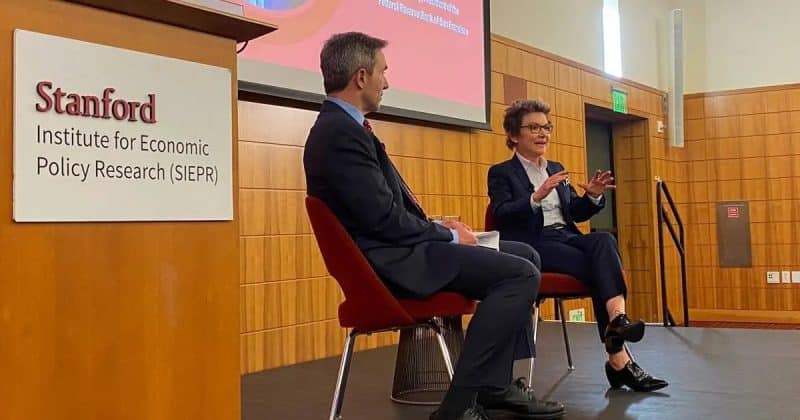
Mary Daly, president of the Federal Reserve Bank of San Francisco, laid out a sobering assessment of the US inflation picture during a keynote address in Tokyo on August 5. The short version: three separate economic shocks are hitting at once, and the Fed isn’t sure yet whether they’ll fade or feed off each other.
Speaking at the Economic and Social Research Institute (ESRI) International Conference, Daly pointed to tariffs that took effect in April 2025, energy price spikes tied to the Iran conflict that began in March 2026, and a surge of artificial intelligence investment as the trio of forces keeping inflation stubbornly above the Fed’s 2% target.
Three shocks, two scenarios
Daly framed the outlook as a fork in the road. In her base case, the shocks prove temporary. Tariff effects stabilize, energy prices ease as peace negotiations progress, and AI spending settles into a sustainable rhythm. Inflation drifts back toward 2%, just on a longer timeline than anyone would prefer.
The darker scenario is more uncomfortable. If these shocks compound rather than dissipate, the US could be staring at inflation running above target for more than five years. That kind of persistence would force the Fed into what Daly called a “significant policy recalibration.”