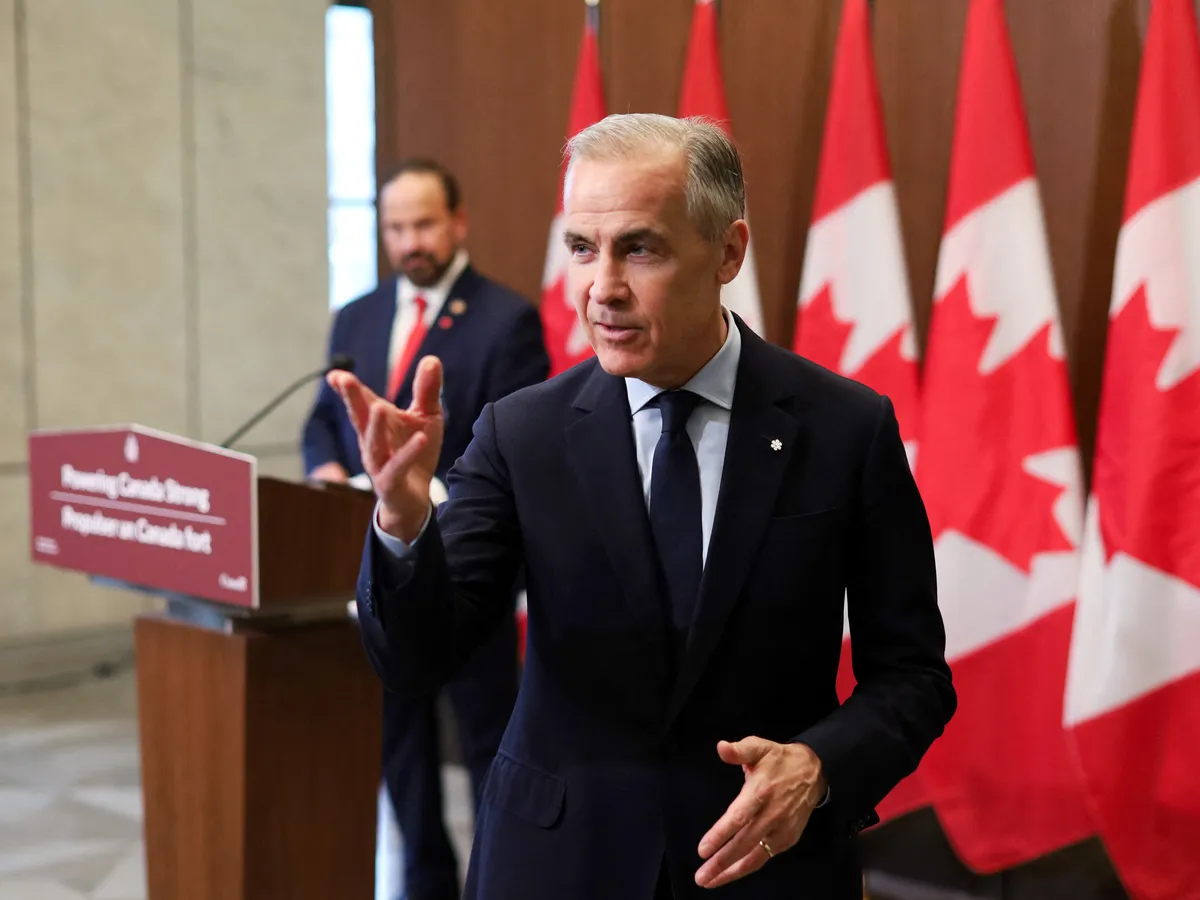
Skip to Content News Archives Economy Energy Oil & Gas Renewables Electric Vehicles Mining Commodities Agriculture Real Estate Mortgages Mortgage Rates Finance Banking Insurance Fintech Cryptocurrency Work Wealth Smart Money Wealth Management Investor Personal Finance Family Finance Retirement Taxes High Net Worth FP Comment Executive Women Puzzmo Newsletters Financial Times Business Essentials More Innovation Information Technology FP500 Podcasts Small Business Lives Told Tails Told Shopping Financial Post Store Obituaries Place a Notice Advertising Advertising With Us Advertising Solutions Postmedia Ad Manager Sponsorship Requests Classifieds Place a Classifieds ad Working Profile Settings My Subscriptions My Offers Newsletters Customer Service FAQ News Economy Energy Mining Real Estate Finance Work Wealth Investor FP Comment Executive Women Puzzmo Newsletters Financial Times Business Essentials HomeFP CommentOpinion: Canada’s new green taxonomy distorts capital marketsLenders and investors don't need official rankings of how green different companies's investments are. They need free capital marketsLast updated 1 hour ago Prime Minister Mark Carney speaks to the media during a press conference in Saguenay, Que., on Aug. 6, 2026. Photo by Francis Vachon/Postmedia filesThough Prime Minister Mark Carney talks about making Canada an energy superpower he has quietly set in motion a bureaucratic exercise that could reshape how and even whether private capital flows to Canadian energy and industry.Subscribe now to read the latest news in your city and across Canada.Exclusive articles from Barbara Shecter, Joe O'Connor, Gabriel Friedman, and others.Daily content from Financial Times, the world's leading global business publication.Unlimited online access to read articles from Financial Post, National Post and 15 news sites across Canada with one account.National Post ePaper, an electronic replica of the print edition to view on any device, share and comment on.Daily puzzles, including the New York Times Crossword.Subscribe now to read the latest news in your city and across Canada.Exclusive articles from Barbara Shecter, Joe O'Connor, Gabriel Friedman and others.Daily content from Financial Times, the world's leading global business publication.Unlimited online access to read articles from Financial Post, National Post and 15 news sites across Canada with one account.National Post ePaper, an electronic replica of the print edition to view on any device, share and comment on.Daily puzzles, including the New York Times Crossword.Create an account or sign in to continue with your reading experience.Access articles from across Canada with one account.Share your thoughts and join the conversation in the comments.Enjoy additional articles per month.Get email updates from your favourite authors.Create an account or sign in to continue with your reading experience.Access articles from across Canada with one accountShare your thoughts and join the conversation in the commentsEnjoy additional articles per monthGet email updates from your favourite authorsSign In or Create an AccountorMandated and funded by the Department of Finance, Business Future Pathways has released a draft “green taxonomy” methodology that proposes criteria to rank economic activities as “green,” “transition” or “abatement.” Dressed up as investor guidance, it’s another instrument of climate-aligned finance that will raise costs, distort capital allocation and squeeze conventional energy projects.Business Future Pathways was created to develop a “made-in-Canada” sustainable finance taxonomy in partnership with the Canadian Climate Institute. An appointment committee led by the former chair of the Trudeau-era “sustainable finance action council”assembled the “taxonomy and transition planning council,” a mix of institutional investors, regulators, bankers, academics and climate activists that oversees the project. The draft methodology report, which was open for public comment until last week, forms the project’s foundation.Get the latest headlines, breaking news and columns.By signing up you consent to receive the above newsletter from Postmedia Network Inc.A welcome email is on its way. If you don't see it, please check your junk folder.The next issue of Top Stories will soon be in your inbox.We encountered an issue signing you up. Please try againClimate mitigation is the focus of the taxonomy’s first phase but climate adaptation and resilience, biodiversity and other environmental and social objectives are expected to be layered on later. Once the framework is in place, expansion becomes the default path, turning a limited classification system into a tool for steering capital to businesses aligned with the objectives of the Paris Agreement and Canada’s “Net-zero by 2050” target.The report classifies activities as green (near-zero emissions), transition (high-emitting activities that can decarbonize), or abatement (“decarbonizing fossil fuel related activities” only). “Abatement” means things like methane cuts or carbon capture, but only on existing oil and gas assets. New production and expansion are excluded. Investment is allowed solely into approved measures that do not extend the lifetime of the assets, and decommissioning or sunsetting is required within timeframes consistent with net-zero. Inclusion of this category may reduce immediate resistance from resource companies and the Alberta government, but it’s a transitional concession within a framework whose underlying logic is to steer capital away from oil and gas.In practice, the taxonomy attaches official labels to economic activities. It’s initially for voluntary use, but what begins as voluntary rarely stays voluntary. Once the labels exist, the financial intermediaries that direct most capital — banks, asset managers, insurers and pension funds — start using them as benchmarks. In the EU, banks must report a “green asset ratio” measuring the share of their portfolios that is taxonomy-aligned. Financing, insurance and investment mandates increasingly favour activities tagged green or transition and become more expensive or even unavailable for those that are not.What is presented as guidance is actually central planning of private capital under a climate label. Free markets allocate capital through prices, insurance, risk assessment and the decentralized decisions of millions of investors. A taxonomy replaces all that with committee judgments, embedding political priorities into the cost and availability of finance. But no committee possesses the knowledge to rank activities correctly across changing technologies and preferences. Committees’ criteria invariably lag innovation, embed political assumptions and attract special-interest capture.A green taxonomy is antithetical to a free-market system. Private capital does not exist to be conscripted into official pathways. Redirecting it by bureaucratic fiat substitutes political priorities for voluntary choice and undermines the principle that investment decisions properly belong to the owners of the capital.Government already distorts markets with subsidies, carbon taxes and other climate policies. A green taxonomy will make the distortion worse. Once the labels exist, pressure for mandatory monitoring, reporting, verification and regulatory adoption will follow, with each additional use extending official influence further into private decision-making. Capital becomes more expensive or even completely unavailable for the “wrong” activities.Investors who value climate-related information already demand and incorporate it into their decisions. Official rankings convert activist and political preferences into a de facto benchmark that imposes a quiet green squeeze on the very energy sector Ottawa claims it wants to strengthen.The taxonomy’s defenders say other jurisdictions are adopting similar frameworks, so Canada must follow if it wishes to attract foreign direct investment (FDI). But the U.S. accounts for over half of Canada’s stock of FDI. (The U.K., in second place, is far behind at 12 per cent.) American policymakers, regulators and financial institutions have been rolling back ESG mandates and climate-aligned capital rules. Yet Canada is preparing to constrain its core energy industries — supposedly to attract capital from jurisdictions, like the EU, which are underperforming and whose sustainable funds are facing capital outflows. Investors are voting with their feet. By continuing the Trudeau-Guilbeault approach to green transition, Canada risks replicating a failing European model.Sensible Canadians should treat the draft taxonomy for what it is: another step in embedding climate activism into capital allocation. The sound response is, not to try to negotiate better criteria, but to completely reject the premise that private capital requires an official hierarchy to function. Free markets do not need activist criteria or scorecards; they need clear property rights, neutral rules and freedom for capital to respond to genuine market signals, not “guidance” systems that expand technocratic control over private investment.Tammy Nemeth is a U.K.-based energy analyst and consultant. Join the Conversation This website uses cookies to personalize your content (including ads), and allows us to analyze our traffic. Read more about cookies here. By continuing to use our site, you agree to our Terms of Use and Privacy Policy.
Opinion: Canada’s new green taxonomy distorts capital markets
Lenders and investors don't need rankings of how green different companies' investments are. They need free capital markets. Read more.
1,345 words~6 min read