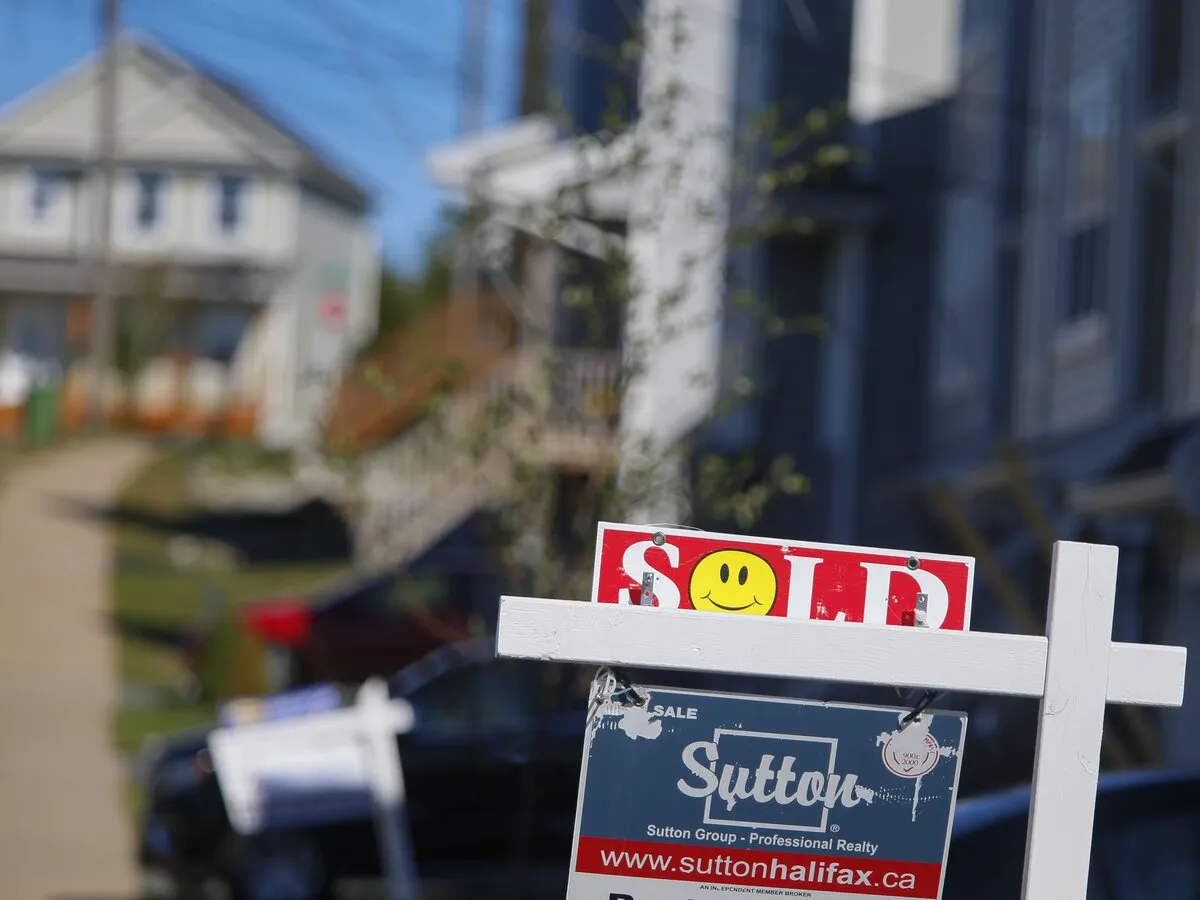
Skip to Content News Archives Economy Energy Oil & Gas Renewables Electric Vehicles Mining Commodities Agriculture Real Estate Mortgages Mortgage Rates Finance Banking Insurance Fintech Cryptocurrency Work Wealth Smart Money Wealth Management Investor Personal Finance Family Finance Retirement Taxes High Net Worth FP Comment Executive Women Puzzmo Newsletters Financial Times Business Essentials More Innovation Information Technology FP500 Podcasts Small Business Lives Told Tails Told Shopping Financial Post Store Obituaries Place a Notice Advertising Advertising With Us Advertising Solutions Postmedia Ad Manager Sponsorship Requests Classifieds Place a Classifieds ad Working Profile Settings My Subscriptions Saved Articles My Offers Newsletters Customer Service FAQ News Economy Energy Mining Real Estate Finance Work Wealth Investor FP Comment Executive Women Puzzmo Newsletters Financial Times Business Essentials HomeReal EstateMortgagesThe expense-lowering, capital-freeing case for buying in a smaller marketRobert McLister: Small-market properties can outperform when enough demand-drivers line upLast updated 42 minutes ago You can save this article by registering for free here. Or sign-in if you have an account.A $600,000 house near Halifax might buy a roomy, renovated place on a lot big enough to lose the dog in. That lifestyle upgrade isn't just financial; it's about comfort too. Photo by Tim Krochak/The Chronicle HeraldFor over a decade, our government has talked about Canada’s severe affordability crisis.Subscribe now to read the latest news in your city and across Canada.Exclusive articles from Barbara Shecter, Joe O'Connor, Gabriel Friedman, and others.Daily content from Financial Times, the world's leading global business publication.Unlimited online access to read articles from Financial Post, National Post and 15 news sites across Canada with one account.National Post ePaper, an electronic replica of the print edition to view on any device, share and comment on.Daily puzzles, including the New York Times Crossword.Subscribe now to read the latest news in your city and across Canada.Exclusive articles from Barbara Shecter, Joe O'Connor, Gabriel Friedman and others.Daily content from Financial Times, the world's leading global business publication.Unlimited online access to read articles from Financial Post, National Post and 15 news sites across Canada with one account.National Post ePaper, an electronic replica of the print edition to view on any device, share and comment on.Daily puzzles, including the New York Times Crossword.Create an account or sign in to continue with your reading experience.Access articles from across Canada with one account.Share your thoughts and join the conversation in the comments.Enjoy additional articles per month.Get email updates from your favourite authors.Create an account or sign in to continue with your reading experience.Access articles from across Canada with one accountShare your thoughts and join the conversation in the commentsEnjoy additional articles per monthGet email updates from your favourite authorsSign In or Create an AccountorWhat has it done to correct the problem?On the surface, not much — assuming you measure surfaces in housing starts.June starts just limped in at a seasonally adjusted annual pace of 238,900, per Canada Mortgage and Housing Corporation (CMHC).CMHC’s preferred six-month trend measure slipped to 248,123, roughly half the annual pace the Liberals promised to build over the coming decade, and some 200,000 fewer homes a year than CMHC said we needed in a June 2025 report.As of March, Ottawa had committed more than $82 billion to its National Housing Strategy, which naturally invites the question, “Where are the homes?”SUBSCRIBER EXCLUSIVE: FP West: Energy Insider brings you behind the oilpatch’s closed doors with exclusive insights from insiders every Wednesday morning.By signing up you consent to receive the above newsletter from Postmedia Network Inc.A welcome email is on its way. If you don't see it, please check your junk folder.The next issue of FP West: Energy Insider will soon be in your inbox.We encountered an issue signing you up. Please try againOf course, Ottawa doesn’t control housing starts in isolation. Municipal zoning, permitting, development charges, infrastructure and builder economics matter too.Either way, nobody will blame you for assuming our leaders will never crack Canada’s housing affordability problem — particularly if they ramp up immigration again.It’s enough to make some people question why they’re paying top dollar to stay in the big city rat race.For most middle-to-upper-income homeowners — specifically those with job mobility or the remote-work luxury — ownership becomes drastically more attainable the moment they search outside their comfort zone.Consider how much homes cost in Canada’s top three metros:$1.82 million in Vancouver$1.14 million in Toronto$700,000 in Montreal (Source: MLS Benchmark prices, via BMO Capital Markets Economic Research)Compare that to:$383,000 in Moncton$383,000 in P.E.I.$475,000 in Quebec City$599,000 in HalifaxAnd if you don’t mind cozy little towns a bit farther from the airport that give you beauty on a budget, other spots include:Cape Breton, N.S. ($280,000)Mahone Bay, N.S. ($496,000)St. Andrews By-the-Sea, N.B. ($460,000)Rossland, B.C. ($525,000) (Source: Real estate boards and estimated values based on current listings.)“I don’t want to leave my circle,” goes the thinking of big-city dwellers. “I like proximity to friends and family.”Hey, believe me, I get it. That’s exactly what kept my wife and me anchored to our home region for so long.But here’s the thing: you’re not moving to Mars. Saving hundreds of thousands on real estate buys a lot of travel credits once the homesickness kicks in.Purchase the average Toronto home with 20 per cent down and you’re looking at $5,421 a month on a mortgage — assuming a four per cent interest rate and 30-year amortization.Do the same in Halifax and mortgage costs nearly halve, to $2,848 a month.An extra $2,573 in monthly cash flow buys a lot of plane tickets. (Note: I say “cash flow” because the higher Toronto mortgage payment includes $866 more in monthly principal, so it’s not technically $2,573 a month in “savings.”)Even if you and your significant other theoretically flew back to see friends and family every three months — four times a year — you’re still ahead by up to $27,000 annually at current airfares.To free up an extra $27,000 for a Toronto mortgage, a buyer must actually gross roughly $45,000 to $50,000 more in pre-tax income. That makes the geo-arbitrage argument dramatically harder to dismiss.Then there’s the property type to consider. In a major metro, $1.1 million might get you an aging, untouched teardown — or a shoebox semi an hour deep into the suburbs.A $600,000 house near Halifax or a $460,000 home in New Brunswick might buy a roomy, renovated place on a lot big enough to lose the dog in.The lifestyle upgrade isn’t just financial; it’s about comfort too.Then comes the down-payment advantage.Based on the example above, you’d face a:Toronto down payment of $228,000Halifax down payment of $119,800That liberates $108,200 of capital.The $108,200 could stay invested, bankroll renovations, sit as an emergency cushion, retire other debt, launch a business or shrink the Halifax mortgage considerably.Lastly, a cheaper home keeps paying you back over time — via lower property taxes, home insurance, maintenance, utilities — plus the lower closing costs, real estate transaction fees and land-transfer taxes.And on that note, moving to smaller cities or towns doesn’t just cut your mortgage. Auto insurance, childcare and everyday service costs often drop significantly outside major urban centres, which compounds the financial windfall.Mind you, Quebec and the Atlantic provinces may claw some of that back through a less friendly income tax burden.All of these savings dial down financial stress, which is scientifically proven to help you live longer. In fact, many longevity experts recommend diet, exercise and never opening a Toronto real estate listing again.Packing up the U-Haul and moving cross-province or cross-country isn’t feasible for most, especially lower-income Canadians.Among other complications:Two-earner households often struggle to land two new jobs at onceBigger cities often have the highest-paying jobs and best career growthMany folks need family support for child or elder careCheaper regions sometimes have worse healthcare access (in some small towns, the family doctor shortage is severe, so do your homework)Some people simply refuse to abandon their social circlesFor nearly everyone else with a portable income, relocating to a cheaper housing market can work, especially equity-rich households cashing out of big cities.Of course, expensive markets may well appreciate faster, although who knows if that will remain true long-term.Moreover, if you pick a desirable spot, a small population doesn’t prevent strong appreciation — not when demand is growing and supply is constrained.Case in point: my wife and I picked up a cheap property near Mahone Bay, N.S. a few years back and sold it 21 months later for a 75 per cent gain — 2.5 to 3.5 times what Toronto or Vancouver returned over the same stretch.Our result may not be typical, but small-market properties can outperform when enough demand drivers line up.Factors like positive and growing net migration, gorgeous views and nature, desirable small towns with nice shops and restaurants or an economic driver like a major new employer or airport can all stack the deck in your favour.Incidentally, if you’re hunting for such places, an AI chatbot in research mode (i.e., extra thinking mode) is a terrific exploration tool.I suspect more and more Canadians will try their hand at that search, once they tire of a big mortgage running their lives.Robert McLister is a mortgage strategist, interest rate analyst and editor of MortgageLogic.news. You can follow him on X at @RobMcLister.For the best national insured and uninsured mortgage rates, updated daily, please visit our mortgage rate page here. Join the Conversation This website uses cookies to personalize your content (including ads), and allows us to analyze our traffic. Read more about cookies here. By continuing to use our site, you agree to our Terms of Use and Privacy Policy.
The expense-lowering, capital-freeing case for buying in a smaller market
Robert McLister: For over a decade, our government talked about Canada's affordability crisis. What has it done to fix the problem? Read on
1,580 words~7 min read