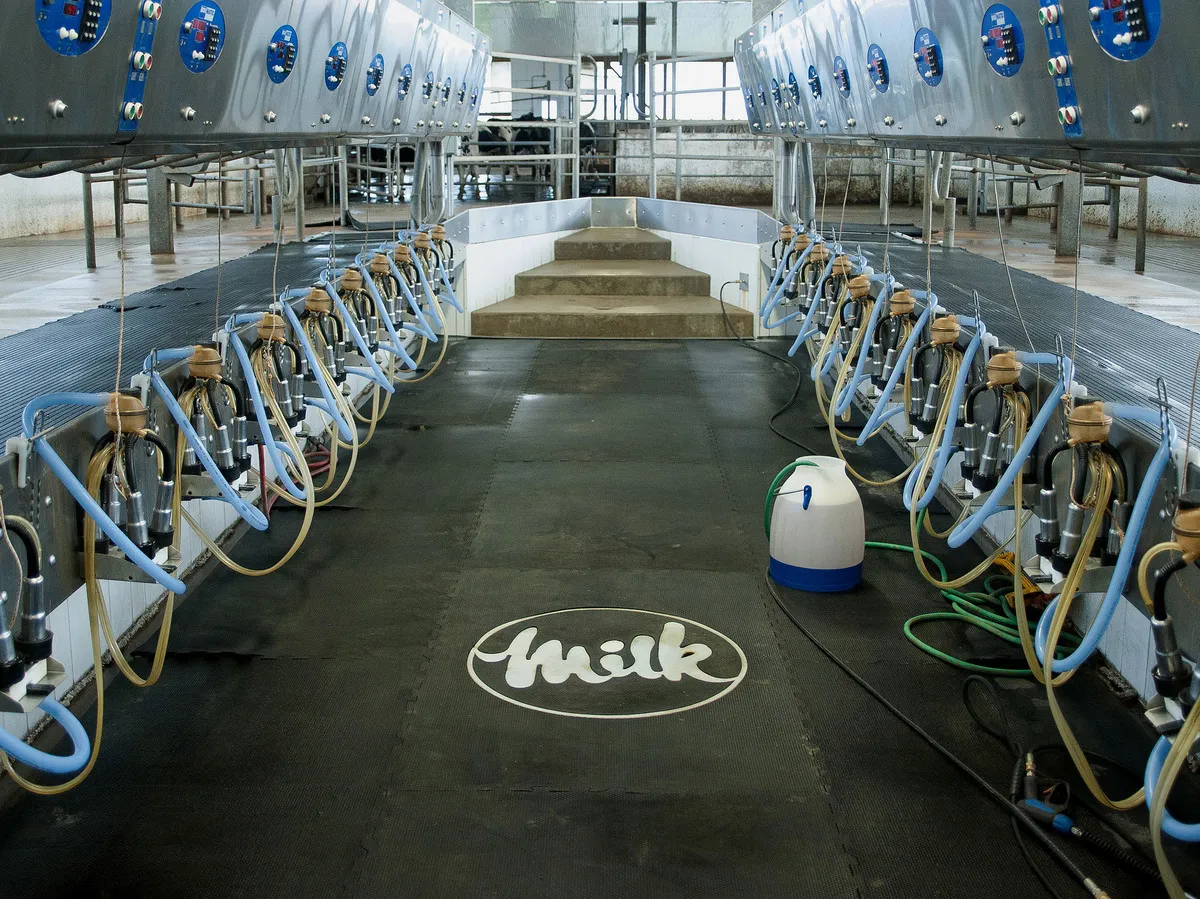
Skip to Content News Archives Economy Energy Oil & Gas Renewables Electric Vehicles Mining Commodities Agriculture Real Estate Mortgages Mortgage Rates Finance Banking Insurance Fintech Cryptocurrency Work Wealth Smart Money Wealth Management Investor Personal Finance Family Finance Retirement Taxes High Net Worth FP Comment Executive Women Puzzmo Newsletters Financial Times Business Essentials More Innovation Information Technology FP500 Podcasts Small Business Lives Told Tails Told Shopping Financial Post Store Obituaries Place a Notice Advertising Advertising With Us Advertising Solutions Postmedia Ad Manager Sponsorship Requests Classifieds Place a Classifieds ad Working Profile Settings My Subscriptions Saved Articles My Offers Newsletters Customer Service FAQ News Economy Energy Mining Real Estate Finance Work Wealth Investor FP Comment Executive Women Puzzmo Newsletters Financial Times Business Essentials HomeFP CommentOpinion: Canada's dairy sector is built on what I warn every client againstMargin-protection schemes are bad for the firms they supposedly benefit. The loss of competitive discipline is fatalLast updated 3 hours ago You can save this article by registering for free here. Or sign-in if you have an account.Protection and preparation are not the same thing. One feels like security. The other really is security. Canadian dairy still has time to choose preparation, but that choice will not stay open forever. Photo by James MacDonald/BloombergI advise small and medium-sized businesses. When I work with a business owner, one of the first risks I look for is a revenue stream that is protected from competition. That may sound like a strength. But it is usually a hidden weakness.Subscribe now to read the latest news in your city and across Canada.Exclusive articles from Barbara Shecter, Joe O'Connor, Gabriel Friedman, and others.Daily content from Financial Times, the world's leading global business publication.Unlimited online access to read articles from Financial Post, National Post and 15 news sites across Canada with one account.National Post ePaper, an electronic replica of the print edition to view on any device, share and comment on.Daily puzzles, including the New York Times Crossword.Subscribe now to read the latest news in your city and across Canada.Exclusive articles from Barbara Shecter, Joe O'Connor, Gabriel Friedman and others.Daily content from Financial Times, the world's leading global business publication.Unlimited online access to read articles from Financial Post, National Post and 15 news sites across Canada with one account.National Post ePaper, an electronic replica of the print edition to view on any device, share and comment on.Daily puzzles, including the New York Times Crossword.Create an account or sign in to continue with your reading experience.Access articles from across Canada with one account.Share your thoughts and join the conversation in the comments.Enjoy additional articles per month.Get email updates from your favourite authors.Create an account or sign in to continue with your reading experience.Access articles from across Canada with one accountShare your thoughts and join the conversation in the commentsEnjoy additional articles per monthGet email updates from your favourite authorsSign In or Create an AccountorA company that earns guaranteed margins because a regulation, exclusive contract or closed market keeps competitors out tends to stop doing the things that keep a business sharp. It stops scrutinizing its cost structure, investing in efficiency or asking how it would cope or what it would charge if its customers had somewhere else to go. The protection may feel like a moat. In practice, it is closer to an anaesthetic.That is the lens I would bring to the conversation now unfolding over Canada’s dairy industry. American trade negotiators have consistently made clear that greater access to Canada’s supply-managed dairy market is near the top of their list. The political debate is already loud and familiar. Defenders frame supply management as a pillar of food security and rural livelihoods. Critics call it protectionism that inflates grocery bills. You decide who’s right: I am not writing to settle that fight.Get the latest headlines, breaking news and columns.By signing up you consent to receive the above newsletter from Postmedia Network Inc.A welcome email is on its way. If you don't see it, please check your junk folder.The next issue of Top Stories will soon be in your inbox.We encountered an issue signing you up. Please try againWhat I am writing to do is describe, in the language of the businesses I advise, what supply management actually is. Supply management is a margin-protection scheme. Production quotas control supply, tariff walls well above 200 per cent keep foreign product out, and a pricing formula guarantees producers a floor. It’s the arrangement nearly every business owner quietly dreams about: stable prices, no real competition, predictable returns. I understand the appeal completely. I also know what it does to a business over time.When margins are guaranteed, the discipline that only competition forces never has to develop. Why drive down cost per litre when the price is set for you? Why invest in scale or new technology when market share cannot be taken from you? By every conventional measure, Canadian dairy looks stable. The sector has never had to find out how it would perform if the wall came down.The headline fear is that any Canada-U.S. deal requires Canada to concede a few more percentage points of market access. The deeper risk is that even a modest opening lands on an industry with no muscle memory for competing on cost or efficiency, pitting it against American producers who have spent those same decades doing little else. A competitor who has been training the whole time meets an incumbent who never had to.When I work with a client whose business leans too heavily on one protected revenue line, whether a sole-source contract, a regulatory carve-out or a single dominant customer, my advice is always the same: Assume the protection erodes. Model the day it is gone. Find your true cost structure now, while you still have the cushion to act on what the numbers tell you. Build the competitive capability before you need it, not after. The businesses that survive the loss of a protected position are the ones that use their remaining protected years to get ready for the unprotected ones.I’m neither arguing supply management should be dismantled nor criticizing dairy farmers, who have made entirely rational decisions inside the system they were handed. But whatever the policy benefits and costs of protection, it remains a choice with a financial consequence, one that does not disappear because the politics are sensitive. A sector shielded for half a century is, by definition, a sector that has not been tested. The review now underway may or may not change the rules. The more important question, the one I would put to any client in this position, is whether the industry is using the time it still has under protection to prepare or is simply hoping the wall holds.Protection and preparation are not the same thing. One feels like security. The other actually is security. Canadian dairy still has time to choose preparation, but that choice will not stay open forever.Daryl Ching is founder of Vistance Accounting. Join the Conversation This website uses cookies to personalize your content (including ads), and allows us to analyze our traffic. Read more about cookies here. By continuing to use our site, you agree to our Terms of Use and Privacy Policy.
Opinion: Canada's dairy sector is built on what I warn every client against
Margin-protection schemes are bad for the firms they claim to benefit. In the long run, the loss of competitive discipline is fatal. Read on
1,198 words~5 min read