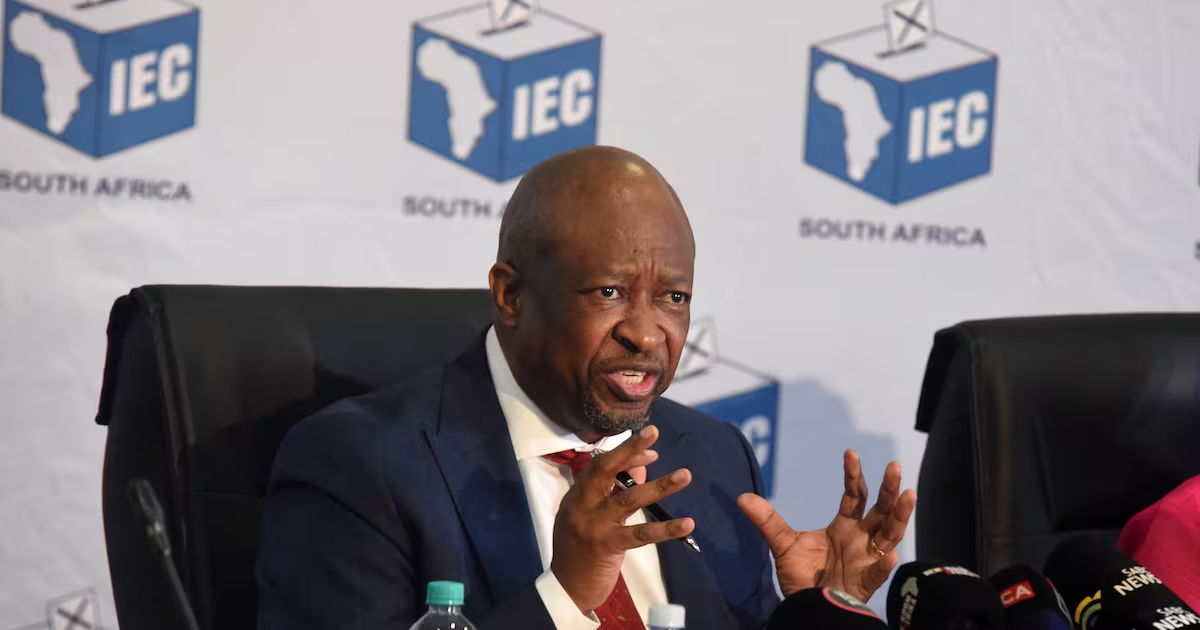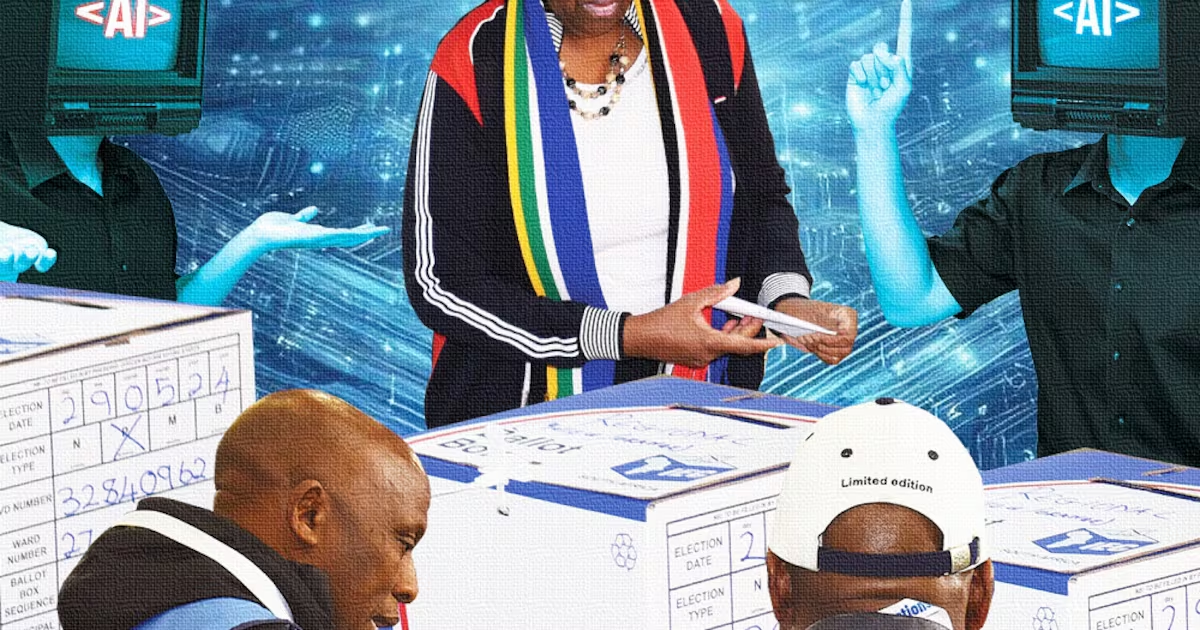
As we approach the November 2026 local elections two camps seem to have emerged. On the one hand are those who believe AI can ensure the quality of elections. On the other there are those who fear manipulation and a corrosion of the democratic process. The Electoral Commission of South Africa (IEC) itself is the loudest voice here, which is notable. Chair Mosotho Moepya stated: “The primary challenge of 2026 is the rise of generative AI and its application in ‘hyperlocal’ contexts. We are seeing a shift from broad national untruths to ward-specific deceptions.” And, citing the South African National Editors’ Forum, he expects a “flurry of deepfakes” in the upcoming elections. Writing for the Mail & Guardian, Mandla Radebe declared: “South Africa’s 2026 local government elections may well be remembered as the country’s first truly AI election.” Complicating this picture is the political context. It could be argued that we are in the midst of the most fragmented party landscape since 1994. The decline of dominant party politics, the emergence of numerous smaller parties, the growing influence of independent candidates and increasingly competitive coalition politics have fundamentally reshaped the electoral environment. In such a context, where electoral margins may be narrow and political competition more intense than ever, the opportunities and risks posed by AI become even more consequential. A hyperlocal deepfake dropped into a single ward WhatsApp group two days before polling only needs to shift a few hundred votes in a marginal ward to change who holds the deciding seat on a hung council. The IEC’s own figures give a sense of the scale of the attack surface, with more than 100,000 candidates expected to contest over 4,400 wards, comfortably exceeding the about 95,000 who stood in 2021. Coalition governments at the municipal level already tend to be volatile and personality driven. Layering a low-cost, high-volume disinformation tool onto that volatility raises the stakes of any single ward-level manipulation far beyond what it would have carried in a more predictable, dominant-party era. South Africa does not have a dedicated AI statuteThe public debate often assumes, much to its detriment, that AI is already the object of a coherent regulatory response. Yet South Africa does not have a dedicated AI statute, nor does it have an AI-specific framework governing elections. Despite growing concern about deepfakes and algorithmic campaigning, there is no single legal instrument that directly addresses these phenomena. What exists instead is a regulatory patchwork of overlapping regimes. The Municipal Electoral Act already criminalises the intentional publication of false election-related information intended to disrupt elections or influence their outcome, though it predates generative AI and says nothing about synthetic media. The IEC’s draft regulations, published in June 2026, represent the first AI-specific response, proposing that parties label AI-generated campaign material, verify and correct false claims, report online disinformation and assume greater responsibility for content on their own platforms. However, these proposals are regulatory rather than legislative, relying primarily on codes of conduct and self-reporting. The Cybercrimes Act provides a criminal law backstop for malicious digital disinformation, while the Protection of Personal Information Act regulates the collection and use of personal data that underpins AI-driven political micro-targeting. The National AI Policy Framework signals the direction of future regulation, but it remains a policy proposal rather than a binding law and will have no legal effect during the 2026 local elections. The net effect is that South Africa is going into its most AI-exposed election with regulation still in draft form and enforcement split across at least three legal instruments that weren’t built for this problem and don’t obviously talk to each other. While that’s workable for detecting and naming the challenge, it is much less so for fast, cross-border enforcement in the compressed window of a campaign. The IEC’s own framing that “the integrity of our 2026 local government elections does not rest on the IEC alone … it rests on the fact-checker in Johannesburg, the legislator in Cape Town, the tech engineer in Silicon Valley and the EU diplomat in Pretoria” is an admission that transparency, media literacy and platform co-operation are doing as much load-bearing work as statute. The net effect is that South Africa is going into its most AI-exposed election with regulation still in draft form and enforcement split across at least three legal instruments that weren’t built for this problem and don’t obviously talk to each other. Set against comparable jurisdictions, South Africa’s position looks less like an outlier and more like the norm under stress-test conditions. For example, the EU’s AI Act imposes binding, risk-tiered obligations on high-impact systems, but even there election-specific enforcement has proved slower and messier than the statute’s ambitions suggested. Brazil’s electoral court has taken the more interventionist route of binding AI-specific campaign rules before its own polls, precisely because it judged that a general data or cybercrime law wouldn’t move fast enough in an election cycle. This is a model South Africa’s IEC draft code gestures toward, but as a regulatory instrument rather than legislation does not yet match in force. The lesson is less that South Africa is behind some settled global standard and more that no jurisdiction has fully solved the problem of matching an election’s compressed timeline to the naturally slower pace of statute and enforcement. What might genuine progress look like in the interim? Civil society coalitions, rapid-response fact-checking networks and platform-level content moderation agreements could function as stopgap measures while formal legislation matures. However, voluntary co-operation is inherently fragile, dependent on goodwill and resourcing that can evaporate under political pressure. Should the 2026 elections pass without major incident, that outcome is likely to reflect the resilience of these informal networks rather than any structural fix to the underlying regulatory gap. Until the law catches up, the burden of protecting electoral integrity will continue to fall disproportionately on nonstate actors and voluntary governance mechanisms. This is a constitutional reality that is necessary and, ultimately, unsatisfactory. • Mpedi is vice-chancellor and principal at the University of Johannesburg.Business Day
LETLHOKWA GEORGE MPEDI | SA will have to rely on stopgap measures to protect election from AI
Hyper-local deepfakes threaten to sway results in tightly contested wards
1,004 words~5 min read