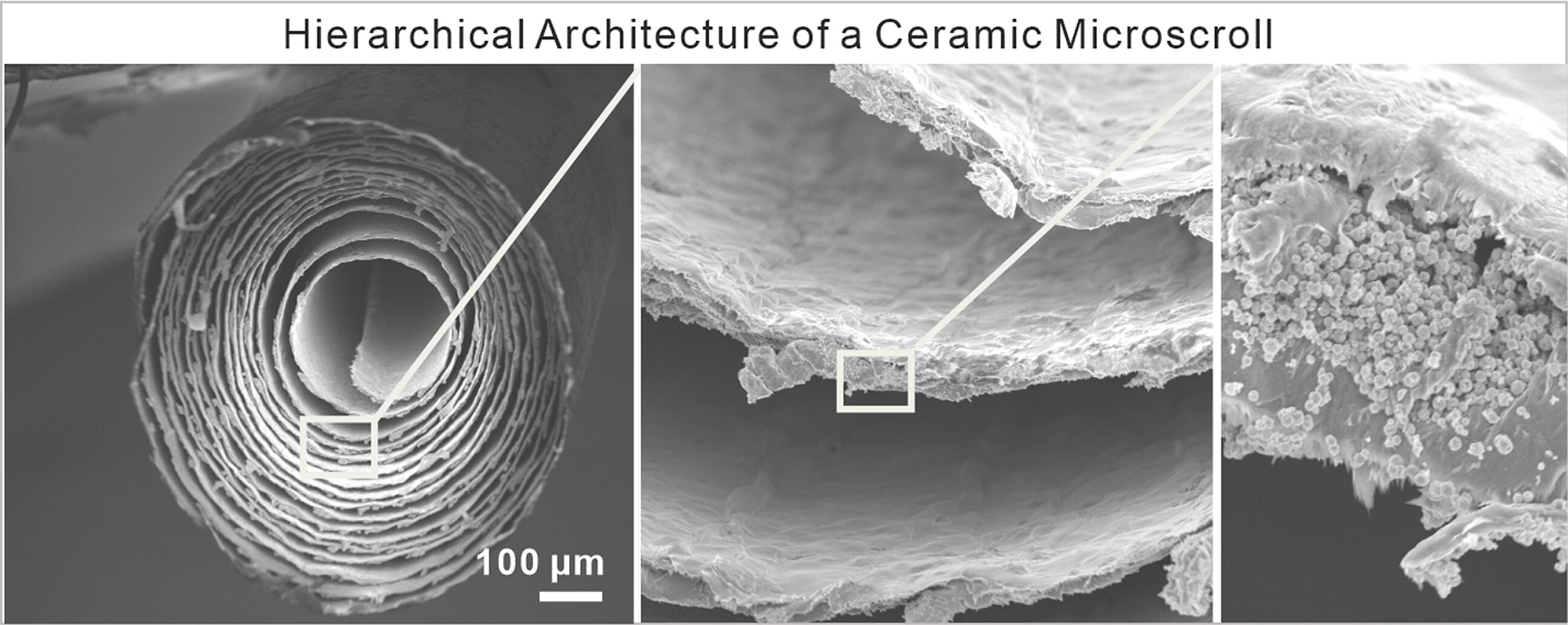
Scanning electron microscope images of the cross-section of a ceramic microscroll (2 × 25 mm). The images reveal the hierarchical multilayer architecture of the microscroll together with the magnetic nanoparticles embedded within the ceramic structure. Credit: University of Stuttgart / Institute for Materials Science.
Researchers at the University of Stuttgart and the Max Planck Institute for Solid State Research have developed tiny rolls that can be unrolled and rolled up in a controlled manner using a magnet. The model for this was the proboscis of butterflies. These smart materials enable the development of more efficient drive technologies for micro- and soft robotics, a field of research of great economic importance. The results have been published in the journal Advanced Materials.
New robotic systems are increasingly making headlines: Microrobots are extremely small robots with potential applications in fields such as medicine and industry. At the same time, the field of soft robotics—which relies on flexible, adaptable materials—is advancing to make robots more adaptable and safer. Just as in macroscopic robotics, actuators must also control movements or grippers in micro- and soft robotics.