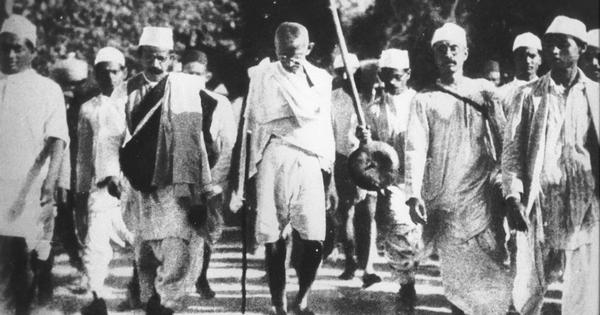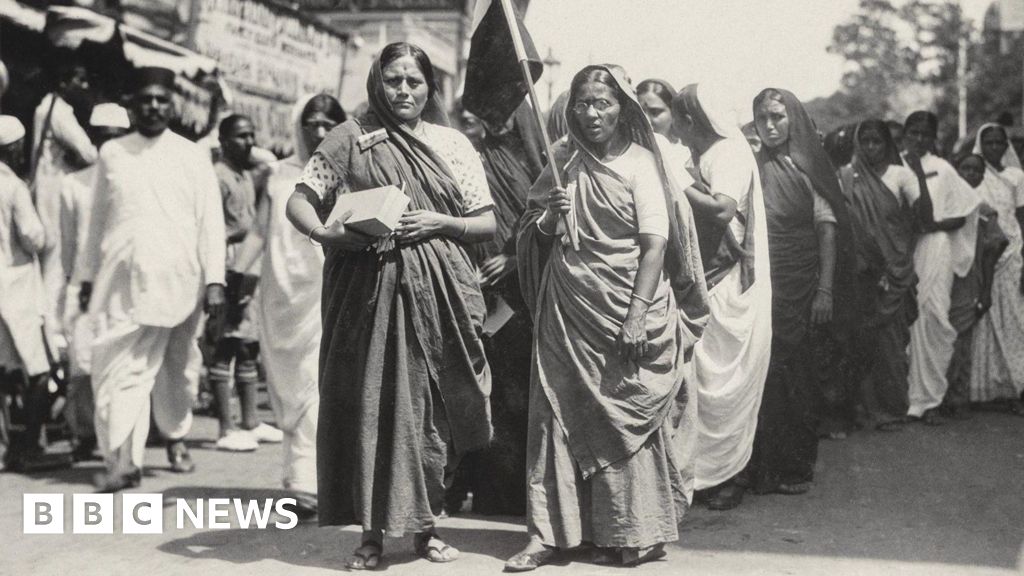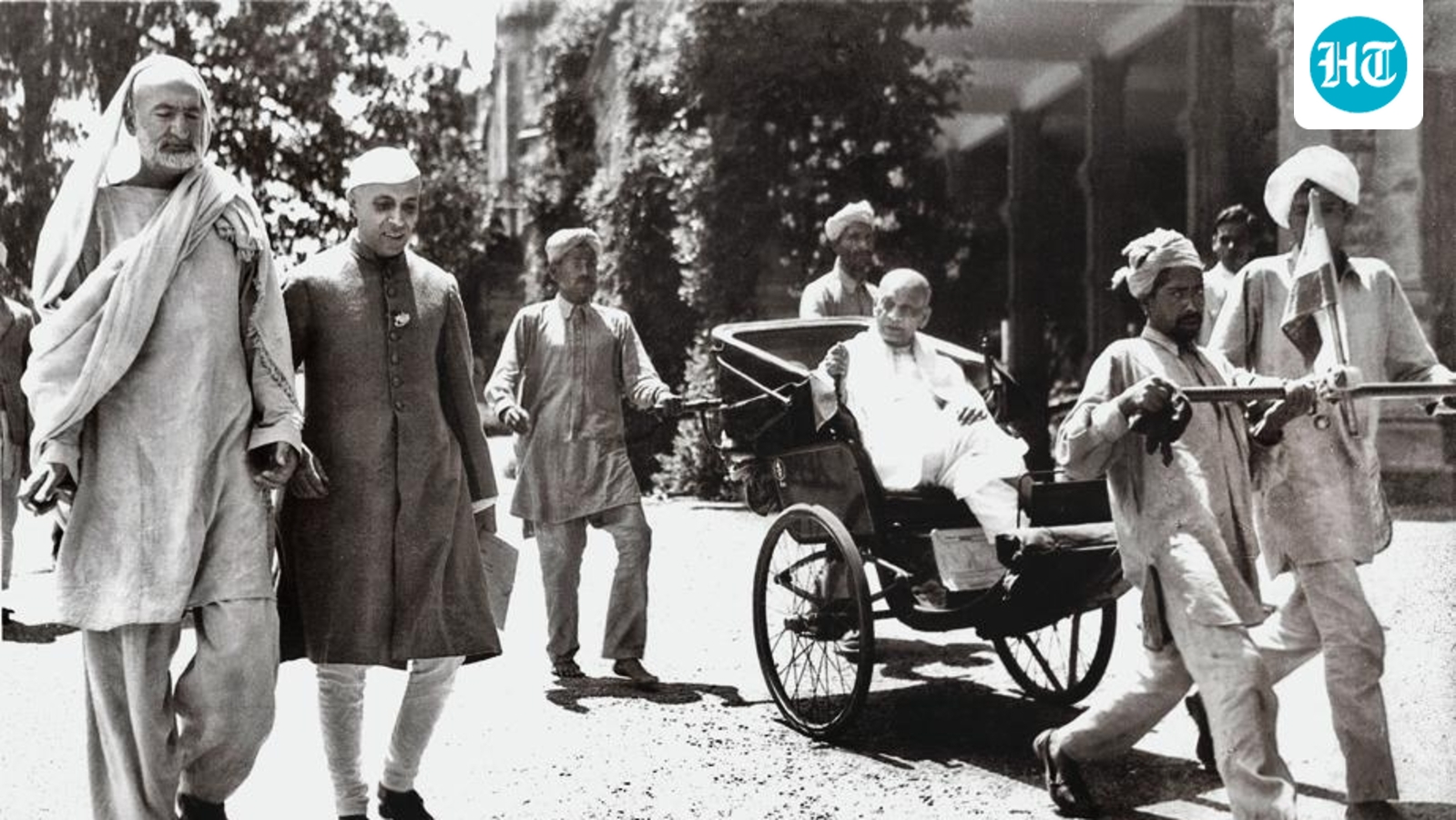
From Gandhi and Bhagat Singh to workers building a new India, photographs and archives reveal how images shaped the visual story of Independence. A postcard with a photograph of Kasturba Gandhi and her husband, Mahatma Gandhi, carries an inscription that reads, “Companions on the endless journey”. Mugshots of 20 men, including Bhagat Singh, form a geometrical shape on a poster titled “Lahore Conspiracy Case Accused”. A group of ghagra and ghunghat-clad women hold head pans with soil and smile shyly as they lock eyes with the camera. These artefacts — variously part of a collection coming up for auction in Mumbai; an archive on display in Gurugram; and an exhibition on view in New Delhi — draw our attention to a powerful ally of the independence struggle: The photograph. No revolution or movement, captured through the alchemy of light on silver crystals, is ever truly over: its life extends for as long as the image remains.Jawaharlal Nehru with Abdul Gaffar Khan at Simla during the Cabinet Mission deliberatiions of 1946. Riding in the rickshaw is Sardar Patel (Kulwant Roy Collection copyright Adityaarya archive)Mehta Half tone Company's design, engraving and published poster of the Lahore Conspiracy Case, c.1932Mahatma Gandhi during a Prayer Walk, Circa 1940s (Saffronart)At Museo Camera, press photographer Kulwant Roy’s archive, gifted to the Gurugram museum founder Aditya Arya in the 1980s, is on display this week. In it, we see a range of images taken by Roy between the 1930s and ’60s, including candid shots of national leaders as well as common citizens. Separately, freedom fighter Anand T Hingorani’s archive is up for auction by Mumbai headquartered Saffronart on August 18 and 19. Hingorani, who was one of the few men from the Sind Province to participate in the Dandi March in 1930, remained a close associate of the Mahatma — the archive, currently on view, comprises of artefacts like Gandhi’s watch gifted to Hingorani, booklets on the rules of Sevagram ashram, compilations of Gandhi’s writings on students and women, edited and published by Hingorani, personal correspondence between the duo, and photographs by Kanu Gandhi and Dady Rustom Dossabhoy Wadia, some of which were converted to prints and postcards.And at New Delhi’s India Habitat Centre, the Tuli Research Centre for India Studies (TRIS) has put up a voluminous exhibit, which encompasses silver gelatin prints by Henri Cartier-Bresson, film posters, paintings, newspaper and magazine clippings, a copy of the Constitution among other things from pre-Independence India to several decades after independence too.Each collection builds on a well established narrative of how India, as a nation, came into being. The idea of independence circulated every time a print with Gandhi’s face and/or his autograph — Hingorani’s collection has a handful on display — went out. The faces of leaders and freedom fighters were also circulated on informational posters — a few are on display at the TRIS exhibition — that often referenced Hindu mythological iconography to reinforce such messaging.The circulation of these visuals was aided, in large part, by technological advances in printing and photography. Early on in his career, Roy used a Speed Graphic, a sheet-film camera that required a good deal of manual strength to handle. Later, as cameras like Rolleiflex and Leica entered the market — more portable, offering a larger number of exposures — Roy switched to using them. Though composition of the image still required skill, Roy was certainly able to take more photographs of the national leaders during momentous occasions, such as Simla Talks between the British government, Congress and Muslim League leaders in 1946, the signing of the Indian Constitution in January 1950, and the building of the Bhakra Nangal Dam in the 1950s.Workers at the Bhakra Dam site, undated, Circa 1950s (Kulwant Roy Collection copyright Adityaarya archive)As historian Indivar Kamtekar pointed out in History in the Making: The Visual Archive of Kulwant Roy (2010), these images “never make us feel that history is headed in the wrong direction. On the contrary, they declare that the world is progressing. In doing so, they embody the optimism of the first decades of independent India.”These images also created a “visual dyad” of loincloth-clad Gandhi on the one hand, pitted against the well-dressed colonialist Englishman on the other, academician Gayatri Sinha writes In Points of View: Defining Moments of Photography in India (2022). “As an emergent new nation, India presented a bipolar photographic view, pitting imperial and nationalist political values and assertions of identity against one another.”But independence, like the freedom struggle, is a narrative of history that leaves out as much as it incorporates. For instance, events like the Bengal Famine of 1943 or the Partition Riots of 1947 that affected millions remain unseen in Roy’s images, Kamtekar pointed out. To be sure, none of these collections on display purport to offer an entire visual history of the nation at the time of its birth.The immediate aftermath of independence was a moment of great confusion. As the Hindustan Times reported on August 15, 1947, of the normal complement of 1,100 Indian Civil Services (ICS) officers that served in the administration, only 450 stayed back after the 15th.Thus, another message had to go out to the country: that of a nation starting from scratch, building itself up from the ashes. Take Roy’s image of the workers on the Bhakra Nangal dam site looking into a camera, or even R.R Bharadwaj’s photograph of the Tata Steel Plant in Jamshedpur captured in 1952.R. R. Bharadwaj 's photograph of the Tata Steel Plant Jamshedpur 1952 (Tuli Research Centre for India Studies)In both images, the worker as well as the factory serve as symbols of national pride. The people building the temples of modern India (as Nehru famously said of the Bhakra Nangal Dam) and the silhouette of the steel plant billowing smoke into the air are icons of a nation well on its way to claim its place in the world after centuries of oppression. Seventy-nine years on, the idea and the images endure.Dhamini Ratnam is the National Culture Editor of Hindustan Times, and writes on society and the arts with a particular emphasis on the politics of gender, sexuality, and queer feminism. She won the SOPA for Human Rights reporting in 2015 and a Global Investigative Journalists' Conference fellowship in 2017. She is co-editor of Queer India Now, a non-fiction anthology published in 2026.Read MoreGet the latest India News, breaking headlines and real-time updates from across the country. Stay informed about politics, government policies, crime, weather major national developments and Karnataka Bandh LIVE.See Less
Postcards from India’s past
From Gandhi and Bhagat Singh to workers building a new India, photographs and archives reveal how images shaped the visual story of Independence. | India News
1,086 words~5 min read