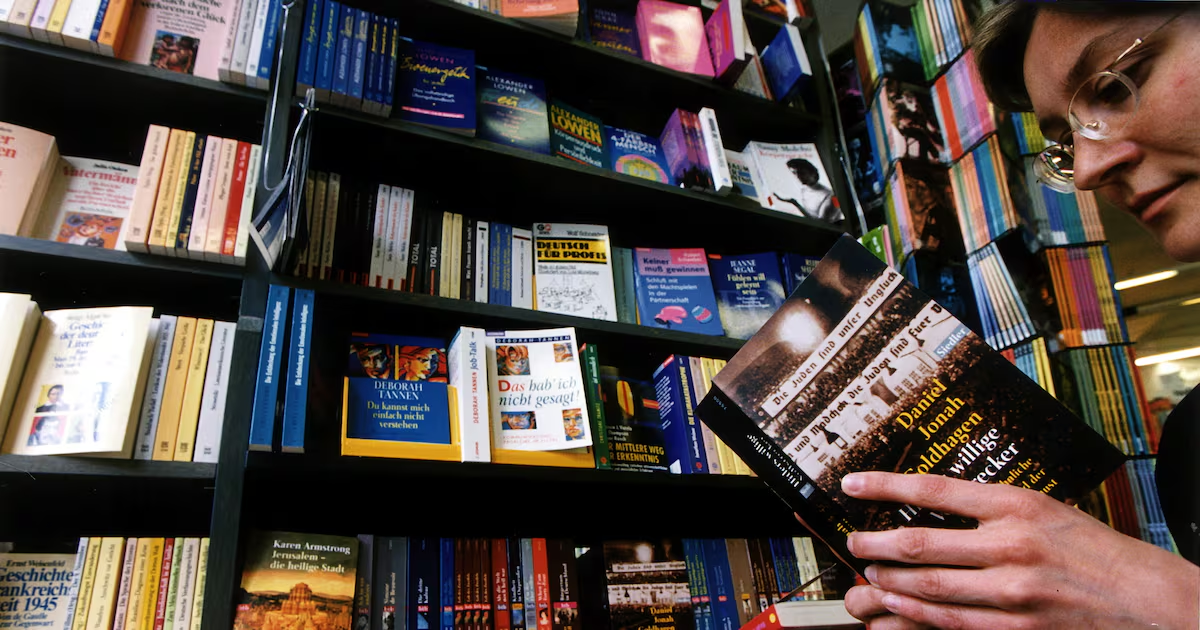
Irish bookshop and online retailer Kenny’s told The Irish Times this week that they have been getting some unusual book orders, received via email in the middle of the night and requesting upwards of 5,000 often obscure titles. The pattern seen in Galway fits with a global story of AI firms buying paper books and feeding them into the models that underpin chatbots. This process, which the industry calls “destructive scanning”, sees the spines sliced off thousands of physical books at a time, the pages digitised, and then the whole lot destroyed. The image of pulped books unsettled many readers, but is just a glimpse into larger, more troubling shifts in the economics of literature and publishing. Something about the idea of destroying books feels instinctively wrong. We think of books as holders of knowledge and artistic beauty, as objects of pleasure, distraction or entertainment, full of the potential for human betterment. They are how we process ideas about the future and how we know about the past, transmitting humanity’s accumulated insights through the ages. They are a thing to be passed along, archived and rediscovered. Reading Derek Scally’s piece, I imagined faceless robots consuming and discarding our literary history, an image perhaps more grounded in the wider pattern of destruction that is being meted out on authors, their rights and profession. Pulping literature is not the same as burning books, but the two feel closer than is comfortable. Book burnings are highly visual shows of power to erase ideas; destructive scanning is erasing them in a more subtle way – by destroying the viability of a livelihood built around creating and challenging ideas. It is also something companies wanted to keep quiet. In an internal memo, an executive at AI firm Anthropic wrote that “Project Panama is our effort to destructively scan all the books in the world ... we don’t want it to be known that we are working on this”. Most of what we do know about scan and pulp practices, including this memo, come from lawsuit disclosures, including a recent US suit against Anthropic, owner of chatbot Claude. In that case a group of authors accused that company of violating their ownership rights for their work by using their books without permission to train the models that underpin Claude. Through these disclosures we learned Anthropic began its attempt to obtain “all the books in the world” by downloading seven million copies of books without authors’ consent from pirating websites, places that already undermine writers’ income. When that resource was exhausted and the company became, in its own words quoted in the judgment, “not so gung ho about” training on pirated books “for legal reasons”, it switched to scanning and destroying physical copies of books. The initial judgment in the suit pointed out two harms these actions caused writers. First, the company had an option of negotiating with publishers and paying a fair price for the rights to these books, but chose not to. After all, the judgment remarks, “users and corporate clients pay to use Claude, generating over $1 billion in annual revenue”. Second, the tools that these ingested books create water down the value of writers’ labour, helping “less capable writers create works as well-written as authors’ and competing in the same categories”, although it added that “Claude created no exact copy, nor any substantial knock-off.”We may question the “well-written” part, but there is evidence that AI-generated books are flooding the market. The number of ebooks published monthly on Amazon has tripled since the introduction of ChatGPT, researchers found, while the quality, measured by things such as average star ratings, worsened. An entire cottage industry has sprung up of influencers hawking get-rich-quick courses that involve mass-producing search optimised books to sell via online sites.Last month journalist Kashmir Hill wrote about finding an AI-generated biography of herself for sale on Amazon for $26.99. The 90-page book had all the hallmarks of AI slop, including completely inventing stories about her life, such as a hallucinated tale of how she met her husband. The “author” of her biography published nine other books the week the one about her came out, and their Amazon profile featured a stock photo pulled from the web of a generic-looking white man in a suit speaking at a conference. Amid the flood of regurgitated rubbish, sales of actual books are dropping. Both fiction and non-fiction book sales have decreased in every category except children’s literature, according to Publishers Weekly. In the UK, half of published novelists told a Cambridge University study that AI is likely to replace their work as fiction writers entirely, and 85 per cent expected their future income to be driven down by the technology.Copyright law has protected authors’ rights and enabled the survival of those who create beauty and value since at least the 1700s. But in a pattern seen repeated across domains, these rights are being chipped away by creative legal manoeuvring backed up by the US courts. A series of legal opinions have frequently sided with the wealthiest companies on Earth and their contention that their ingestion of the whole history of human creativity for their own gain without compensation is covered under the idea of “fair use”. [ The Irish Times view on AI regulation: Ireland is spreading the burden widelyOpens in new window ]This includes the judgment in the lawsuit mentioned above taken against Anthropic. The litigation did eventually see a payout for writers whose books had been taken from pirating websites, but no such compensation was awarded for those whose work had been scanned and pulped. There are four key inputs you need to build AI. You need chips and data centres for computing power, technical capabilities offered by coders and engineers, energy, and data, by which we mostly mean the outputs of human creative labour. Yet AI companies have decided they are only willing to pay for the first three of these. This is despite the fact that, as the Anthropic judgment states, the company “could have purchased books, but it preferred to steal them” in order to avoid what the CEO called the “legal/practice/business slog” of paying for people’s work.
Liz Carolan: Why are AI firms bulk buying and pulping books? Because it’s cheaper than paying writers
In an internal memo, an executive at AI firm Anthropic wrote that ‘Project Panama is our effort to destructively scan all the books in the world’
TL;DRAI
Anthropic destructively scans thousands of books without author compensation, generating $1B revenue. This erodes copyright and writer viability; fair-use claims enable cheap training, signaling licensing pressure and regulatory backlash for AI firms.
1,028 words~5 min read