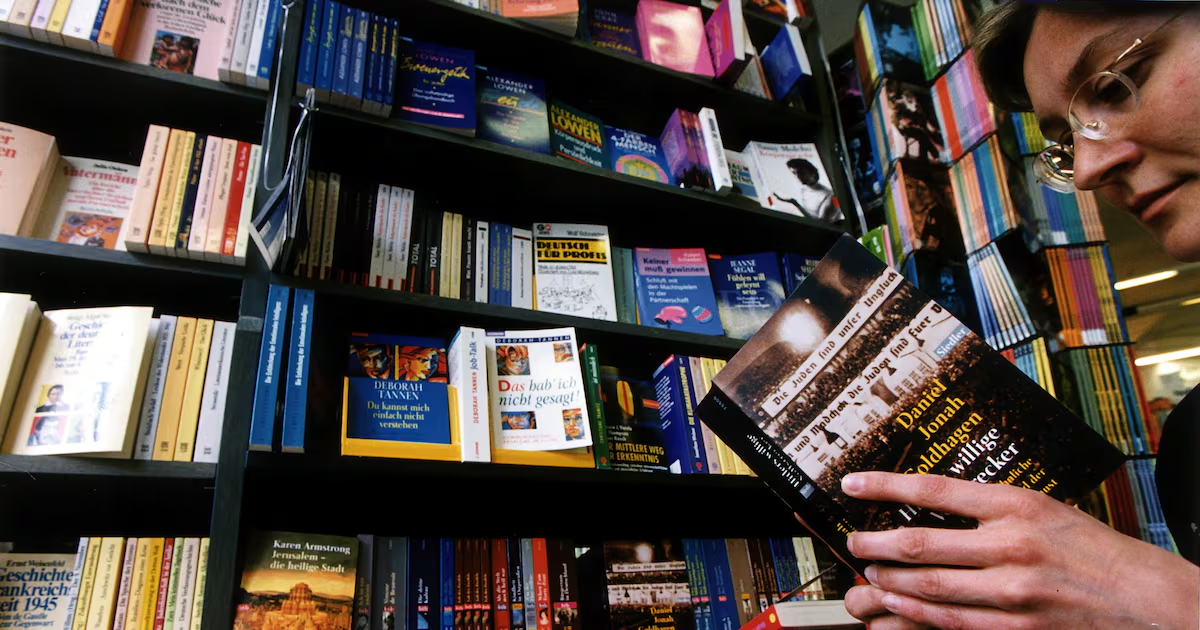
From Galway to Berlin and beyond, independent booksellers across Europe agree that something very strange is going on.Last May Tomás Kenny of famous Galway book retailer Kennys received what he describes as a “bananas” online order for 5,000 books. But it was less the scale of the order that caught his eye and more its eclectic selection.“Some was high-quality non-fiction, like A History of Connemara, and the next thing might be The Eddie Hobbs Guide to your SSIA,” said Kenny.Large orders are nothing new for the kennys.ie website. It was only the second bookshop in the world to launch a website in 1994 and it is popular with large institutions, such as Asian universities seeking to stock shelves in newly opened English libraries.But when publicly funded institutions contact him, they usually negotiate a bulk price. May’s online order – with no haggling – sent up a second red flag.Last May, Tomás Kenny of Kennys Bookshop, received a 'bananas' online order for 5,000 books Over in Berlin, booksellers in the German capital are grappling with similar-sized mass orders. They arrive in the night via email, are as profitable as they are perplexing, involving dusty books that no one in their right mind would buy. Pass Your Driving Test, 2018 Edition, anyone?Booksellers say it is not unusual for these orders to range from €10,000-€50,000, welcome income amid an ongoing earthquake in their industry thanks to Amazon and other online booksellers. Yet many fear that, with these bulk orders, they may be signing their own death warrant. As evidence, they point to a January Washington Post report about a similar mass-order phenomenon among US antiquarian book retailers.According to that report, AI giant Anthropic was behind Project Panama, spending “tens of millions of dollars to acquire and slice the spines off millions of books, before scanning their pages to feed more knowledge into the AI models behind products such as its popular chatbot, Claude”.[ Anthropic’s Claude AI models hack into 3 outside groups during testingOpens in new window ]Details of the US plan emerged through filings related to a copyright lawsuit against Anthropic. That ended with a $1.5 billion settlement with book authors.Berlin antiquarian book dealer Urban Zerfass has no doubt some tech giants are engaged in a similar practice in Europe. “The Anthropic plan is clear in documents to its investors, meanwhile Amazon earns 20 per cent on every transaction,” he said.Germany’s Publishers and Booksellers’ Association has described mass scan-and-pulp practices as destructive and illegal.“Under German law scanning books – regardless of the purpose – would not be permissible and constitute a clear violation of copyright law,” said Thomas Koch, spokesman for the association. “That this is now happening with second-hand books is another highly troubling example of this practice.”German book retailers have put their heads together and suspect the entire ordering process is being run automatically, by an AI-driven bot, with a focus only on books with an ISBN number, the identification system introduced in 1966.AI giant Anthropic was behind Project Panama, spending 'tens of millions of dollars' to acquire books and scan their pages to feed more knowledge into AI models behind products such as its popular chatbot, Claude. Photograph: Jason Henry/The New York Times
A mysterious buying spree is unsettling Europe’s booksellers
Independent retailers are receiving vast orders for obscure titles, fuelling suspicions that AI companies are quietly building the next generation of chatbots
TL;DRAI
Anthropic and rivals mass-buy used books across Europe for LLM training, replicating Project Panama ($1.5B settlement). For tech leaders: signals AI suppliers' copyright arbitrage (US fair use vs. EU law), shaping LLM training costs and compliance risk.
911 words~4 min read