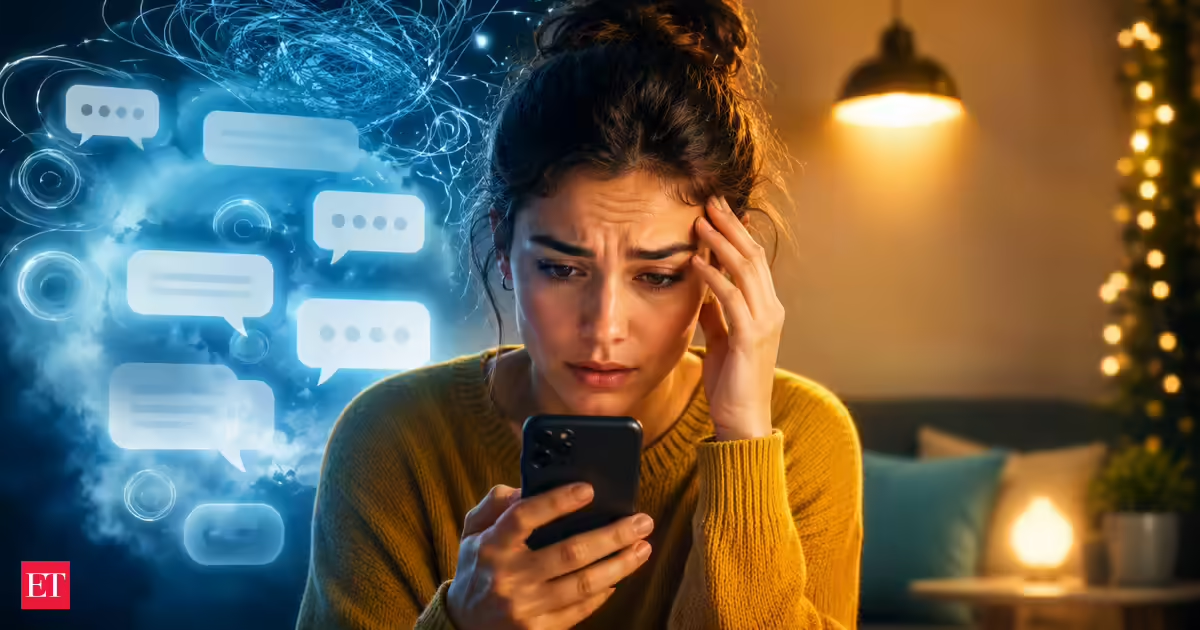
Imagine you're chatting with someone and suddenly those three little dots appear: “typing…”. You know a reply is coming. And yet, instead of feeling reassured, you may suddenly become more alert.What are they writing? Did they misunderstand you? Are they angry? Is it going to be a one-word reply or a long explanation? Then the dots disappear. A few seconds later, they return. Somehow, three tiny dots have turned an ordinary conversation into a suspense thriller.Why uncertainty can make the brain uncomfortableOne of the most important concepts behind this behaviour is intolerance of uncertainty. In psychology, it describes the tendency to find uncertain or unpredictable situations particularly difficult to tolerate.A large preregistered meta-analysis published in Clinical Psychology Review in 2026 brought together 738 effect sizes from 115 studies and dissertations, representing 28,693 participants. Researchers found a robust relationship between intolerance of uncertainty and worry and was also associated with anxiety across several anxiety-related conditions.That does not mean someone who feels tense when they see “typing…” has an anxiety disorder. Instead, it helps explain the basic psychological mechanism: when the outcome is unknown, some people find it harder to simply wait for the answer.And the typing indicator creates a particularly strange form of uncertainty. It tells you that something is happening, but withholds the information you actually want.Why waiting for a reply can become a cycleResearch by psychologist R. Nicholas Carleton and colleagues provides another important piece of the puzzle. In a 2019 paper examining increasing intolerance of uncertainty in an increasingly connected world, the researchers discussed how mobile phones can provide almost constant access to information and “safety cues” that people use to reduce uncertainty and anxiety.But there is a catch. Repeatedly seeking reassurance may provide short-term relief while potentially reinforcing the urge to seek reassurance again.That creates an interesting digital loop. You see “typing…”. You wait. You check the conversation again. You may check whether the person is still online. You wonder why the message hasn't arrived. Eventually, the reply appears and the uncertainty disappears.Repeated reassurance-seeking can potentially reinforce the tendency to seek reassurance when uncertainty returns.This doesn't mean checking your messages is inherently unhealthy. It simply illustrates why uncertainty can make digital communication surprisingly absorbing.Instant messaging has changed what “waiting” feels likeThere is also emerging research looking specifically at the emotional experience of instant messaging.A 2025 qualitative study published in the South Eastern European Journal of Public Health examined how undergraduate students experienced silence, delayed responses and blocking in instant messaging. The researchers conducted semi-structured interviews with 10 participants and identified themes including communication silence, expected responsiveness and cognitive and emotional strain.That finding is useful, but it needs to be kept in perspective. Ten participants cannot establish that typing indicators generally make people anxious, nor can a qualitative study establish cause and effect.What it does show is that the experience exists in people's actual digital lives and can become emotionally significant when responsiveness matters to them.Why your mind starts writing the message for themPerhaps the most relatable part is what happens during the silence. The other person hasn't actually said anything negative. Yet your brain may begin constructing an explanation for the delay.This is where uncertainty and worry can interact. The 2026 meta-analysis found that worry appears to play an important role in the relationship between intolerance of uncertainty and anxiety.In everyday language, uncertainty can create an information vacuum, and worry can start filling it.The dots may not be the problemThe most important takeaway is that there is no established psychological rule saying that people who become nervous when they see “typing…” are anxious people.Personality, the importance of the relationship, the subject of the conversation, previous experiences and an individual's tolerance for uncertainty can all influence how they respond.So the next time those three dots appear and you suddenly find yourself staring at the screen, psychology offers a more nuanced explanation than “you're overthinking.” You may simply be experiencing one of the oldest psychological discomforts in a very modern form: not knowing what happens next.
Psychology explains why seeing ‘Typing…’ can trigger overthinking, make uncertainty harder to tolerate and leave you imagining what the other person might be thinking
The "typing…" indicator can create anxiety due to intolerance of uncertainty. This psychological trait makes unpredictable situations difficult to tolerate for many. Repeatedly seeking reassurance online can create a reinforcing digital loop. Instant messaging has altered the emotional experience of waiting for replies. Individual factors influence reactions to digital communication delays.
667 words~3 min read