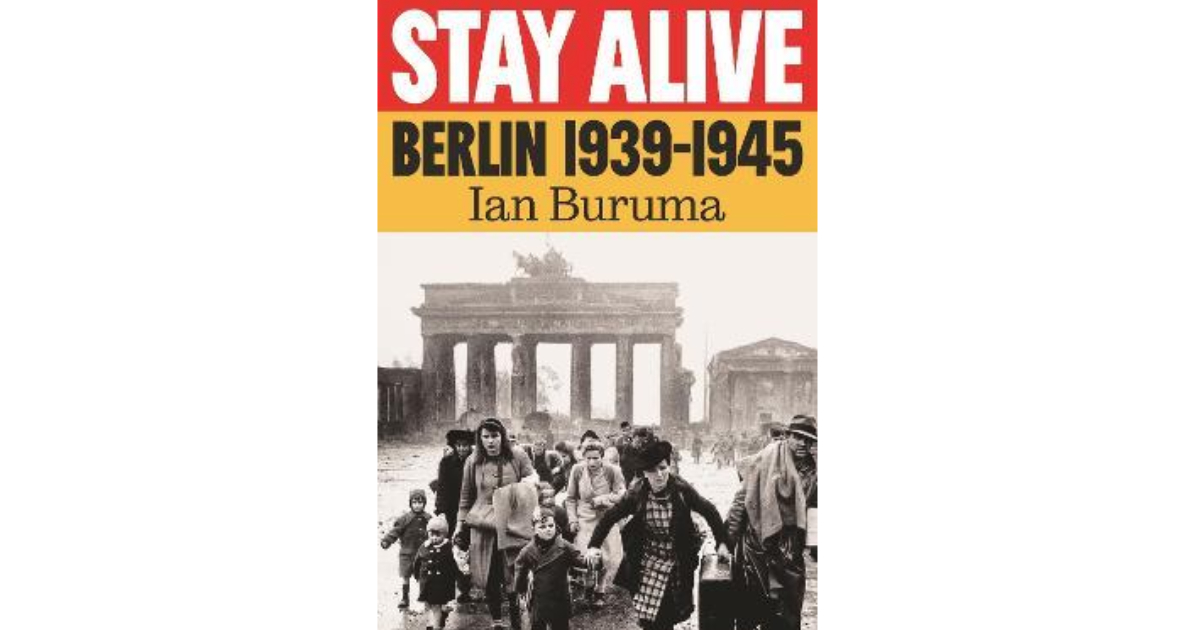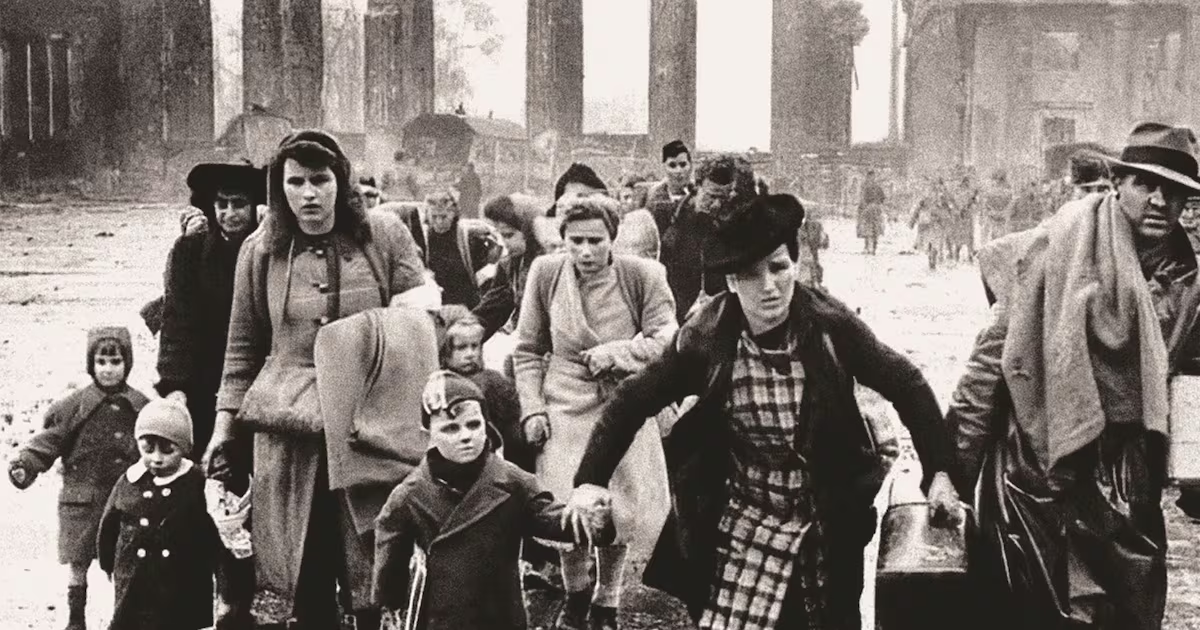
Watch enough British telly, and you will learn about the Blitz, that period in World War 2 from September 1940 to May 1941, when London endured wave after wave of Luftwaffe bombings, causing huge fires and devastation.Old newsreels show visits by the king and queen or prime minister Winston Churchill to the East End of London to comfort the people, raise morale and display the British bulldog spirit. And, in Churchill’s case, to puff away on a cigar and raise that famous two-fingered V-sign.Life in wartime London has been well documented, but I knew far less about wartime Berlin. Until now.‘Stay Alive: Berlin 1939-1945’ by Ian Buruma. Picture: (Supplied) Thanks to extensive research, delving into archives, memoirs and journals, conducting dozens of face-to-face interviews and enjoying access to his own father’s wartime Berlin writings, author Ian Buruma has done a marvellous job in bringing to life a city at war in Stay Alive: Berlin, 1939-1945.He is brilliant at weaving together all these divergent accounts into a narrative that gives authentic insight into a range of characters and their differing levels of courage, fear, resistance, defeatism, inhumanity, and sadism.Those whom he writes about range from his own dad, a Dutchman who had been sent to Germany as a forced labourer, to ordinary and extraordinary, and vile and repellent, Germans.Buruma explains: “The bundles of letters in [my father’s] tin box first gave me the idea of writing a book about the way people lived in a great city that had only recently been famous, and to some notorious, for its sexual and artistic freedom, its extraordinary flowering of culture, and its intellectual and scientific sophistication, but ended up being pummelled to destruction because of the evil forces its rulers had unleashed.”Many of those who feature in the book are Jewish, but few Jewish Berliners would survive the war.Prominent Nazis include Adolf Hitler himself, who died as the Russians were closing in on his underground bunker.He had just married his mistress, Eva Braun, and the couple committed suicide — she took cyanide, and then he shot himself. Then their bodies were burnt. Not your typical honeymoon.We also read about musicians and actors, many of whom contributed to Nazi propaganda. Some were killed for their beliefs, others for their ethnicity.While the subject matter is grim and often deeply depressing, there is also a resilience that shines through, not least through humour — a characteristic for which the Germans are not always renowned.“A common way for Berliners to say goodbye was no longer auf Wiedersehen, or Heil Hitler, but bleiben Sie übrig, stay alive,” Buruma reveals.He also shares a rather good wartime Hitler joke: “Hitler asks a labourer how many hours he works in a day.“‘Eight hours.’“‘I see, and how many hours, if you were to work in an armaments factory?’“‘Sixteen hours.’“‘And if you were to work for our Party?’“‘Twenty-four hours, of course.’“‘Good man. What work do you actually do?’“‘I’m a gravedigger.’”Though they might have been defensively secretive about the true purpose of the concentration camps, the Nazis made no secret of their anti-Semitism and their desire to rid their nation’s capital of all Jews by sending them to the camps.In the years before the war, some fortunate ones were able to flee Germany, but survival became increasingly difficult for those Jews who remained.“To survive in Nazi Berlin, identity papers were essential. So, to be able to eat, or to avoid detection and arrest, papers and coupons had to be faked, or stolen, or acquired from courageous helpers,” he writes.“To stay in one place for too long, even in an abandoned toilet, the cellar of a ruined building, or a wooden shed in one of the many garden allotments around Berlin, was dangerous. You had to keep moving in a lethal game of cat and mouse, never knowing whom to trust. There were people everywhere only too happy to report a suspected [Jew] to the authorities. There were so many reports that the Gestapo, to save time, made it an offence to send false accusations.”The plight of the Jews is well known, but trainloads of non-German workers were transported to the capital city to work in factories. Millions of these would not survive the war.Buruma writes: “In the summer of 1943, 6.5-million foreign workers were employed in German industry and agriculture. Forty percent of Daimler‑Benz workers came from abroad, and so did 60% of the workers in aircraft factories.“Some were Eastern Europeans of all ages. Women forced to labour in Germany sometimes came with their young children. There were Soviet POWs, many of whom died of ill treatment and starvation. Some were prisoners from concentration camps, who were mostly worked to death. Italians came too, men who turned against Mussolini under Marshal Pietro Badoglio in the summer of 1943. Thirty‑two thousand Italians died of overwork or starvation in the following winter.“And there were workers from Western European countries under German occupation, such as Belgium, France and the Netherlands. Nearly two-and-a-half million non‑Jewish foreign workers died in Germany during the last three years of the war.”Some were Eastern Europeans of all ages. Women forced to labour in Germany sometimes came with their young children. There were Soviet POWs, many of whom died of ill treatment and starvation. Many Berliners certainly suffered during the war, but the plight of many continued after the surrender, as the Russians who stormed into the city were a ghastly bunch.“Rape is something all conquering armies do. But the scale of violence against German women was extraordinary,” Buruma writes.“Hospitals estimated that more than 100,000 Berlin women were raped, and about 10,000 victims died, often by killing themselves in shame. Survivors claim that German women in East Prussia and other areas that are now part of Poland and Russia suffered even more. Brutalised by battle, enraged by what the Germans had done to them, and filled with sheer bloodlust encouraged by their leaders, Soviet soldiers took out all their worst impulses on German women.“From people whose memories I tried to probe, I kept hearing the same thing: “Life was much harder after the war”, that is “when things got really rough”. It took time for the raping of women and looting of homes to subside, and for Red Army discipline to be imposed.”World War 2 may seem such a long time ago, and as each year passes, there are fewer survivors from those who lived in Berlin at that time. However, the lessons of history are timeless, and Buruma suggests there are horrific echoes from the past in Moscow in the present Ukraine conflict: “I am writing these lines even as another brutal war is being fought on European soil. Some things I read about Russia bear an uncanny resemblance to what I was finding in the newspapers and magazines of wartime Berlin. Vladimir Putin, just like Joseph Goebbels in the early war years, is trying hard to make life for middle‑class Muscovites appear as normal as possible, even as Russian troops are causing bloody mayhem in a neighbouring country.”However, his final message is upbeat: today’s Berlin is a city whose dark past does not overshadow its future: “Looking history in the face without flinching is an essential condition for redemption,” he concludes.This is an excellent book with a powerful message. It is the sort of history book I wish they had issued to me when I was at school.
A deeply moving and horrific account of wartime Berlin
His father’s wartime letters spurred Ian Buruma to write Stay Alive: Berlin, 1939-45
1,227 words~6 min read