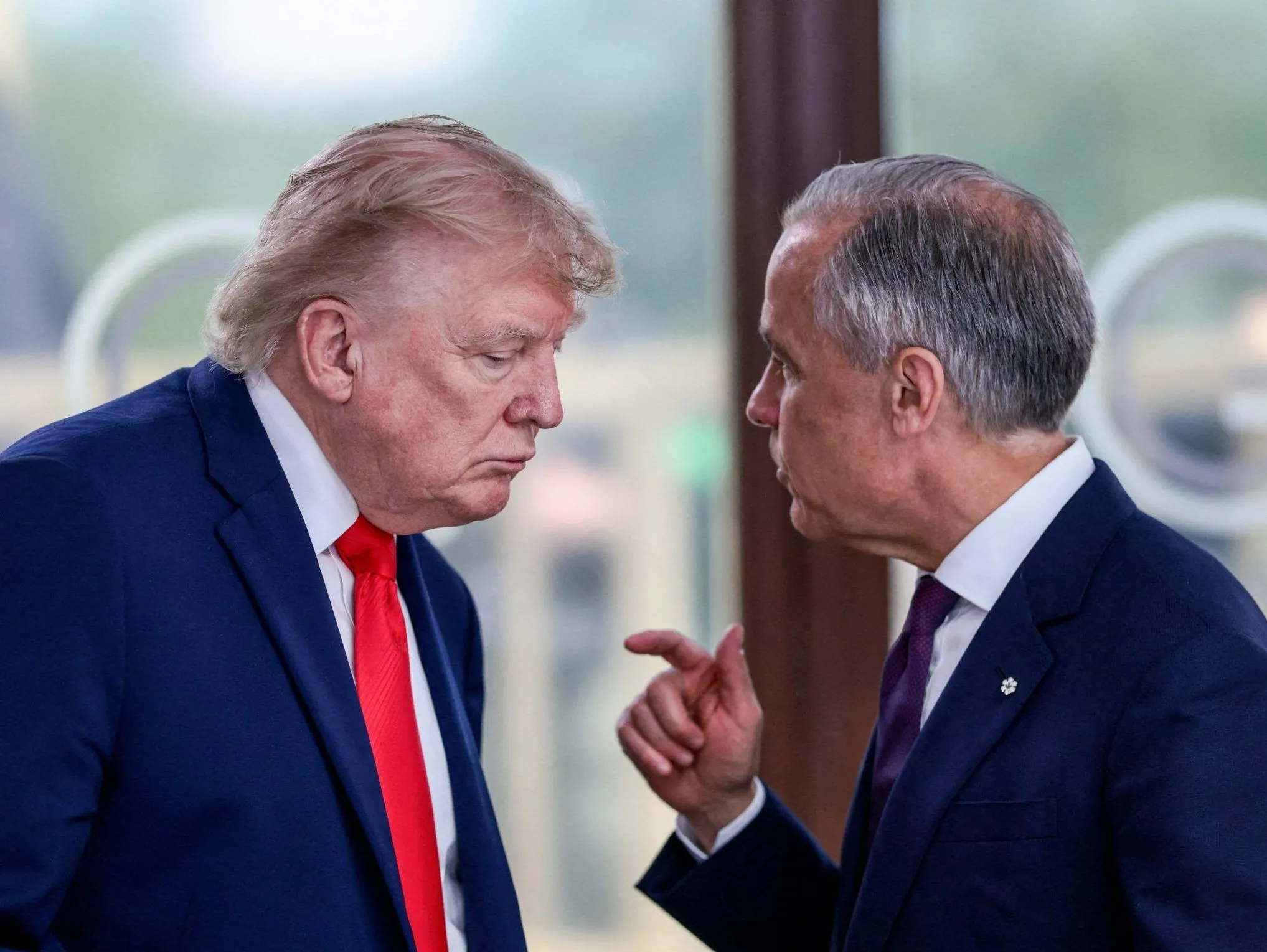
Skip to Content News Archives Economy Energy Oil & Gas Renewables Electric Vehicles Mining Commodities Agriculture Real Estate Mortgages Mortgage Rates Finance Banking Insurance Fintech Cryptocurrency Work Wealth Smart Money Wealth Management Investor Personal Finance Family Finance Retirement Taxes High Net Worth FP Comment Executive Women Puzzmo Newsletters Financial Times Business Essentials More Innovation Information Technology FP500 Podcasts Small Business Lives Told Tails Told Shopping Financial Post Store Obituaries Place a Notice Advertising Advertising With Us Advertising Solutions Postmedia Ad Manager Sponsorship Requests Classifieds Place a Classifieds ad Working Profile Settings My Subscriptions Saved Articles My Offers Newsletters Customer Service FAQ News Economy Energy Mining Real Estate Finance Work Wealth Investor FP Comment Executive Women Puzzmo Newsletters Financial Times Business Essentials HomeNewsEconomyEven in tariff-sheltered Alberta, businesses uneasy about new leviesThe tariff clock is ticking as White House sets its sights on what it calls Canadian trade ‘discrimination’Last updated 49 minutes ago You can save this article by registering for free here. Or sign-in if you have an account.Edmonton Chamber president Doug Griffiths speaks at the State of the City luncheon at the Convention Centre on May 14, 2026. Photo by Shaughn Butts/PostmediaWhile experts see the latest U.S. tariff threat targeting nearly $29 billion worth of Canadian goods as a tough bargaining chip rather than a genuine move, they still caution businesses to keep their guard up.Subscribe now to read the latest news in your city and across Canada.Exclusive articles from Barbara Shecter, Joe O'Connor, Gabriel Friedman, and others.Daily content from Financial Times, the world's leading global business publication.Unlimited online access to read articles from Financial Post, National Post and 15 news sites across Canada with one account.National Post ePaper, an electronic replica of the print edition to view on any device, share and comment on.Daily puzzles, including the New York Times Crossword.Subscribe now to read the latest news in your city and across Canada.Exclusive articles from Barbara Shecter, Joe O'Connor, Gabriel Friedman and others.Daily content from Financial Times, the world's leading global business publication.Unlimited online access to read articles from Financial Post, National Post and 15 news sites across Canada with one account.National Post ePaper, an electronic replica of the print edition to view on any device, share and comment on.Daily puzzles, including the New York Times Crossword.Create an account or sign in to continue with your reading experience.Access articles from across Canada with one account.Share your thoughts and join the conversation in the comments.Enjoy additional articles per month.Get email updates from your favourite authors.Create an account or sign in to continue with your reading experience.Access articles from across Canada with one accountShare your thoughts and join the conversation in the commentsEnjoy additional articles per monthGet email updates from your favourite authorsSign In or Create an Accountor“You really can’t take any tariff threat lightly,” said Doug Porter, chief economist at the Bank of Montreal. “This one certainly is very meaningful.”The new tariffs could cut Canada’s GDP by as much as 0.5 per cent if they were to go through and stick around for a while, Porter added. That may pile on the 1.5 per cent dent the Bank of Canada estimated before new levies were in the picture.SUBSCRIBER EXCLUSIVE: FP West: Energy Insider brings you behind the oilpatch’s closed doors with exclusive insights from insiders every Wednesday morning.By signing up you consent to receive the above newsletter from Postmedia Network Inc.A welcome email is on its way. If you don't see it, please check your junk folder.The next issue of FP West: Energy Insider will soon be in your inbox.We encountered an issue signing you up. Please try againIn July, U.S. President Donald Trump revealed plans to impose a new 50 per cent tariff on hundreds of Canadian goods by Aug. 19, in response to what his government called trade “discrimination” against American cars, alcoholic beverages and dairy.The range of goods that could be affected by the new tariff includes toys, bicycles, honey and paper products. Other things listed include various grades of plywood, cartons or cases of corrugated paper and wooden doors.“A 50 per cent tariff would probably pretty much cease the export of all those goods,” Porter said.Ontario, Quebec and British Columbia were hit hardest last year, as tariffs on steel, aluminum, lumber and autos put a dent in the provinces’ economies. Still, Canada’s economy grew last year.Canadian energy, potash and critical minerals would remain exempt from the new tariffs. That carveout has sheltered resource-rich provinces such as Alberta and Saskatchewan from the brunt of the effects.“The trade war really has not had a big impact on those two provinces,” Porter said. “The more dependent you are on manufactured goods, the more susceptible you have been to the trade war.”Still, uncertainty from tariffs may linger over Alberta businesses.“I don’t think the anxiety went away from the whole last year,” said Doug Griffiths, chief executive of the Edmonton Chamber of Commerce.“Businesses need consistency, and we just have not had it for such a long time,” Griffiths said.Moshe Lander, an economics lecturer at Concordia University and an Alberta resident, said merely talking about tariffs could create a chill for businesses.“On a day-to-day basis, you might not notice what’s going on, but accumulated over time, this is the type of thing where Alberta could very easily end up on the loser pile as well,” Lander said.Meanwhile, Adam Legge, president of the Business Council of Alberta, said its members are not overly concerned with the latest round of tariff threats, mostly because of the energy exemption.“The optimism amongst our members is still quite strong,” Legge said.Ottawa has been engaging with the U.S. to address the trade situation, with hopes an agreement may be reached by next week. Dominic LeBlanc, Canada’s minister for Canada-U.S. Trade and Intergovernmental Affairs, was in Washington, D.C., on Tuesday.The tariffs? They’re bargaining leverage, says Charles St-Arnaud, chief economist at Servus Credit Union.“It’s clear that the U.S. administration is unhappy with some of the retaliation from Canada,” St-Arnaud said, adding that some of Canada’s retaliatory measures have been effective.“The U.S. is trying to use its strength to push Canada to accept more concessions,” he said.Griffiths equated the Canada-U.S. trade war to one friend being mean to another constantly.“Eventually you just go make other friends,” Griffiths said. “There’s a shift in the Canadian business mindset that we could use some better friends.”There are signs the Canadian economy is adapting — in part by diversifying exports, aiming to become less reliant on the U.S. market.Exports to the U.S. fell over 5 per cent last year, while exports to other countries grew by nearly 16 per cent, according to ATB Financial.“Canadians do seem to be adapting to the uncertainty and getting on with life,” Porter said.FP West: Energy Insider brings you behind the closed doors of the oilpatch, with exclusive insights from insiders every Wednesday morning. Sign up now. Join the Conversation This website uses cookies to personalize your content (including ads), and allows us to analyze our traffic. Read more about cookies here. By continuing to use our site, you agree to our Terms of Use and Privacy Policy.
Even in tariff-sheltered Alberta, businesses uneasy about new levies
While experts see the latest U.S. tariff threat as a tough bargaining chip rather than a genuine move, they still caution businesses.
TL;DRAI
Trump announces 50% tariffs on ~$29B Canadian goods (toys, bicycles, paper) by Aug. 19; Alberta protected through energy and critical minerals exemption. Supply chain uncertainty pressures tech sourcing strategies and cross-border M&A decisions in North America.
1,178 words~5 min read