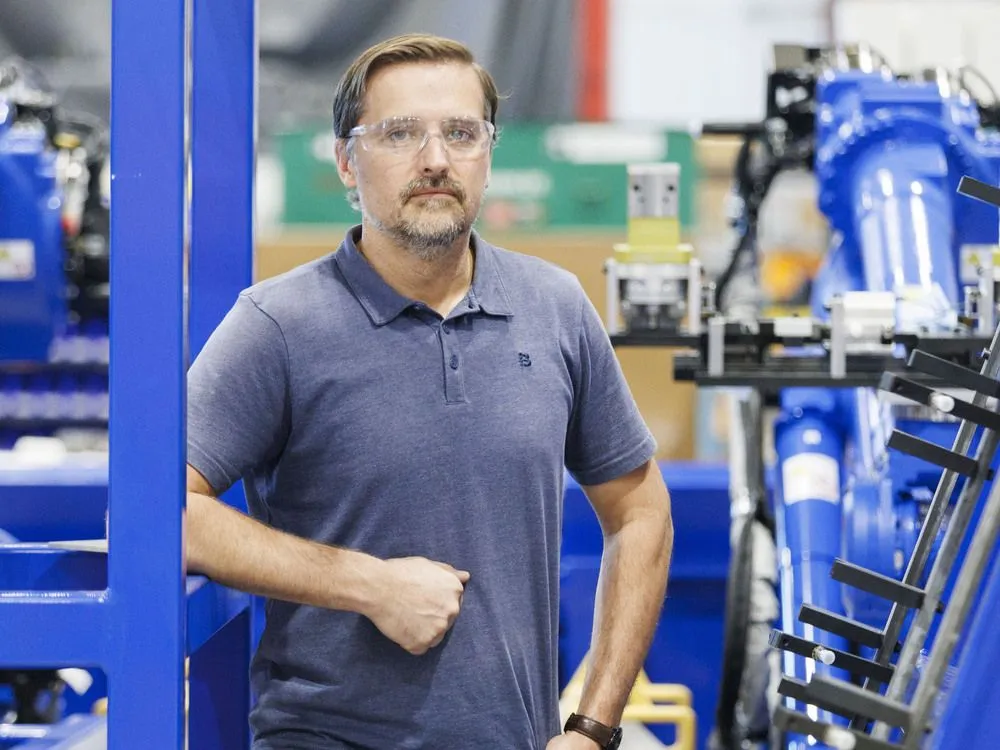
Skip to Content News Archives Economy Energy Oil & Gas Renewables Electric Vehicles Mining Commodities Agriculture Real Estate Mortgages Mortgage Rates Finance Banking Insurance Fintech Cryptocurrency Work Wealth Smart Money Wealth Management Investor Personal Finance Family Finance Retirement Taxes High Net Worth FP Comment Executive Women Puzzmo Newsletters Financial Times Business Essentials More Innovation Information Technology FP500 Podcasts Small Business Lives Told Tails Told Shopping Financial Post Store Obituaries Place a Notice Advertising Advertising With Us Advertising Solutions Postmedia Ad Manager Sponsorship Requests Classifieds Place a Classifieds ad Working Profile Settings My Subscriptions Saved Articles My Offers Newsletters Customer Service FAQ News Economy Energy Mining Real Estate Finance Work Wealth Investor FP Comment Executive Women Puzzmo Newsletters Financial Times Business Essentials HomeNewsEconomyBusinesses weigh U.S. expansion as new Trump tariff threat loomsSome companies say the proposed 50 per cent U.S. tariffs could force long-term changes, while others expect little impact You can save this article by registering for free here. Or sign-in if you have an account.Bos Innovations Inc president Ben Huigenbos poses for a photo at the company’s facility in London on Friday, July 24, 2026. (Geoff Robins/The London Free Press)Companies facing the United States’ latest threat of 50 per cent tariffs on a wide range of Canadian exports say they are weighing their options ahead of an Aug. 19 deadline, though one company executive doesn’t expect them to affect his sector.Subscribe now to read the latest news in your city and across Canada.Exclusive articles from Barbara Shecter, Joe O'Connor, Gabriel Friedman, and others.Daily content from Financial Times, the world's leading global business publication.Unlimited online access to read articles from Financial Post, National Post and 15 news sites across Canada with one account.National Post ePaper, an electronic replica of the print edition to view on any device, share and comment on.Daily puzzles, including the New York Times Crossword.Subscribe now to read the latest news in your city and across Canada.Exclusive articles from Barbara Shecter, Joe O'Connor, Gabriel Friedman and others.Daily content from Financial Times, the world's leading global business publication.Unlimited online access to read articles from Financial Post, National Post and 15 news sites across Canada with one account.National Post ePaper, an electronic replica of the print edition to view on any device, share and comment on.Daily puzzles, including the New York Times Crossword.Create an account or sign in to continue with your reading experience.Access articles from across Canada with one account.Share your thoughts and join the conversation in the comments.Enjoy additional articles per month.Get email updates from your favourite authors.Create an account or sign in to continue with your reading experience.Access articles from across Canada with one accountShare your thoughts and join the conversation in the commentsEnjoy additional articles per monthGet email updates from your favourite authorsSign In or Create an AccountorWine is among the products that would be hit by the new tariffs, but very little Canadian wine is exported to the U.S., said Quinton Jenkins, owner of Jenkins Vineyards Niagara Inc.His business, which sells grapes to Canadian wineries, has been booming ever since the Ontario government closed the door to U.S. liquor, particularly Californian wine.SUBSCRIBER EXCLUSIVE: FP West: Energy Insider brings you behind the oilpatch’s closed doors with exclusive insights from insiders every Wednesday morning.By signing up you consent to receive the above newsletter from Postmedia Network Inc.A welcome email is on its way. If you don't see it, please check your junk folder.The next issue of FP West: Energy Insider will soon be in your inbox.We encountered an issue signing you up. Please try again“We have sold our crop twice over this year,” he said. “There’s physically not enough fruit in Niagara to actually supply the demand for Canadian wine right now.”But other companies see the levies on their products as potentially business-altering.“We would probably look at moving half the company down to the U.S. as an idea. Not for sure, but it’s an idea,” Mike Vigneux, a partner and general manager at Pro-Ply Custom Plywood Inc. in Ingersoll said. “And then if we did do that, we would probably keep it there no matter what, even if things went back to normal. Half of the company there, half here.”Pro-Ply manufactures high-end plywood veneers for products such as cabinets, wall panelling and office furniture, and about 50 per cent of its products are shipped to the U.S.Plywood is one of hundreds of products, ranging from furniture to electronics to hockey sticks, included in three proclamations signed Monday by U.S. President Donald Trump that would impose 50 per cent duties on Canadian exports.The U.S. administration said the levies are in response to trade irritants between the two countries, specifically provincial bans on U.S. alcohol, Canadian tariffs on cars coming from the U.S. and access to the dairy industry.The tariffs would apply to goods regardless of whether they are covered by the Canada-United States-Mexico Agreement (CUSMA), with one economist projecting they could affect $31 billion worth of goods.The levies would also push Canada’s average U.S. tariff rate to about six per cent from five per cent, which would still be among the lowest globally but would also be “highly damaging at an industry level,” said Bryan Yu, chief economist at Central 1 Credit Union in Vancouver. An employee works on a nearly completed product at BOS in London on Friday, July 24, 2026. (Geoff Robins/The London Free Press)Ben Huigenbos, president of Bos Innovations Inc. in London, said his company, which hasn’t been hard-hit by sector-specific tariffs on autos, aluminum and steel, is still trying to determine which of its products could be hit by the new levies.“Most of what we did, I would say, fell under typical CUSMA,” he said. “Now, they’re starting to cut into stuff that was more certain and protected, so this is going to have some more real impact.”The company, which employs about 115 people, supplies machines to manufacturers and parts makers, with the U.S. market representing about 30 per cent of its business.Bos Innovations opened a plant in the U.S. a year ago, something Huigenbos said was already planned “but accelerated due to the current trade situation.”He said the prospect of 50 per cent tariffs on any product or component would alter the business equation for his company.“Unfortunately, that means perhaps a little bit less business here and a little bit more business there,” he said. “We’ll find ways to continue to support our workforce here, of course. But it’s just going to have more cost impact on us, and it’s going to make business more difficult.”However, Huigenbos said it’s important not to put a whole lot of stock in anything that’s said publicly or react too quickly, “but you have to make meaningful long-term systemic changes to your business to protect your interests and the interests of the business and the families that it supports.”The economic fallout will also likely be felt unevenly across the country.Yu wrote in a note the tariffs would hit about 13 per cent of British Columbia’s total exports, nine per cent of Ontario’s and 10 per cent of Quebec’s.The overall impact on those provinces’ exports, however, will be more muted compared with central Canada since B.C. only sends about 50 per cent of its international goods south of the border while Ontario and Quebec send about 70 per cent to the U.S.With files from Financial Post reporter Gigi Suhanicjjuha@postmedia.com Join the Conversation This website uses cookies to personalize your content (including ads), and allows us to analyze our traffic. Read more about cookies here. By continuing to use our site, you agree to our Terms of Use and Privacy Policy.
Businesses weigh U.S. expansion as new Trump tariff threat looms
Some companies say the proposed 50 per cent U.S. tariffs could force long-term changes, while others expect little impact.
TL;DRAI
Trump imposes 50% tariffs on CAD $31B exports (Aug 19 deadline), forcing manufacturers like Pro-Ply to weigh permanent U.S. relocation. Supply chain economics reverse—nearshoring now demands upfront capex/infrastructure investments as long-term competitive positioning.
1,263 words~6 min read