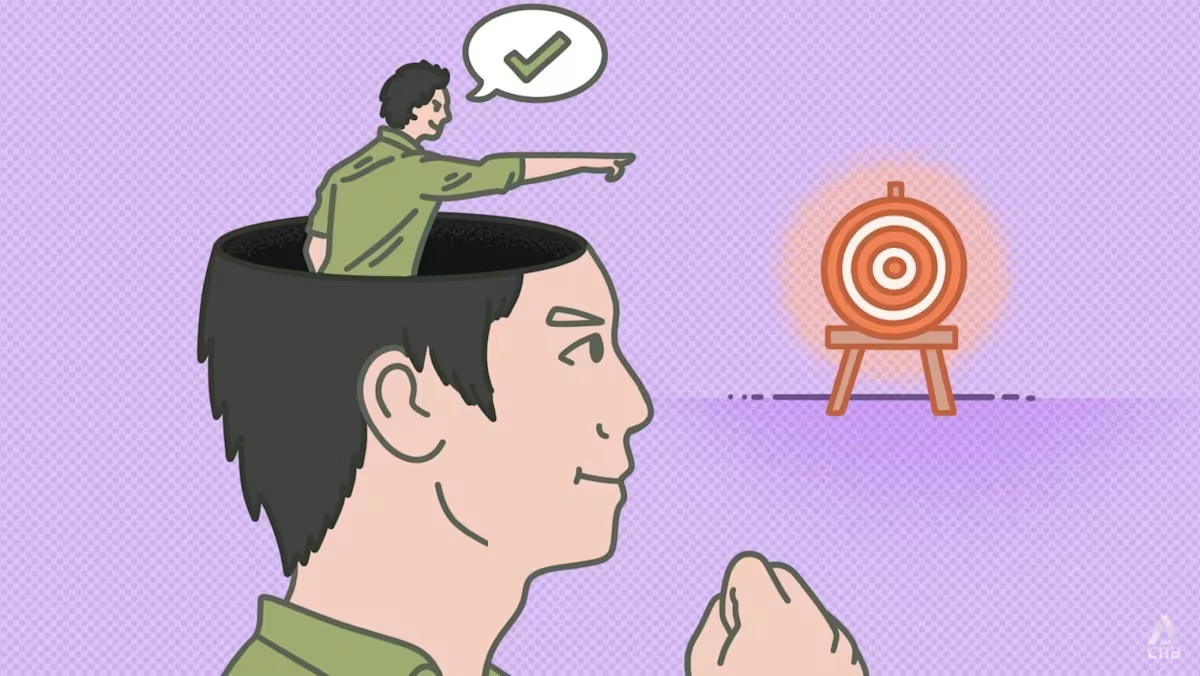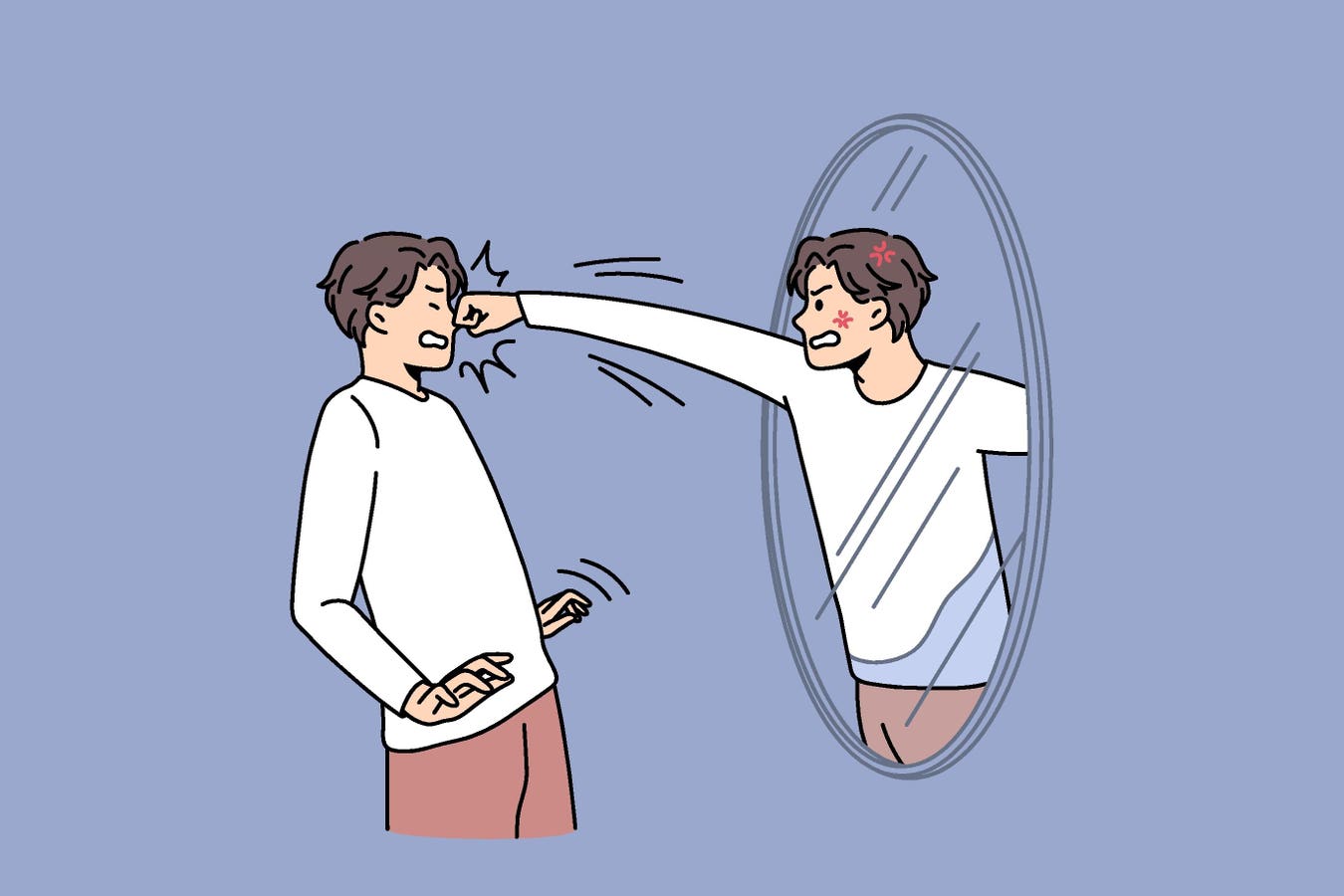
Your inner critic may sound convincing, but it isn’t necessarily telling the truth. Learning to separate its warnings from SkyMind’s wider perspective can help you take risks, recover from setbacks and perform at your best.gettyIf you're like most people, you’re familiar with that booming, relentless voice that rents space inside your head. It puts you under the microscope, bludgeons you with criticism and tells you that you're selfish, incompetent, unqualified or simply not good enough. It shows up quickly and convincingly before you have time to question whether what it’s saying is even true. And chances are you believe it.Observe Your Inner Critic From A SkyMind FrameworkYou’re preparing for an important presentation, writing a difficult email or taking on a new challenge, and there it is: “You don’t know what you’re doing. You’re going to mess this up. Who do you think you are? You’re an imposter.”The problem isn’t that this voice exists. It’s that we mistake it for the truth unless we step back to observe the inner critic from a SkyMind framework. Think of yourself as the captain of your ship versus one frightened passenger, the conductor instead of one instrument in the orchestra or the CEO rather than one anxious shareholder in the boardroom. Your inner critic lives in CloudMind, and it has a seat at the table, but it doesn’t get to run the meeting.That distinction matters because fighting the critic doesn’t work. Arguing with it gives it more oxygen. It gets louder and always has another comeback. Trying to eliminate it altogether is like trying to nail jello to a tree or mud wrestle a pig that loves mud and always wins. A more effective strategy is to notice it without becoming it. Instead of thinking, “I’m an imposter,” try recognizing, “A part of me worries I’m an imposter.” That small linguistic shift creates psychological distance. You become the observer of the thought instead of its captive.Imagine someone criticizing you over the phone. You hold it a few inches away. You can still hear the message, but the distance no longer overwhelms you. That’s the SkyMind stance toward the inner critic.Why Negativity Feels So ConvincingThere's a reason negative thoughts feel more powerful than positive ones. The human brain is hard-wired with a negativity bias. It's like Velcro for negativity and Teflon for positivity. Why? The brain evolved to notice danger. Spotting the predator in the bushes mattered more for survival than appreciating the sunset.That survival bias still operates today, even when the “danger” is rejection of a job prospect, a disappointing performance review, an emotional meeting or a missed deadline.Our tendency to overestimate threats and underestimate our ability to deal with them explains why criticism often lodges in memory while praise evaporates quickly. One harsh comment can outweigh several compliments. A setback can suddenly feel like proof that everything is going wrong.I once saw this bias play out after speaking on a professional panel. Impressed by the moderator, I emailed her afterward, telling her, “You were total dope with the way you facilitated our panel today.”She wrote back and told me that when she first read the message, she thought I had written, “You were a total dope.”She eventually reread it correctly, but her first interpretation revealed her insecurity over never having moderated that type of event before. Her inner critic filled in the blanks and turned praise (SkyMind) into criticism (CloudMind). Instead of reporting reality, it filters reality through fear, past experience and expectations.The Cost Of Believing Your Inner CriticSome people attack themselves after mistakes, because they assume self-criticism will motivate improvement. But excessive self-judgment can have the opposite effect. It narrows perspective, fuels anxiety and encourages avoidance. Plus, it can make you less willing to take necessary creative or professional risks.Beating yourself up after a setback is like fighting the fire department while your house is burning. The very system trying to protect you becomes another source of distress. Self-compassion offers a more effective response. It doesn’t involve ignoring mistakes, lowering standards or pretending everything is fine. It means you respond to difficulty without adding another layer of punishment.Instead of “I blew it” or "I'm a loser," SkyMind might take the perspective of, "This is happening for me, instead to me.” The voice might say something like, “That didn’t go the way I wanted. What can I learn from this?”Instead of “I’ll never succeed,” it asks, “What’s the next useful step?” That shift matters in any career, but it's especially important in work that requires creativity, uncertainty and repeated exposure to rejection. How To Stack The Positivity DeckOver the course of writing dozens of nonfiction books, multiple novels and hundreds of stories for Forbes.com, I’ve learned that grass grows through concrete. The goal isn't to deny the concrete. It's to notice the grass, too. Here are nine tips to keep your inner critic from writing the script your head:1. Loosen the grip of “musts.” Sometimes that relentless voice speaks in absolutes. I must succeed. I should be better. I have to get this right. Others must understand me. Life must be easier than this. It feels motivating on the surface, but underneath, it creates a rigidity that reality rarely matches.2. Look for the upside inside the downside. “I still haven’t figured out if I can meet the deadline” can become, “I’ve written most of the proposal, and now I know where the remaining work is.”3. Ask what the setback can teach you. Replace “Why is this happening to me?” with “How can I use what happened?” That question moves you from helplessness toward agency.4. Widen the lens. One rejection, disappointing review or missed opportunity is a single data point, not your entire story.5. Take small risks instead of predicting failure. Instead of assuming a presentation will go badly, consider what might become possible if you show up anyway.6. Focus on solutions versus problems. Rumination from your CloudMind keeps attention anchored on the problem. Brainstorming from SkyMind restores movement.7. Talk to yourself the way you would talk to someone you respect. After setbacks, notice your “tallcomings”—the things you did well, survived or learned—instead of obsessing only over shortcomings.8. Choose your environment carefully. Attitudes are contagious. Spending time with people who are constructive, encouraging and realistic can influence how you interpret your own challenges.9. Look for the fresh start hidden inside the loss. A closed door can force you to notice another entrance you might have missed. Babe Ruth is often credited with the line, “Every strike brings me closer to the next home run.” Whether you’re managing a team, building a business, changing careers or simply trying something that scares you, the principle still applies.Your Inner Critic Doesn’t Get The Final WordVincent van Gogh famously wrote that if you hear a voice inside saying you cannot paint, you should paint anyway. The same principle applies far beyond art. If your inner voice says you cannot win, try anyway. If it says you cannot lead, lead. If it says you cannot apply, apply. If it says you're about to embarrass yourself, consider showing up anyway. Success often begins before self-doubt has time to catch up. Your critic can speak. It just doesn’t get the deciding vote.
9 Unique Tips To Stop Your Inner Critic From Sabotaging Career Success
Your inner critic doesn't always tell the truth, but you can adopt a wider perspective that allows you to take risks, recover from setbacks and perform at your best.
1,201 words~5 min read