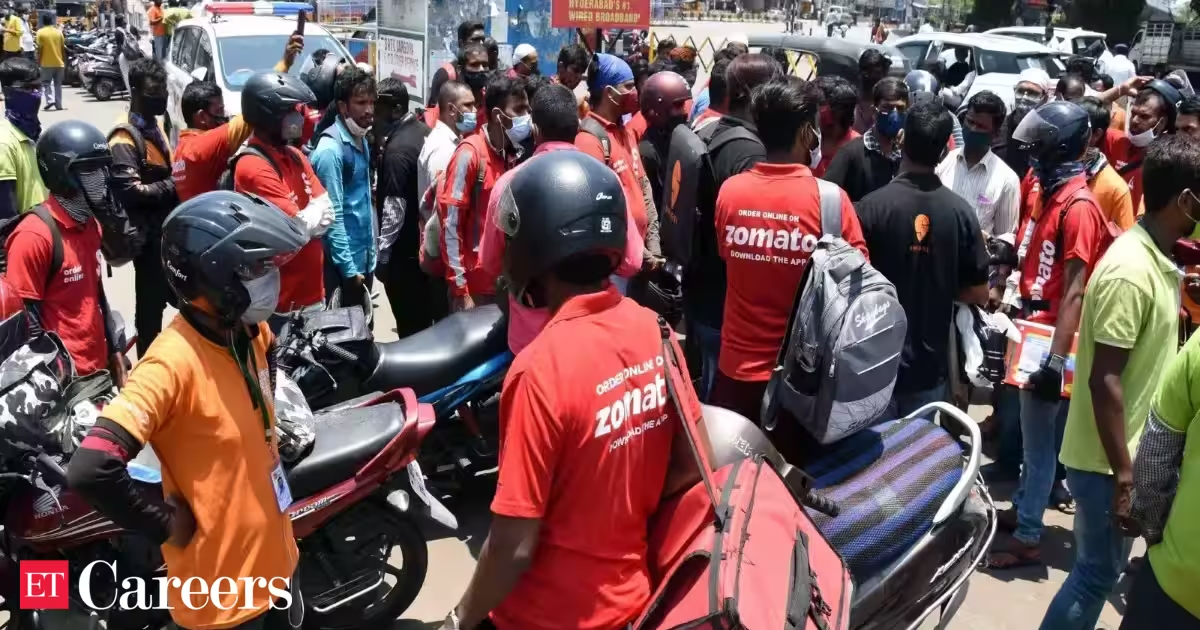
Temporary hiring across organised retail, ecommerce, quick commerce, logistics, FMCG and consumer durables is expected to grow 15-20% this festive season, according to TeamLease Services’ Festive Season Workforce Report 2026.Hiring, however, is shifting beyond volume recruitment towards specialised frontline roles as businesses prepare for a longer festive calendar, faster fulfilment expectations and increasingly omnichannel consumer journeys, according to a statement from the company.India’s festive consumption engine continues to gather pace. Festive ecommerce GMV crossed Rs 1.2 lakh crore last season, while quick commerce increased its share of festive spending to 12% from 8% a year earlier, reflecting consumers’ growing preference for instant fulfilment across electronics, beauty, fashion and gifting.As sale windows extend from Independence Day through Diwali and the year-end holiday season, employers are building workforces designed for sustained execution rather than short-term demand spikes.“The festive hiring season continues to evolve beyond volume hiring to precision hiring,” said Balasubramanian A, senior vice-president, TeamLease Services. “Employers are focusing equally on speed, productivity and customer experience, leading to increased demand for specialised operational roles.”“We expect temporary hiring to grow on similar lines to last year (15-20%), supported by strong demand from ecommerce, retail, logistics and quick commerce. Organisations are also investing more in incentives, digital onboarding and workforce readiness to ensure seamless execution during the festive period,” he said.TeamLease estimates frontline salaries could increase by 8-10% during the second half of 2026, although employees’ effective take-home pay may rise by 5-8% due to labour law changes. Median monthly CTC for frontline festive workers rose marginally to Rs 20,525 in the second half of 2025 from Rs 20,282 a year earlier, the report showed.Ecommerce, quick commerce and logistics continue to offer the highest average monthly compensation among frontline sectors.Geographically, hiring momentum is expected to remain strongest in south and west India, led by Bengaluru, Hyderabad, Chennai, Mumbai, Pune and Ahmedabad, while employers are expected to add workers across all regions.City-tier dynamics are also reshaping festive workforce deployment. TeamLease estimates that tier-1 metros will account for 40.5% of the frontline workforce in 2026, up from 38.2% in 2025 and 33.1% in 2024. Tier-2 cities are expected to account for 26.5%, while tier-3 markets will contribute 33%.The growing concentration in metros is being driven by the rapid scaling of ecommerce and quick-commerce networks, particularly dark stores and hyperlocal fulfilment infrastructure. Meanwhile, tier-2 and tier-3 markets continue to see absolute workforce growth, supported by expanding retail and logistics footprints.The report identifies warehouse pickers, packers and dark-store personnel as the largest hiring categories this festive season, followed by in-store promoters and specialists, retail associates, cashiers and store operations executives. Demand is also rising for newer operational roles such as inventory and fulfilment coordinators, warehouse automation operators and returns management executives, reflecting the increasing sophistication of India’s retail supply chains.To improve retention during peak demand, employers are increasingly deploying attendance bonuses, sale-event surge pay, referral incentives, productivity-linked rewards and digital learning programmes. The report also highlights paperless onboarding, pre-assessed talent pools and cross-functional training as key workforce strategies helping businesses shorten hiring cycles and improve deployment readiness.The report analysis is based on TeamLease’s internal workforce dataset, evaluating anonymised employment records of about 60,000 frontline associates deployed during the festive season across consumer durables, organised retail, ecommerce, quick commerce, logistics and FMCG.
Festive hiring set to rise 15-20% as frontline roles get more specialised
Temporary festive hiring is expected to grow15-20%across retail, ecommerce, quick commerce, logistics, FMCG and consumer durables, TeamLease said. Hiring is shifting towards specialised frontline roles. Ecommerce, quick commerce and logistics will see strong demand, while frontline salaries may rise8-10%in H2 2026. Tier-1 cities are expected to account for 40.5% of festive jobs.
543 words~2 min read