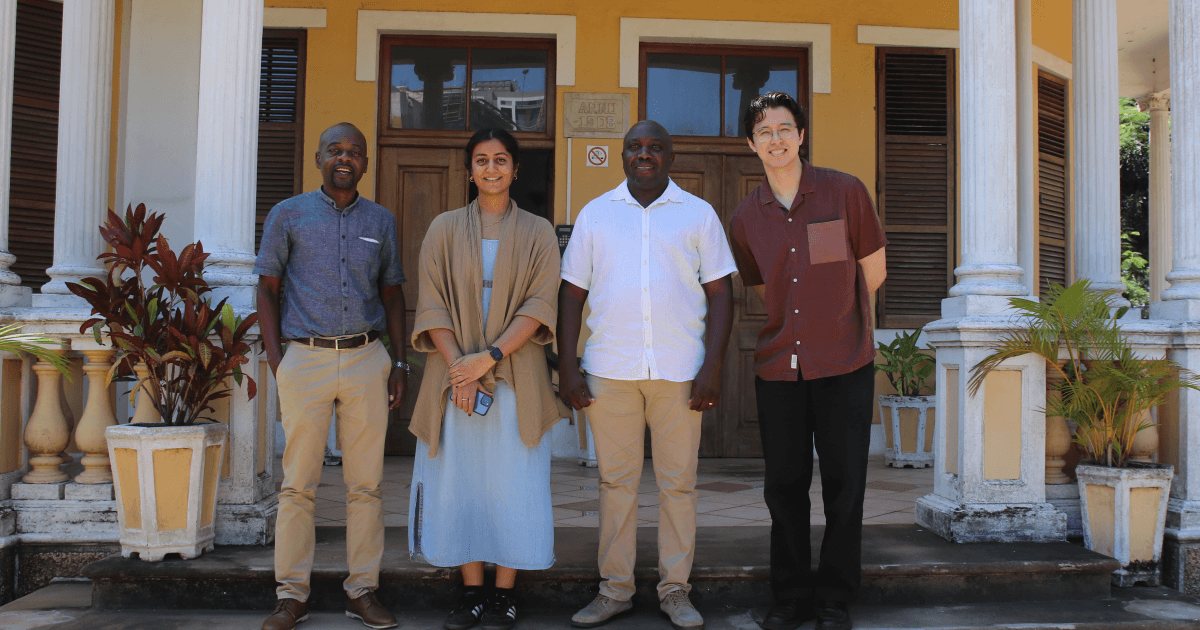
Mitul Iyengar and Luke Fiorante, MDE '26, with meteorologists at the National Institute of Meteorology in Mozambique
More than 80 countries face chronic drought, yet only a third have systems in place to act before a drought arrives rather than after. The gap is costly. According to the United Nations Food and Agriculture Organization, every dollar invested in anticipatory action can save up to seven dollars in averted losses, while also helping protect lives and livelihoods before crisis conditions take hold. Acting early works. So why don't more countries do it?That question was at the core of Mitul Iyengar and Luke Fiorante’s Master in Design Engineering (MDE) thesis. The MDE program, a joint degree between the Harvard John A. Paulson School of Engineering and Applied Sciences (SEAS) and the Harvard Graduate School of Design, trains its students to diagnose a problem before solving it – to identify, in a tangle of technology, institutions and incentives, the real bottleneck, and then build a solution. For Iyengar and Fiorante, MDE ‘26, that meant traveling to Mozambique, home to one of the most institutionally developed government-led drought anticipatory action systems in the world. What they found helped them reframe the problem of drought preparedness entirely.