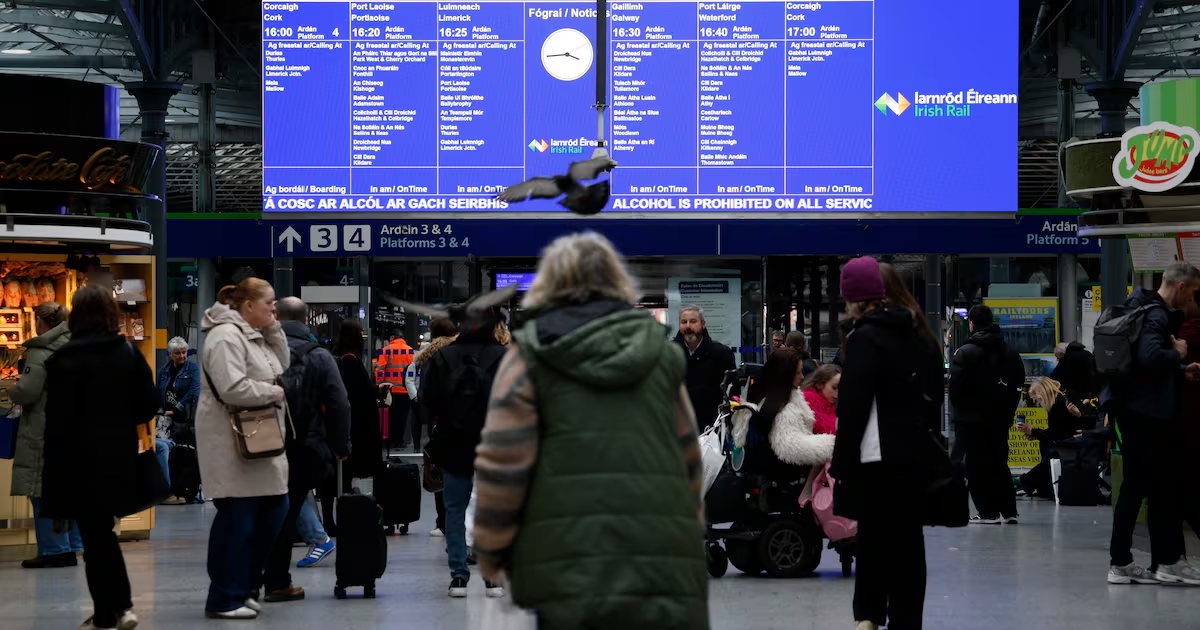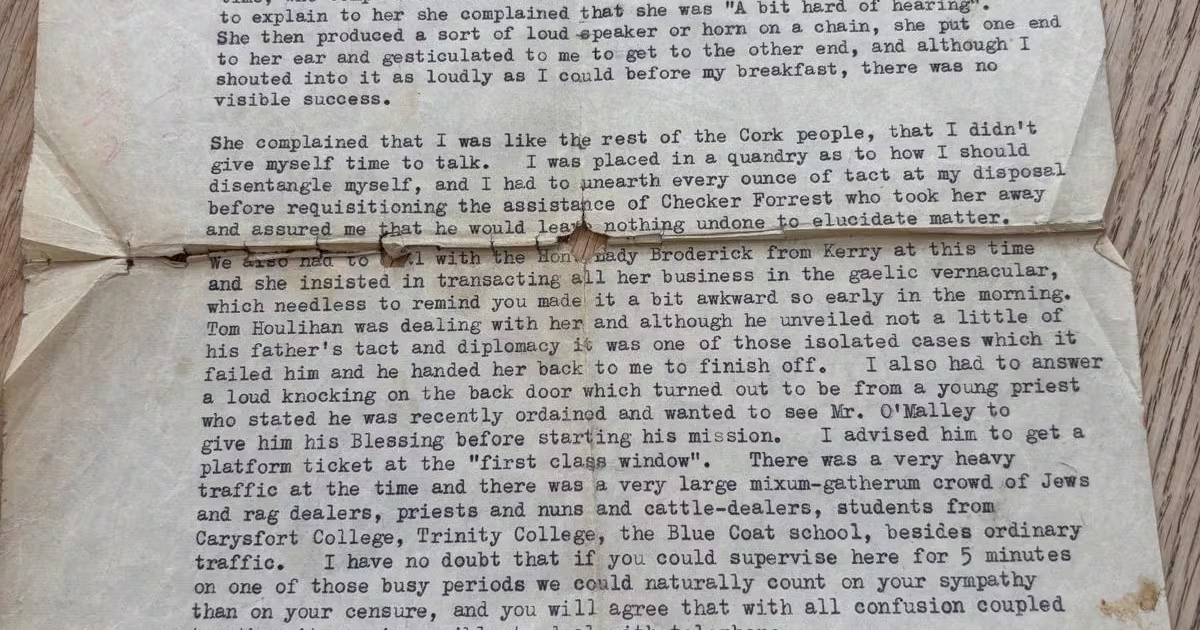
How many of us would like to see Dublin’s busy Heuston Station revert to those gentler times in the 1940s when it was still known as Kingsbridge and customer service consisted of a staffed cloakroom equipped with a telephone?A letter drafted in response to a complaint, dated August 25, 1943, has come into my possession from the CIÉ archives which gives a fascinating insight into the pressured life of a Cork man working in the Kingsbridge cloakroom that Wednesday morning. It was composed just a few months after a famous speech by the Taoiseach Éamon de Valera which conjured up an Ireland of fields, villages, comely maidens and cosy homesteads but neglected to mention our many railway stations which were the lifeblood of the country, especially during the so-called Emergency.These vital nodes of transport were in the hands of unsung heroes such as D O’Donoghue, who on that day made clear to his correspondent that his failure some days earlier to pick up the cloakroom telephone in Kingsbridge was due to the unceasing demand for his services on that particular morning. In those halcyon days before the advent of FAQs and automatic answering services, O’Donoghue – who was either conscience-stricken or duty-bound – took some pains to explain why he could not answer the telephone on that busy morning. Not only was “the time in question one of our busiest periods”, he writes, but there was a pilot engine blowing off steam in front of the cloakroom door and he “had almost to embrace passengers to hear what they were saying”.There was also “an old lady from Co. Clare, about this particular time, who complained that she had lost everything she had” and was somewhat deaf. He wrote that the lady “produced a sort of loud speaker or horn on a chain, she put one end to her ear and gesticulated to me to get to the other end, and although I shouted into it as loudly as I could before my breakfast, there was no visible success”.She complained that he was like “the rest of the Cork people, that I didn’t give myself time to talk”. He continued: “I was placed in a quandry (sic) as to how I should disentangle myself . . . before requisitioning the assistance of Checker Forrest who took her away and assured me that he would leave nothing undone to elucidate matter."Any thoughts that this document might be a wind-up were dispelled by the appearance in it of the formidable figure of the Honourable Lady Albinia Brodrick, the sister of the staunchly unionist Earl of Midleton, who turned her back on a life of wealth and Anglo-Irish privilege to live in Kerry and become a public health nurse, IRA sympathiser, anti-Treaty republican and Irish Nurses Organisation chairperson.A resident of Sneem where she played the Church of Ireland organ on Sundays and a regular commuter on the Great Southern Railways line between Tralee and Kingsbridge, Lady Brodrick took the name Gobnait Ní Bhruadair and spoke fluent Irish with an upper-class English accent.She insisted on communicating with Mr O’Donoghue “in the Gaelic vernacular which needless to remind you made it a bit awkward so early in the morning”.He could not have been more flustered if she had asked him: “Have your bowels moved today?” Famously, that was often the first question she put to her patients in Kerry when she was an active nurse there. At the age of 81, she was more likely asking about any possible delay in the departure of the morning train for Tralee given wartime efforts to save coal and reduce services on the Kingsbridge-Mallow-Killarney-Tralee line.We may never know what was on her mind that morning as we are simply told: “Tom Houlihan was dealing with her and although he unveiled not a little of his father’s tact and diplomacy it was one of those isolated cases which it failed him and he handed her back to me to finish off.”O’Donoghue then tells of a loud knocking on the back door of the cloakroom which turned out to be a newly ordained priest who wanted “to see Mr O’Malley to give him his Blessing before starting his mission”. Of this, he added: “I advised him to get a platform ticket at the first class window.”As if all these demands were not enough, he had to attend to “a very large mixum-gatherum crowd of Jews and rag dealers, priests and nuns and cattle dealers, students from Carysfort College, Trinity College, the Blue Coat school, besides ordinary traffic”.He assures his correspondent that “if you could supervise here for 5 minutes on one of these busy periods we could naturally count on your sympathy than on your censure, and you will agree that with all confusion coupled together it was impossible to deal with telephone (sic)”.A further apology is offered for the actual delay in responding to the complaint but at no point does he take the option of pointing out that there’s a war on.
1943 apology letter a stunning glimpse into the chaos faced by Irish railway workers
Irate passengers and an unexpected demand that he converse in Irish prevented D O’Donoghue from answering the phone that day
833 words~4 min read