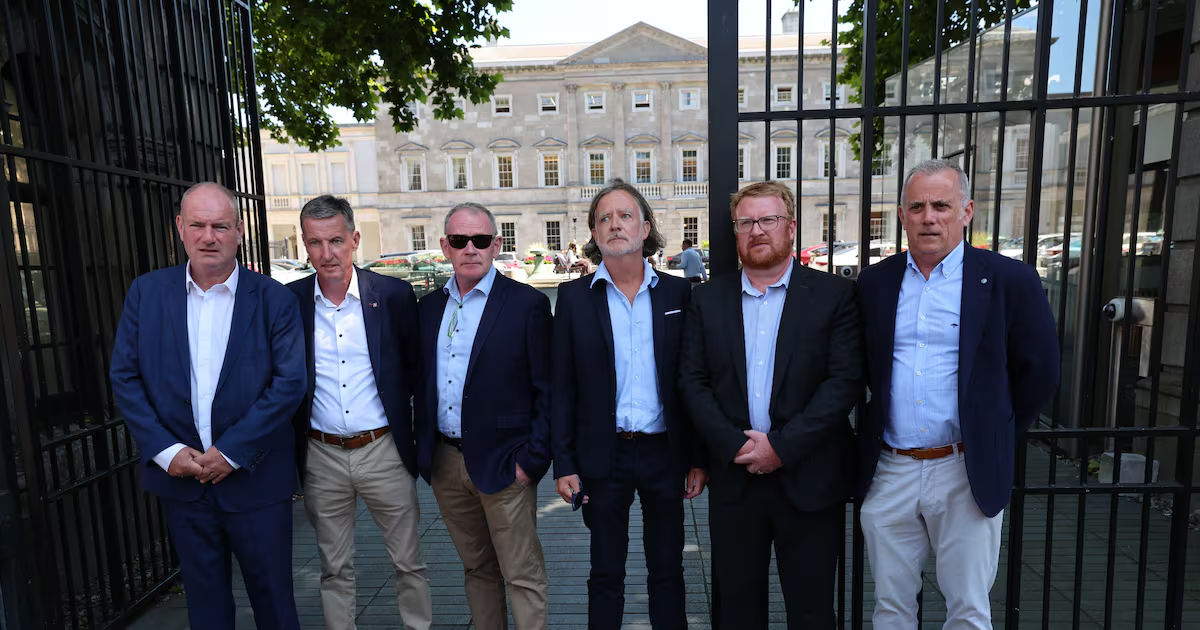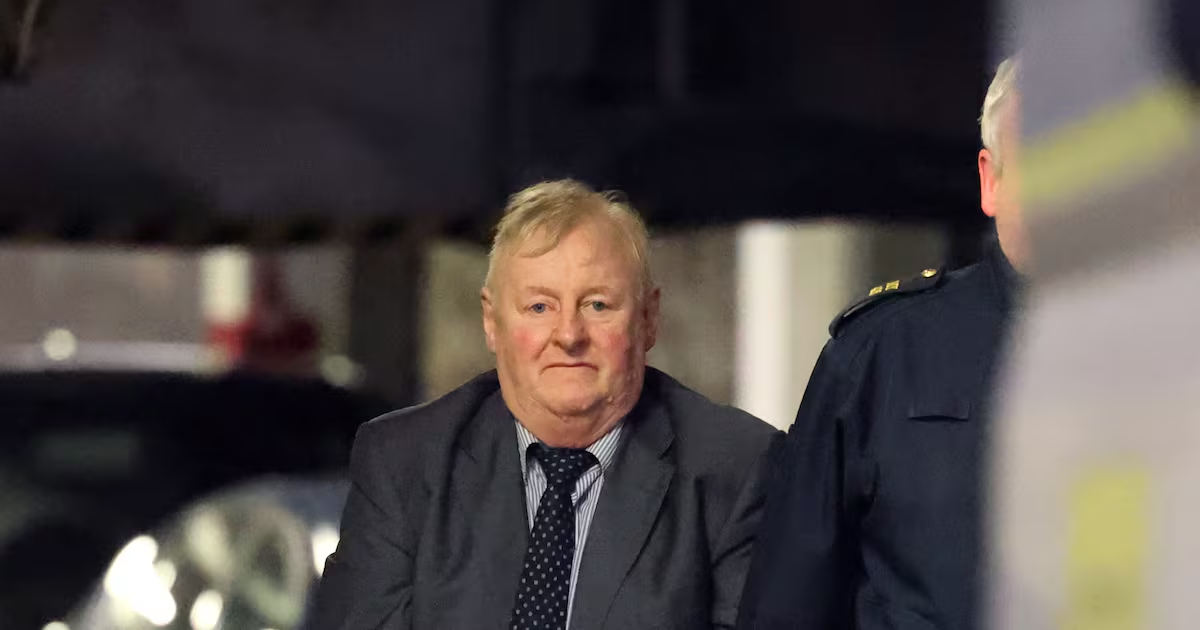
Sir, – Last Tuesday, with advance public notice of the event, and great solemnity, Taoiseach Micheál Martin issued a formal State apology to the Waterford men who suffered appalling abuse at the hands of paedophile Bill Kenneally 40 years ago.The Taoiseach added the ritual rider that “we must also ensure that it can never happen again”.Well, “it” was happening again while the Taoiseach and politicians of all parties were on their feet in the Dáil, adding their words of condemnation and apology and extolling the bravery of the men. There are two traumas suffered in this and other numerous cases: the original crime and the subsequent stonewalling by public servants, over decades in some cases, in frustrating victims’ search for truth and justice, and ignoring their cries to be heard. In 2015, Louise O’Keeffe, after an 11-year legal battle with the State, won her case in the European Court of Human Rights over the abuse she suffered at the hands of school principal Leo Hickey in the 1960s and 1970s. But still, today, 19 women who suffered the same abuse, by the same man, at the same time, are still fighting for redress against the inertia, incompetence and misguided understanding of their responsibilities among public servants holding positions of trust in various State institutions. There are several other ongoing cases where the bottomless pockets of the State and the virtual anonymity of officials are testing the bravery and financial resources of victims and whistleblowers. We will never know how many people with a just cause give up, exhausted and financially drained, like the whistleblowers who exposed the horrific abuse of the young woman we know as “Grace”.Behaviour is a function of consequences so, unless there are consequential sanctions applied to the public servants who put Kenneally’s victims through the wringer for 40 years as they campaigned for truth and justice, “it” will happen again and again, constituting a deep flaw in our Republic.An hour after finishing the above paragraphs of my letter to The Irish Times, I was stopped in my tracks by the report on RTÉ into how institutions of the State (meaning individual public servants) covered up the sexual abuse of hundreds of boys in Our Lady of Lourdes Hospital in Drogheda by Dr Michael Shine.A State apology and financial redress are not enough. – Yours, etc,EDDIE MOLLOY,Rathgar,Dublin 6.Exempted developmentSir, – Exempted developments, which do not require planning permission, have existed for more than 20 years. The Government, in line with what has now become customary practice, decided to guillotine a number of Bills going through the Dáil and Seanad in advance of the summer recess.Exempted (Planning) Development Regulations to ease planning requirements in certain circumstances was also pursued through both Houses of the Oireachtas this week.This, despite Senators and TDs charged with the responsibility to consider and approve the Exempted Development Regulations not being furnished with any of the 900 submissions to the official public consultation for their consideration. Senators and TDs were, therefore, unable to assess whether Government policy around these regulations aligns with what is in the consultation. In a democracy, it is important that the views of the public are taken into account. For public consultations to be meaningful and not meaningless, politicians in Leinster House must have access to the full content of submissions so we can make informed decisions based on all stakeholders’ views and experiences. – Yours, etc, SENATOR VICTOR BOYHAN, Leinster House, Kildare Street,Dublin 2.Ten reasons to enjoy weatherSir, – Ten reasons why I’m enjoying our super Irish summer:1) It’s a great conversation starter.2) Eating far too many 99s. (For medicinal purposes only, of course.)3) It’s not just a phrase to entice you in; the sea actually does feel like soup.4) Opera in Griffith Park.5) Not envying those holidaying abroad.6) Hydration breaks. 7) Seeing nothing but sun on the Met Éireann app.8) The wash is dry in hours.9) Sleeping naked with the windows open.10) Oversharing, because that’s what you do when you’re happy. – Yours, etc,HUGH McDONNELL,Glasnevin, Dublin 9.Chat flows swimminglySir, – The recent spell of good weather has encouraged me to go swimming in the Forty Foot in Sandycove. Besides the benefits of a salt water dip, it’s refreshing to report that there’s no shortage of conversation to be had. Regardless of age or gender, there’s a constant flow of conversation between people. Whether it’s about the weather, the tides or the temperature of the water, there’s a great buzz of chatter everywhere. – Yours, etc,FERGUS MADDEN,Goatstown,Dublin.Water and wildlifeSir, – Given the prolonged and widespread hot and dry weather, could I suggest we give the wonderful wildlife with whom we share our gardens a helping hand, by putting out a shallow dish of water each day? In my garden I have many birds both drinking the water provided and bathing in it. The fox takes a drink too at night time.I also have a pair of blackbirds who are feeding nestlings and the halved apples I put out provide them with food, while mealworms soaked in warm water are excellent food for their chicks.The ground in my garden is extremely dry and hard, and I suspect that birds and other wildlife may be under some pressure to find enough water and food. Remember how much the song of the blackbird was appreciated during the Covid pandemic? This is a chance to show that we haven’t forgotten. – Yours, etc.KATHERINE QUIRKE,Dún Laoghaire,Co Dublin.US and Iran conflictSir, – Having read Vincent Durac’s excellent article (“Despite the bluster, the US and Iran want the war over”, Opinion, July 16th), I wonder how Ireland, which holds the presidency of the Council of the European Union, could help.Ireland could perhaps help by strongly and publicly promoting diplomacy over military escalation. Rather than suggesting the seeking of a resolution of every issue at once, Ireland could use its role as an honest broker to convene negotiations, encourage dialogue and shape a consensus between Iran and the United States, and even engage in some form of “shuttle diplomacy” between them.No mean feat considering their respective history with each other, but still achievable at this stage.An immediate priority would be to clarify the unfortunately ambiguous terms of the ceasefire agreement, particularly around navigation through the Strait of Hormuz, reducing the risk of misunderstandings that could trigger further conflict.This is the crux of the current impasse. Iran and the US seem to feel they have agreed to something different. Clarifying this through the good offices of the EU could go a long way towards bringing about peace. Ireland could then advocate for an independent international mechanism to monitor maritime security and verify compliance with agreed measures, taking much of the heat out of the question of who operates such a mechanism or procedure.Ireland could also encourage the EU to link economic co-operation, reconstruction funding and trade incentives for Iran to measurable steps towards de-escalation. By focusing negotiations on shared interests – regional stability, secure trade routes, economic recovery and humanitarian concerns – rather than military confrontation, the EU could help create conditions where peace becomes the most beneficial option for all sides. Finally, Ireland could propose a multiphase approach to peace, beginning with confidence-building measures and technical agreements, allowing Iran and the US to save face – both are proud nations – while gradually building trust for a more comprehensive and lasting settlement. It is a far from intractable situation, but without diplomatic assistance this conflict could bubble along for years, costing many lives and damaging the global economy. – Yours, etc,LEO E SHARKEY,Bratislava,Slovakia.Not liking the likesSir, – I frequently send a text to thank somebody who has supplied me with a good service or sold me a product they recommended which suited my needs perfectly. Frequently, when I receive an acknowledgment, it quotes my text exactly, but starts with “Loved” or “Liked” followed my original text, word for word. What’s wrong with just using “Your comment is appreciated” or just “Many thanks for your thoughtful reply”? Is this just another custom creeping in to depersonalise communications, or perhaps we are just becoming robotic and edging towards automaton behaviour? – Yours, etc,BRENDA MORGAN,Howth, Co Dublin.Integrated educationSir, – Thirteen years ago I returned to Northern Ireland after much of my career in the Republic, encouraged by the progress of the peace process and the growth of integrated education. Today, 76 integrated schools educate almost 30,000 children and young people together every day, making integrated education one of the most significant and sustained reconciliation projects on this island.While this progress is welcome, the wider education system remains largely divided. Catholic-maintained schools have fewer than 2 per cent Protestant pupils, while controlled schools have fewer than 8 per cent Catholic pupils. Too many of our children are still educated separately. This is not a criticism of individual schools, all of which strive to provide an excellent education. However, Archbishop Robin Eames and Denis Bradley were surely right when they warned in 2009 that “reconciliation may never be achieved if our children continue to attend separated schools”. Integrated education offers a practical and proven way to address that challenge – not by erasing differences, but by embracing them and enabling young people to learn and grow together. – Yours, etc,RODERICK DOWNER,Co Down.Transport always an issueSir, – Adrian Conway draws our attention to the many altered and abandoned plans for the Dublin region in the past 30 years (Letters, July 16th). If any of those plans had been implemented, the transport system in the Greater Dublin Area would be in a much better place than it now is.Conway does not refer to the proposed Swords-city centre Bus Connects, which was announced in 2019, but there is as yet no indication as to when work will commence on this project – or will it too be abandoned in favour of a Metro North which may never be built? As the city becomes more congested, it is time not only for clarification of these matters but for shovels in the ground. – Yours, etc,LOUIS O’FLAHERTY,Santry,Dublin 9.Septic tank misconceptionsSir, – Permit me to correct a misconception which is oft repeated in your Letters page and so far has gone unchallenged.The misconception is that septic tanks cause significant pollution of our rivers and lakes. There are two million homes in Ireland, give or take (cso.ie 2022 Census). There are about half a million septic tanks in Ireland (epa.ie). A good estimate is that a quarter of our people use septic tanks.The website, catchments.ie, is a collaboration between the Department of Housing, Local Government and Heritage, the EPA and the Local Authority Waters Programme.According to catchments.ie, the biggest challenges to the water quality of our rivers and lakes continue to be: 1) Excess nutrients from agriculture.2) Excess nutrients from urban wastewater.3) Damage to the physical habitat due to land and river drainage, forestry and urban development.Notably absent from this list are industry and domestic septic tanks.If the level of pollution caused by industry and by domestic septic tanks was significant, they would have been included in the list. I hope this brings some clarity to the issue. – Yours, etc,J J POWER, BEng Hons Civil,Former chair of the Eastern River Basin District Advisory Council,Co Kildare.
Letters to the Editor, July 20th: on public servants taking responsibility, exempted development and ten reasons to enjoy the good weather
A State apology and financial redress are not enough
1,867 words~8 min read