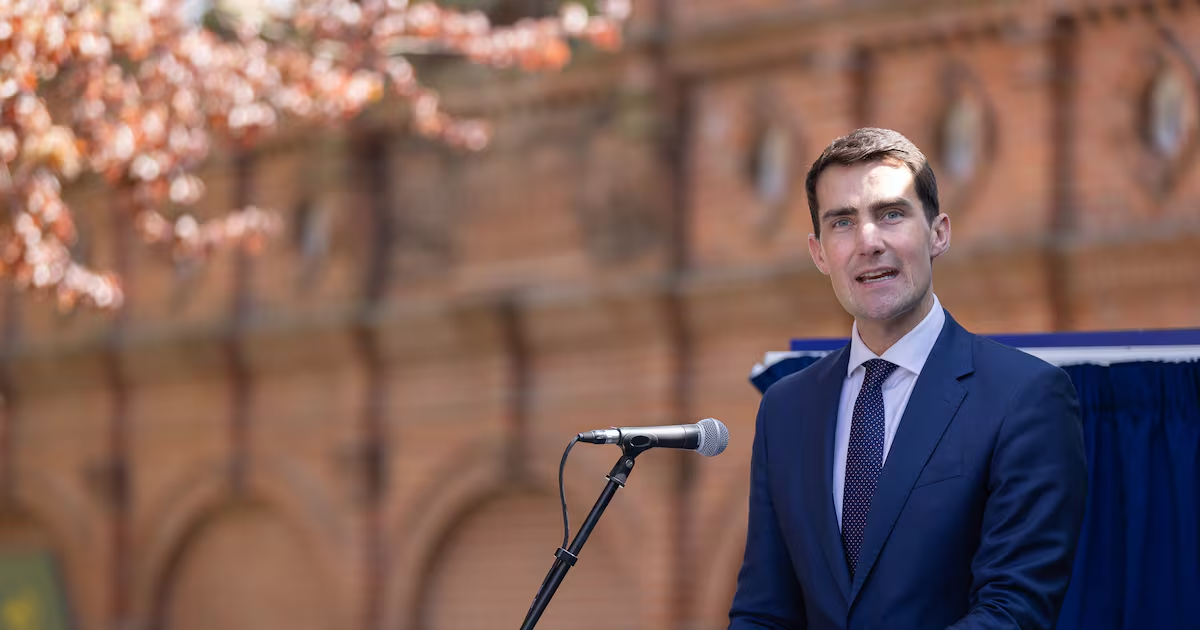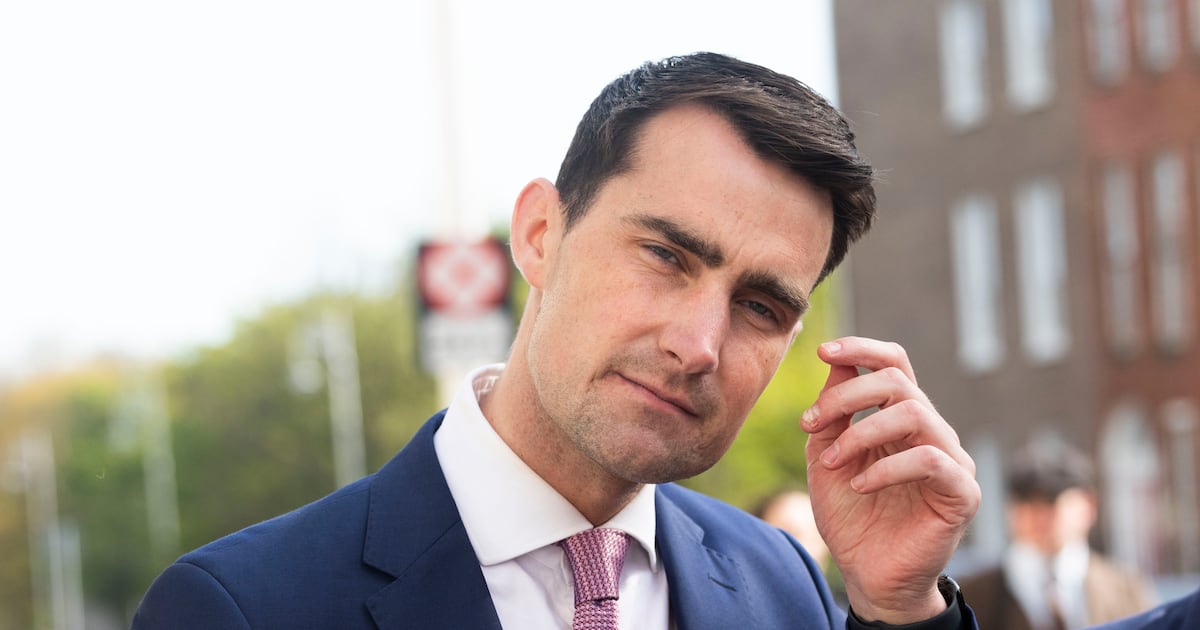
Sir, – You report Minister Jack Chambers as rebuking public servants over their “risk aversion”. (“Government to urge public servants to take more risks for infrastructure”, Business This Week, May 15th).The Minister has made similar public statements over the past 12 months, and the occasion this time was his address at the conference of the Association of Consulting Engineers of Ireland.As Minister for Public Expenditure and Reform, Mr Chambers is a member, along with the Taoiseach, the Tánaiste and a couple of Secretaries General, of an entity called the Accountability Board, which we are to believe carries out performance reviews of senior public servants.If the Minister has any concerns about the performance of public servants, the place to express them is in the context of a face-to-face, grown-up performance review, and not from the safety of a conference platform. He needs to take the personal risk of confronting poor performance, of which there are countless examples of serious failings across the public service, which are passed over without any consequences arising.But, of course, that would upset the cosy pact described by former Labour Party leader Pat Rabbitte at the Burren Law School 15 years ago as: “The system of accountability we pretend to have is grounded in a lie.It enables civil servants to hide behind the skirts of ministers and for ministers to avoid responsibility. And if questions are asked as to who actually decided what, when and why, the corporate veil would descend upon the entire department.”As the Minister responsible for Public Service Reform, nothing will disturb this implicit understanding between ministers and officials, unless Chambers takes the risk of leading the way in holding public servants to account, that is with consequences arising. – Yours, etc,EDDIE MOLLOY,Rathgar, Dublin 6.Funding local governmentSir, – I welcome the observations expressed by Minister for Higher Education James Lawless complaining that “some departments are bound by national agreements but are given no extra resources to fund them”. (“Chambers faces ministerial backlash over his plans to tighten spending,” May 13th)Welcome to the continued workings of local government, Minister, as imposed by this and previous governments.Nearly uniquely, local government is obliged to implement all national agreements despite having no voice at the negotiating table. It is told to implement all such agreements without any consequential funding.Such agreements often include additional side sections on housing and other social services that local government is instructed to deliver with no requirement on the negotiating parties to fund. It is long past time that local government be directly involved in any such future agreement discussions. For clarity I do not accept at all that the civil servants from the Department of Housing represent the local government sector. They never have. – Yours, etc,COUNCILLOR DERMOT LACEY,Donnybrook,Dublin.Fianna Fáil and womenSir, – I refer to Justine Mc Carthy’s article (“Fianna Fáil is a white man’s party,” May 15th) where she says: “The Ireland that has moved on from a lot of white men will be unenthused as we watch Jack and Jim climb up the hill.” I would add “Jill comes tumbling after,” spilling an already overfilled pail of water in the form of onerous family duties. No wonder most poor Jills spill and keep spilling the water as they juggle two jobs, work and home, too busy to countenance a career in politics or anything else for that matter. Having two Fianna Fáil Ministers, Norma Foley and Mary Butler is not sufficient to overcome the adage you can’t be what you can’t see. It’s 2026 for goodness sake, to repeat Justine McCarthy. Why are women not being identified at an early stage to develop in Fianna Fáil to prepare them to run in elections? If radical change is needed in Ireland, it needs to start with women being as successful as men in government and every facet of society. This requires support by both men and women. – Yours, etc,CARMEL WHITE,Castleknock,Dublin.Psychosis and psychoeducationSir, – Among mental health conditions, psychosis (most commonly linked to diagnoses such as schizophrenia and bipolar disorders) presents some of the most complex and long-term challenges for individuals, families and society. While recovery is possible, it can be a slow and arduous process. Public policy in mental health, as outlined in the Department of Health’s 2020 document Sharing the Vision, emphasises the importance of collaboration with service users and their families in the design and delivery of personalised recovery care plans. To make this vision a reality, service users and their families need information and peer support, which are essential to gain an understanding and integration of their experiences, to overcome stigma and to engage confidently with community mental health teams in developing effective pathways to recovery.Group psychoeducation programmes offer a proven way to provide this much needed information and peer support. By bringing together service users, families and mental health professionals, these programmes foster shared understanding and empowerment and are strongly recommended by the World Health Organisation as core components of care for people with experience of psychosis and their families. It is therefore difficult to understand why, having initially supported the development and national roll-out of comprehensive, evidence-based and recovery-focused psychoeducation (the EOLAS Programmes) from 2010, the HSE withdrew support from the national delivery of psychoeducation in 2019. A recent 2025 survey of psychiatrists in Ireland, commissioned by a mental health advocacy group (the Psychosis Education Network) and facilitated by the College of Psychiatrists of Ireland, highlights the consequences. In most areas of the country, service users and family members still lack access to comprehensive, evidence-based psychoeducation. Programmes such as EOLAS are available in only a small number of areas through the efforts of local mental health teams, resulting in a “post-code lottery” for service users and families. Psychiatrists responding to the survey are strongly convinced that psychoeducation is helpful to recovery and express support for the relaunch of programmes such as EOLAS around the country. It is well past time that the HSE took meaningful action to address this gap in provision. The evidence is clear, the professional consensus is strong and the need is urgent. Now is the time to move beyond rhetoric and deliver the comprehensive psychoeducation that people who experience psychosis and their families deserve. – Yours, etc,Dr PATRICK GIBBONS,Chairperson, Psychosis Education Network.Co Wicklow.Fixated on BritainSir, – Throughout last week, Irish news outlets have consistently placed stories such as the ongoing internal machinations of the British Labour Party at the top of their agendas. I want to remind them that plenty is happening in our own country that deserves serious attention and comment, and we shouldn’t keep prioritising coverage of political developments on the mainland. – Yours, etc,HOWARD WELCH,Raphoe,Co Donegal.Voting transfersSir –“ It’s highly probable that this race will come down to transfers” (“Dublin Central byelection”, May 15th). Don’t they all? – Yours, etc,LOMAN Ó LOINGSIGH,Dublin 24.Give me your credit cardSir, – In light of the current controversy surrounding the amount of credit card fraud, email fraud, message fraud, and all other kinds of fraud, people go to great lengths to protect themselves from all these unwelcome attempts to relieve them of their hard-earned cash. But isn’t it amazing that in spite of all the precautions taken,we will willingly volunteer our credit card number, expiry date, and three numbers security code to the local takeaway when placing an order for delivery, and wishing to pay by card. – Yours, etc,PAUL O BEIRNE,Beaumont, Dublin 9.Keeping receiptsSir, – From now until July 1st, I am keeping all receipts for meals in restaurants and stays in hotels and will compare the payments to those after July to ensure that there is a 4.5 per cent reduction, to reflect that ridiculous Vat reduction which will cost the taxpayer ¤750 million in a full year. I am the ultimate consumer, who pays the VAT, and consequently the person who must benefit by the reduction and if I do not see the reduction from any particular establishment, I shall refer the matter to Revenue. I urge other readers to follow suit. – Yours, etc,TIM BRACKEN,Cork.Tackling dog foulingSir, – In response to Thomas G Cotter’s letter (May 15th) comparing the productivity of traffic wardens and dog wardens, there is a key difference: illegally parked cars are easy to spot and remain in place, while dog fouling is quick, hidden, and rarely witnessed. This makes enforcement far more challenging, regardless of how willing or able dog wardens may be. Dog fouling often occurs when no one is watching, and both the owners and the dogs are constantly on the move.While increasing fines may deter some, enforcement is not simply a matter of numbers; it’s about the practical realities and limitations of catching offenders.Public awareness campaigns also play a part –such as the UK’s “Bag it and bin it!” and Cork’s more recent “Get Your Sh**t Together” initiative, which has certainly attracted attention.No single approach will suit every owner or every situation. What’s really needed is a combination: for example, high-visibility patrols in problem areas, more bins, free dog litter bags in popular walking spots, straightforward ways for people to flag problem areas, and more dedicated dog parks. Keeping the community informed helps too. With a bit of civic pride, a combination of practical steps and enforcement should go a long way. – Yours, etc,BARBARA CLANCY,Stillorgan, Co Dublin. A lightbulb momentSir, – Why has life become so complicated? Once when replacing a light bulb all one need think about is whether it was 40W, 60W or 100W and a choice of clouded or clear. Now there are so many different permutations of types and fittings that it is a minefield with probably many visits to different shops to find the right one. I’m moidered but I suppose I’ve little to worry about. – Yours etc, MARY O’DWYER,Terenure, Dublin 6W.Doctors and trainingSir, – The United Kingdom’s recent decision to prioritise domestically trained doctors for specialty training should prompt serious discussion in Ireland about the direction of our own medical workforce policy.The UK Government has openly acknowledged what many doctors have been warning about for years: a healthcare system can become so dependent on international recruitment that its own graduates begin to lose realistic access to career progression. Following the lifting of visa restrictions in 2020, applications for UK specialty training reportedly increased dramatically, while growing numbers of UK-trained doctors found themselves unable to secure training posts.Britain’s response has been politically significant. New legislation proposes prioritisation for UK and Irish graduates, together with those who already possess substantial NHS experience. The reasoning is straightforward: the taxpayer funds medical education, and no country can sustainably invest enormous public resources into training doctors only to deny many of them progression into specialist careers.Ireland now faces many of the same pressures.Over the past decade, the HSE has become increasingly dependent on international medical graduates to sustain hospital staffing. Many overseas-trained doctors provide excellent care and have become an essential part of the Irish health service. However, concern is growing among Irish graduates and trainees that access to higher specialist training is becoming progressively more competitive in a system where consultant expansion and training numbers have failed to keep pace with demand.Historically, Irish and EU graduates enjoyed a strong practical advantage in accessing structured training pathways. While there may never have been an explicit legal reservation of training places, there was a widespread expectation that Irish-trained doctors would have a realistic pathway to consultant level within the country that educated them.That expectation is now being questioned.Policy changes introduced in recent years mean that non-EU doctors who obtain Stamp 4 residency status are now treated equivalently to EU/EEA applicants for many specialist training competitions. Many of these doctors are highly experienced and make an invaluable contribution to Irish healthcare.Nevertheless, the overall effect has been to intensify competition for a limited number of specialist training places available to Irish graduates.This is not an argument against international doctors. Ireland unquestionably benefits from international talent and would struggle without it.Rather, it is an argument for balance and long-term workforce planning.The Irish State heavily subsidises medical education. If increasing numbers of Irish graduates repeatedly fail to progress into specialist training, the consequences are obvious: emigration rises, morale declines, shortages worsen, and dependence on overseas recruitment deepens further.The question Ireland now needs to ask is not whether international recruitment should continue. Clearly, it must.The real question is whether Ireland can continue indefinitely with a model in which the doctors it trains increasingly feel uncertain about their future within the healthcare system.RODERICK TYRRELL,Solicitor (retired),MSc Healthcare Ethics & Law,Dublin 4.Nuclear powerSir, – Sineád Mercier suggests that advocates of nuclear power in Ireland has become the fuel of choice for the far right, and goes on to say that it has been well established that we do not need it (Letters, May 12th).Nuclear power has been widely used in the US, Canada, France, Japan, UK to mention a few countries, for the past seventy years, could these countries be termed as far right?It is a clean efficient method of generating electricity, the technology has advanced in leaps and bounds, and mini reactors can be installed in a fraction of time that it previously took to plan and construct nuclear power stations. If we are not be left behind we must have the debate on all forms of power generation, whether it is solar, wind, nuclear or other options, we have to open our minds to all possibilities. – Yours, etc,JVCARROLL, CEng,Rathfarnham,Dublin 14.
Letters to the Editor, May 18th: On Ministers, public servants and accountability, Fianna Fáil and women and a lightbulb moment
Chambers needs to take the personal risk of confronting poor performance,
2,236 words~10 min read