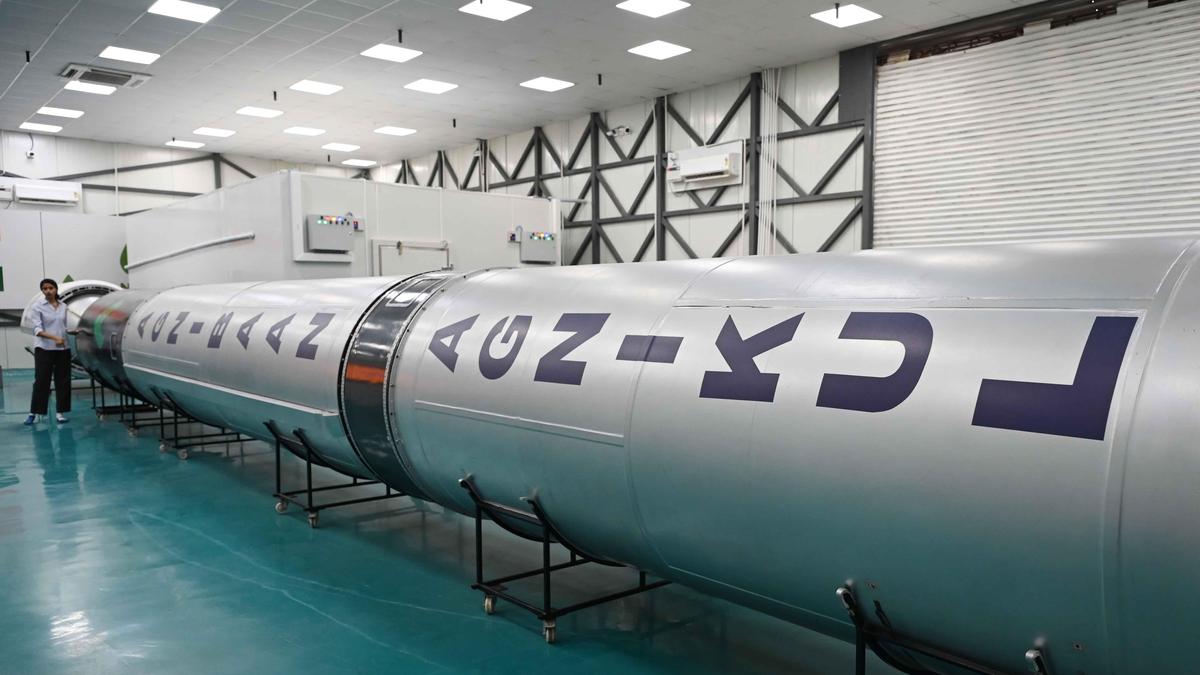
Agnikul is developing an integrated approach spanning design, manufacturing, testing and flight
| Photo Credit:
India’s private space sector is entering a new phase, with startups shifting focus from proving launch and satellite technologies to building the infrastructure, manufacturing capabilities and downstream applications needed to support a sustained commercial space economy.The shift is being driven by companies expanding beyond individual products to develop more integrated capabilities across propulsion, spacecraft manufacturing, testing and data applications.“India’s private space sector is entering a clear second phase,” said Moin SPM, Co-founder and COO, Agnikul Cosmos. “Over the next 2-3 years, expect the ecosystem’s focus to shift from proving flight capability to building what a launch enables afterward.”Reduced TimeAgnikul is developing an integrated approach spanning design, manufacturing, testing and flight. The company said its in-house manufacturing capabilities have brought engine production time down to about seven days, a 90-97 per cent reduction compared with traditional assembly. It has also said its full-stack approach has reduced the cost of building for space by roughly 50-60 per cent.The company is also working towards booster-stage recovery and an upper-stage architecture that can remain useful in orbit, as private launch companies look to improve the economics of space missions.According to Moin, the next wave of investment is likely to target areas where a single capability can serve multiple purposes. “Propulsion and orbital computing will likely see the strongest investment since better propulsion enables higher cadence, and orbital computing gives every launch a secondary revenue stream,” he said.Scaling PhaseThe expansion, however, is not limited to launch infrastructure. Earth observation and other downstream applications are expected to become an increasingly important part of the ecosystem as demand from sectors such as defence, disaster management and infrastructure monitoring grows.“The next phase will be about scaling manufacturing, strengthening supply chains, developing supporting infrastructure and, importantly, building more capabilities in-house,” said Suyash Singh, Co-founder and CEO, GalaxEye.GalaxEye is developing its proprietary OptoSAR technology and has been building spacecraft and systems capabilities, with its Mission Drishti demonstrating the technology.Customer DemandIndustry players, however, point to gaps in advanced manufacturing, specialised supply chains, testing and qualification infrastructure, skilled talent and patient capital. These constraints could become more significant as companies move from technology development to higher-volume production.The shift is also changing the economics of the sector. While launch and propulsion companies will require higher launch cadence to improve unit economics, downstream businesses will depend on recurring customer demand.“The economics of the sector will increasingly be driven by scale, reliability and sustained customer demand,” Singh said.The next two to three years could therefore see India’s private space ecosystem evolve from a collection of launch and satellite startups into a broader commercial stack spanning propulsion, manufacturing, launch infrastructure, satellite operations and space-enabled applications.Published on August 10, 2026