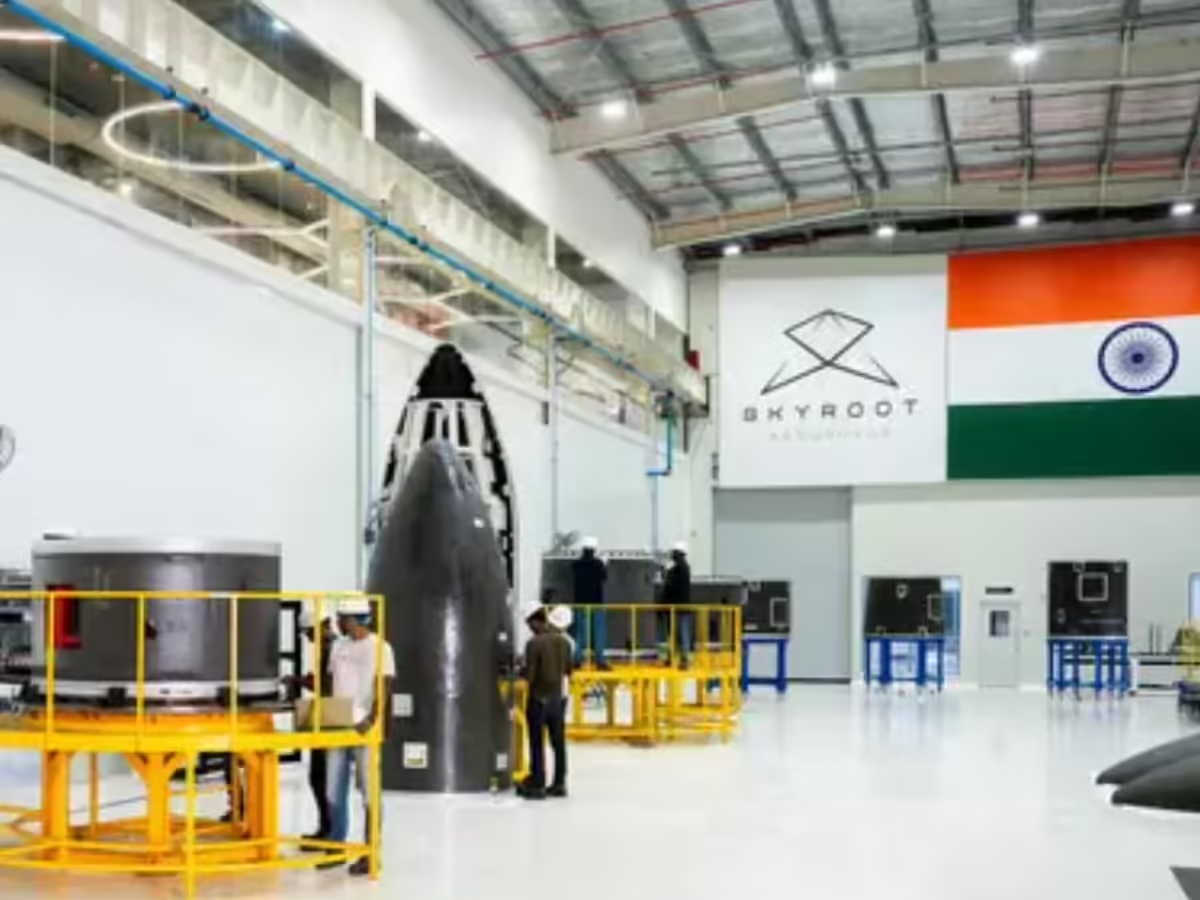
India’s attempt to fire up its fledgling private space program is showing early signs of success.Three years after Prime Minister Narendra Modi allowed non-government firms to own spaceports, launch rockets and sell remote-sensing data, the country has its first space unicorn preparing for a lift-off, and boasts start-ups making advanced Earth-imaging and all-weather satellites. Billionaire Mukesh Ambani is also evaluating plans to deploy a constellation that could pit him against Elon Musk’s Starlink in India.For decades, the Indian Space Research Organisation has launched cost-effective, pioneering missions, including the world’s first landing near the Moon’s south pole. The national agency, which allows start-ups to use its facilities for early tests, will soon share technology involving its workhorse rocket to speed up local knowhow.“We are becoming more aggressive in the kind of technology that we are able to transfer from ISRO because we now see the ability of the private sector to absorb this technology and take it forward,” Pawan Goenka, an automotive industry veteran tasked with building a commercial space economy, said in a recent interview. “Frankly, we are late to the party, and the US is now more private sector than government in terms of the overall space economy.”Starlink, a unit of SpaceX, illustrates the magnitude of the challenge. It alone invested more than $11 billion over three years to expand its constellation to 10,000-plus satellites. SpaceX listed in the US in June after a historic $75 billion IPO made Musk the world’s first trillionaire. By comparison, India counts some 260 space start-ups with a total funding of almost $730 million, about a quarter of which flowed last year, according to data provider Tracxn. Yet, last year’s military conflict with Pakistan and the US-Iran war have reinforced the urgency to build critical infrastructure within Indian borders.“Ten years ago, if I graduated as an engineer, the only visible path was software services or moving abroad on an H-1B visa,” said Suyash Singh, 34, chief executive officer of GalaxEye Space Solutions Pvt, which has developed the world’s first satellite that combines optical cameras with radar sensors, allowing it to see through thick clouds and operate in pitch darkness.“The Indian ecosystem today is extremely ripe for deep tech,” Singh said. “The challenges are real, especially around capital and supply chains, but the momentum is also very real.”Launched using SpaceX’s Falcon 9 rocket on May 3, GalaxEye’s satellite is named Mission Drishti—Sanskrit for ‘focused gaze’. The company, which counts Infosys Ltd as an investor, aims to expand to roughly 10 satellites over the next three years and eventually a full constellation. Singh said much of its early imaging capacity is already booked with demand from defense, agriculture, insurance, disaster management and security applications.Its Bengaluru-based rival Pixxel Space India Pvt was born out of an opportunity its founder spotted while still at university. Awais Ahmed, 28, said he realized that, outside of China, there were no commercial providers of imagery to detect crop diseases or underground leaks that are invisible to conventional remote sensing. Pixxel now offers the highest-resolution hyperspectral data to customers including NASA, Rio Tinto Plc and India’s Ministry of Agriculture.The start-up, backed by Google and Lightspeed, plans an over fourfold increase in its capacity to build such satellites.Meanwhile, Hyderabad-based Skyroot Aerospace Pvt, India’s first space startup to surpass a $1 billion valuation, raised funds from GIC and BlackRock as it prepares the first flight of the Vikram-1 orbital rocket later this month. The company will carry out more test launches before a commercial lift-off, said co-founder and CEO Pawan Kumar Chandana, a former ISRO scientist.All three firms were founded around 2020, when Modi first announced his intention to open the space sector to private players. Policies were formalised in 2023. About 400 start-ups are currently registered with the Indian National Space Promotion and Authorization Centre.At least a third of their revenue comes from overseas, according to Goenka, who chairs the agency. A key milestone to ensure the sector’s success, he said, is making Indian companies use space technology.There are signs that the country’s giants are seeing value. Ambani’s Jio Platforms Ltd is evaluating a low-orbit satellite network for India as it seeks to cement control over the nation’s communications infrastructure. The Economic Times reported that the digital unit of Asia’s third-richest person is set to launch over 1,600 such satellites over the next two to three years, and the firm has acquired a stake in Bengaluru’s Digantara, which specializes in building ground stations, tracking satellites and monitoring space debris.While Ambani’s telecom venture has tied up with Starlink, the Indian government has effectively frozen approvals for Musk’s firm, Bloomberg News reported earlier, citing concerns over the use of the company’s network in the US-Iran war.Satellite communications was always the largest business in the global space market, but telecom companies will have to move to high-speed 6G networks for the Indian space economy to truly grow, according to Chaitanya Giri, fellow at Observer Research Foundation, a policy think tank.That is about to happen soon, said Giri, referring to the 6G tests in the country. India’s planned spy constellation and the satellite network for civilian use will also generate opportunities to create new users, he said.Still, a big hurdle to wider private participation would be a lack of launch capacity outside of ISRO, which itself faced setbacks after its most reliable Polar Satellite Launch Vehicle failed to deploy payloads twice over the past year. A former director at an ISRO unit had told Bloomberg News that back-to-back failures shouldn’t call into doubt the rocket’s future, but he anticipated a faster shift toward the private sector. The government is in talks with large private companies to share the technology involving PSLV, Goenka said. State-owned Hindustan Aeronautics Ltd. and Mumbai-based conglomerate Larsen & Toubro Ltd. are already working on their version.Skyroot has a head start as it became the first Indian private company to send a rocket to the edge of space for a few minutes in 2022. But it has deferred the debut lift-off to place satellites into orbit at least thrice since 2023. Chandana’s firm now targets the orbital launch between July 12 and August 4.Goenka expects a virtuous cycle to develop only after the nation becomes a global hub for small satellite launches with one lift-off every two weeks, and gains the capability to deploy commercially successful constellations.Pixxel’s Ahmed is optimistic about his own firm’s business. The company expects to turn in an operating profit this year and become cash-flow positive by early 2028, though an IPO is still four or five years away, he said.“China opened its space sector to private companies around 2014 or 2015 and funded them aggressively,” Ahmed said. “To catch up, India needs sustained funding, stronger venture capital participation and continued government procurement.”More stories like this are available on bloomberg.comPublished on July 3, 2026
India’s space industry hunts for its SpaceX moment
India's space industry is poised for growth, with start-ups innovating in satellite technology and seeking to compete globally.
1,135 words~5 min read