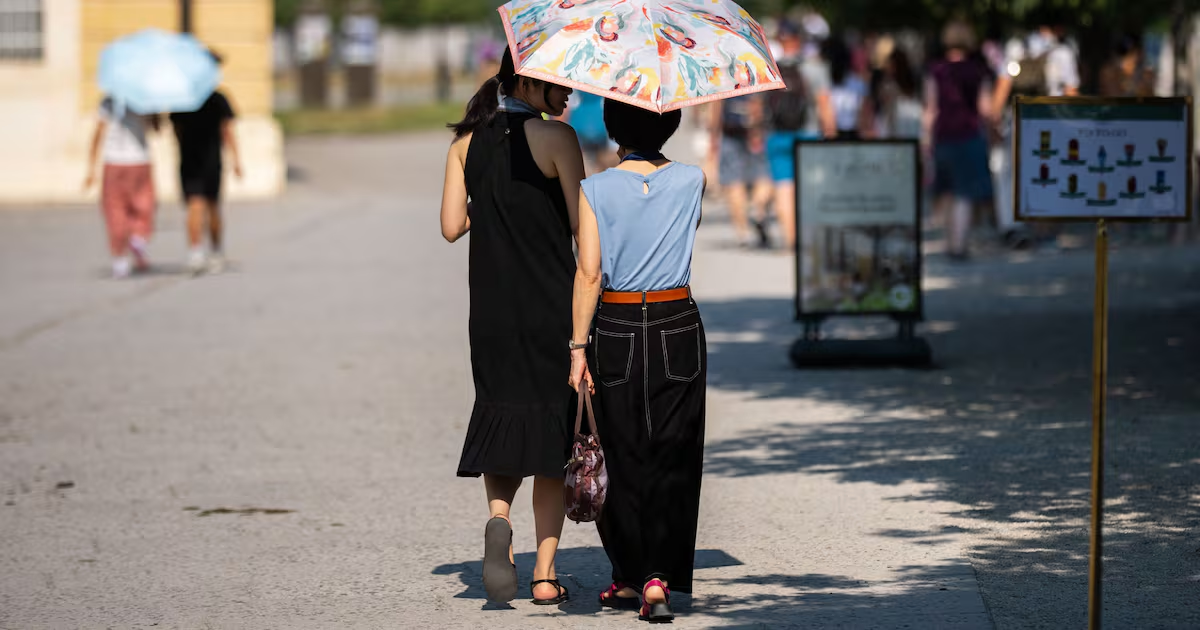
Gender is probably the most unnoticed aspect of housing in Ireland. Historically, and not just in Ireland, there has been very little attention paid to the needs of women in the planning and construction of housing and neighbourhoods. The reality is that the built environment is designed by men, for men: the mobility, safety and physiological needs of the heteronormative, middle-income, younger, able-bodied and healthy man. The issues facing people with a disability or whose mobility is impaired trying to navigate our public realm are a subject for another column. But planners don’t just fail to consider their needs – they rarely consider the needs of half the population. Just ask any woman (or man, but it is mostly women) who has had to struggle with a buggy and narrow footpaths with no dropped kerbs, searching for a public toilet to change a nappy. Or ask anyone who has felt unsafe in a poorly lit public space; or an older person at a pedestrian light where Rhasidat Adeleke would struggle to cross while the green man stays lit. Or anyone waiting for a bus at a stop with no seating.As with many things in housing, Vienna in Austria has led the way for decades. All aspects of public life there – especially housing – are driven by the city’s aim to make planning more gender equitable. In 1992, the city authority established a women’s office to gather data, run pilot tests and develop broader reform for integrating women’s needs into the city’s built environment and housing. They faced opposition in the beginning, often from fellow city officials. Decision-making was still dominated by men, but slowly Eva Kail and her colleagues overcame the resistance. “Gender-mainstreaming” is now normalised across all areas of Viennese policy. The most famous project to result from this work – Frauen-Werk-Stadt (1997) – was a “gender sensitive” housing design competition, only open to female architects, for a mix of 357 subsidised apartments. The buildings responded to the needs of residents (rather than investors), and included flexible c.85sq m three-bedroom apartment layouts that can be adapted to the changing needs of the family through life; communal rooftop laundries where parents could socialise and children play at the same time as waiting for the washing; wide stairways, with bright communal buggy and bicycle storage rooms at the entrance to the building; open kitchen layouts with outward facing windows, so the person in the kitchen can see and hear outside as well as be seen and heard from within; and buildings of a height so that parents on the top floor could still communicate with their children playing in the courtyard below.A second Frauen-Werk-Stadt was completed in 2004. Neither was more expensive than any other apartment development built by the city. Now in Vienna, all housing projects that want to claim public funds are “assessed for the requirements of living suitable for women and everyday life”.In Ireland, as in Vienna, the day-to-day journeys of women and caregivers are often complex, making trips for childcare and dependents, errands and domestic jobs, while also commuting to and from work. Men – less likely to be primary caregivers – tend to go from A to B and back again. Vienna undertook a pedestrian improvement programme specifically for women and older people, improving intersections, removing obstacles and adding seating and lighting among many other upgrades.The city is consistently in the top three of European cities ranked for quality of life. Dublin is much lower down the list. Housing is a large part of both results.Just 27 per cent of Irish councillors are women (compared with 48 per cent in Austria), ranking us 22 out of 27 EU countries for female representation in local government. No local authority has a women’s office.In the Civil Service, there are seven women at secretary general level, compared with 16 men. (Female representation is improving steadily across departments and senior grades.)The Department of Housing, which is responsible for planning and housing policy, and the Department of Public Expenditure and Reform, which controls the purse strings to deliver housing, are led by men. In the Department of Housing, the majority of assistant secretary generals involved in housing and planning are men.The top house-building companies are all run by men with the exception of one husband-and-wife team, as is the State’s Land Development Agency and as was Nama.The Government’s Cabinet Handbook requires that all proposals coming before Government must indicate potential socio-economic impacts, including gender. Under Freedom of Information, I sought copies of gender assessments for several critical housing policy documents, including: Delivering Homes, Building Communities (2025); and the Planning Design Standards for Apartments: Guidelines for Planning Authorities (2025).No records of any such assessment were found. The word “women” appears in neither document, and “gender” once, but specifically in relation to domestic violence. Research shows that women suffer more than men from the outcomes of poor housing policies, whether it be design, affordability or location. Housing problems are associated with increased anxiety, stress, depression, sleep disorders, chronic diseases, impairment in daily tasks, and suicide due to lack of social support, which then require the use of costly state services to mitigate.Incorporating gender into policy and plans can be done. When applying (and getting) planning permission for the new Luas to Finglas, An Coimisiún Pleanála noted Transport Infrastructure Ireland’s consideration of the “specific mobility needs and concerns of women”.The new town of 18,500 homes for 46,000 people proposed for Dunsink in north Dublin is an opportunity to adopt gender mainstreaming and create a location where women’s needs are central to the development. But the draft Dunsink Urban Area Plan has no mention of either gender or women.There is plenty of research available on the benefits of integrating gender mainstreaming into housing and planning policies – more than 24,000 results on Google scholar – but it is ignored or, worse, policymakers are ignorant of it. One can only conclude that until the decision-makers themselves stop to consider the experiences of women, their housing and planning needs will continue to be overlooked and unmet. The men will be grand, though.
Lorcan Sirr: What would happen if Ireland designed housing with the needs of women in mind?
Housing and planning policy here largely designed by men and fail to address daily needs of rest of population
1,016 words~5 min read