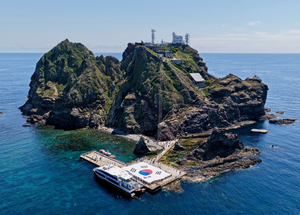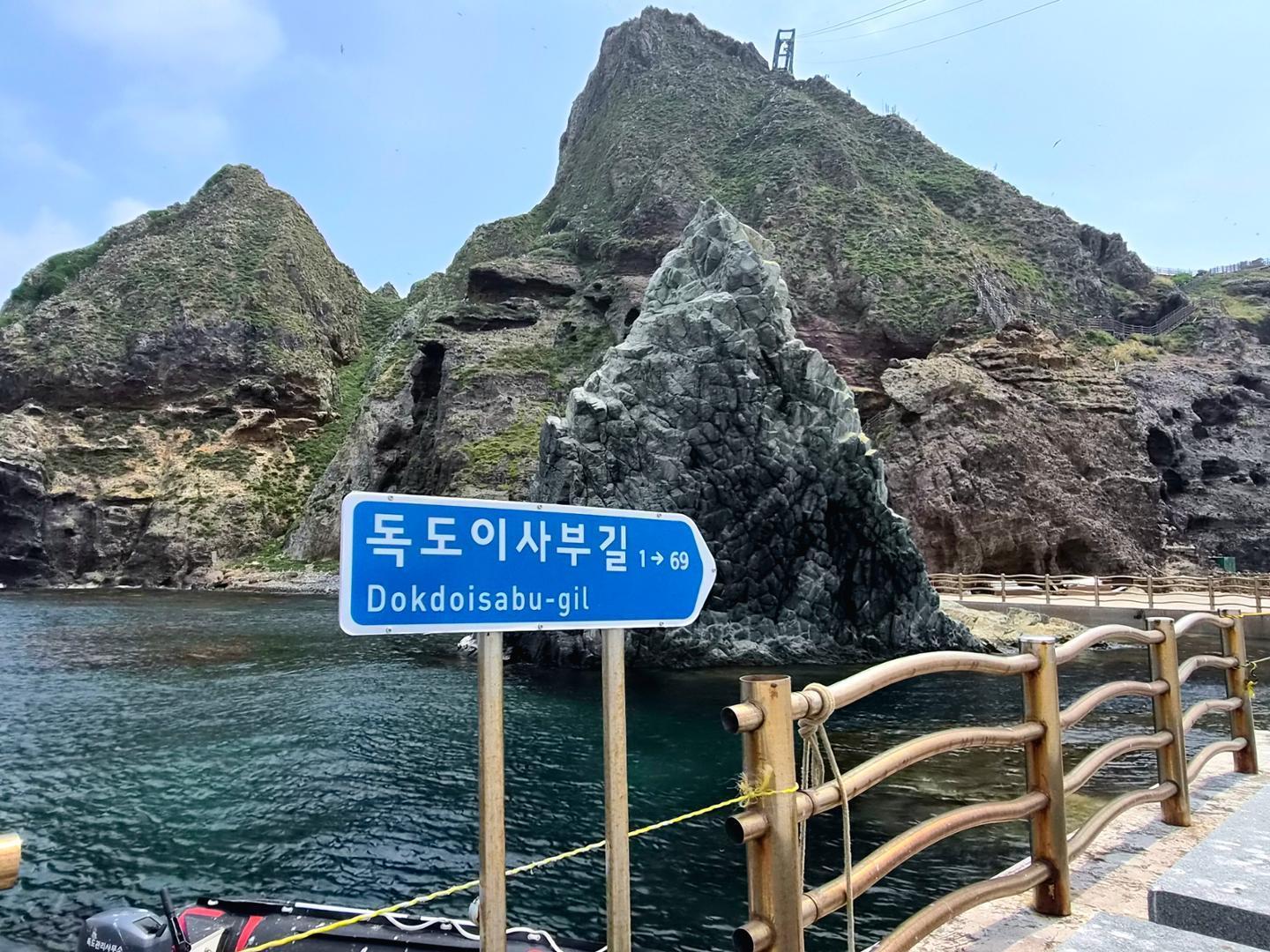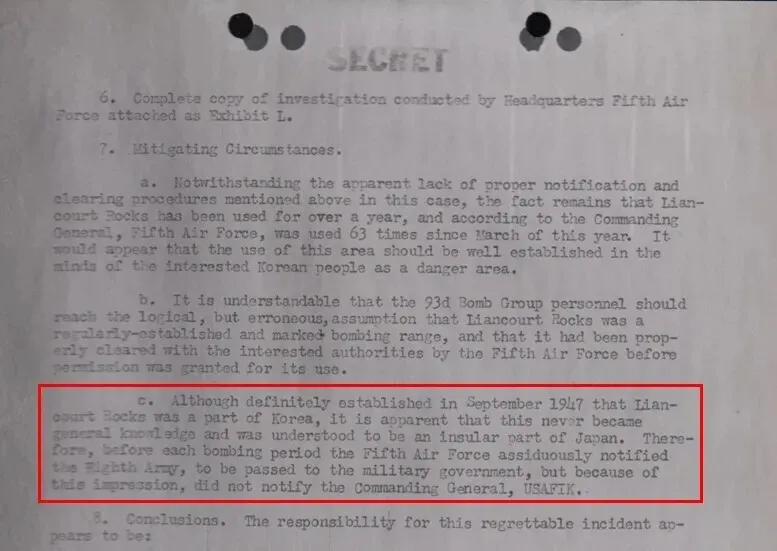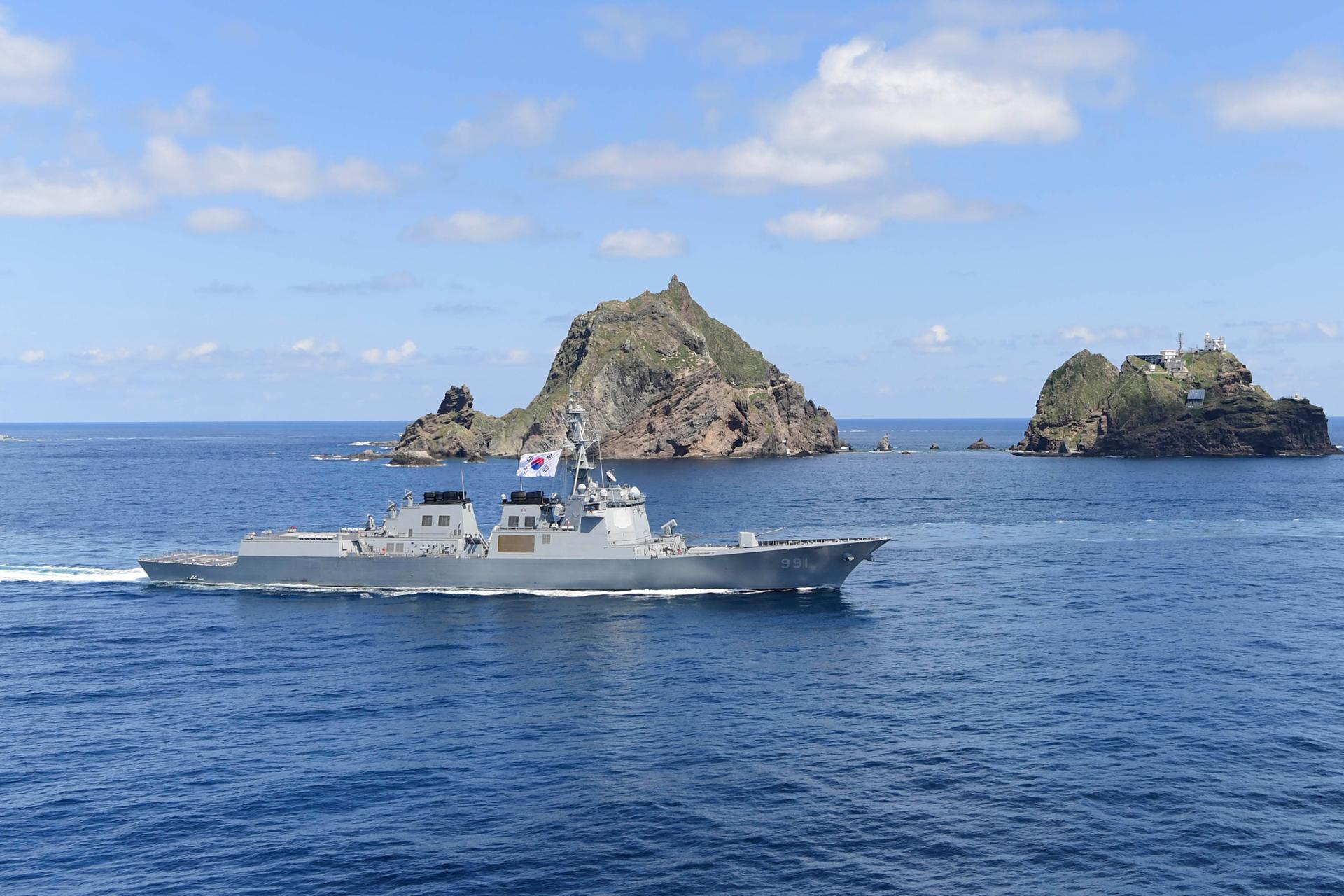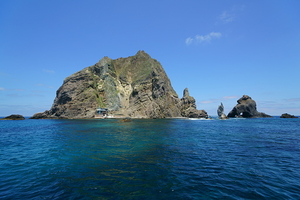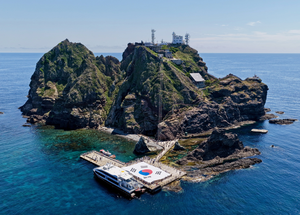
This photo shows the Dokdo islets in the East Sea, along with a megasized Korean flag on its harbor. (Yonhap) The daughters of Dokdo’s first and last registered civilian residents have been locked in a yearslong dispute over who should be allowed to live on the islets next and how their fathers’ contributions to Dokdo should be remembered, according to the Ulleung County Office on Sunday.Dokdo has had no permanent resident since Kim Shin-yeol, its last registered resident, died in March. The island county of Ulleung-gun, which has jurisdiction over Dokdo, has been rejecting Kim's daughter's requests to register as a resident of the rock islets.Kim had lived on the islets with her husband, Kim Sung-do, who died in 2018. She continued residing there until 2020, when she was forced to leave after Typhoon Haishen damaged the residential.Public officials dispatched by the Ulleung County Office and Ulleung Fire Station currently stay on Dokdo on a rotating basis. But they are not registered as permanent residents.Kim Jin-hee, the couple’s daughter, has sought to follow her parents by requesting registration as a Dokdo resident and moving onto the islets. After the local government instructed her to remove her family’s belongings from the civilian residence, she filed an administrative lawsuit, arguing that she wanted to establish residency there herself.“Residing on Dokdo is the strongest weapon for protecting the island’s sovereignty,” Kim said.Dokdo is South Korea’s easternmost territory. While South Korea exercises effective control over the islets, Japan continues to claim sovereignty over them.Choi Eun-chae, daughter of Dokdo’s first registered resident Choi Jong-duk, has also sought permission to live there, saying she first applied roughly 15 years ago.“I will fulfill my father’s dream of creating a Dokdo village,” Choi said.Her father began living on Dokdo in the 1960s and officially moved his residential registration to the islets in 1981. He died in 1987.The Ulleung County Office has said that limited residential facilities and administrative procedures make it difficult to accommodate both women simultaneously.Legacy of Dokdo residentsThe dispute extends beyond who should become Dokdo’s next resident, however, with the two families also clashing over how much credit their fathers should receive for establishing infrastructure on the islets.One point of contention is the so-called 998 Stairs, which connect the residential area with other parts of Dokdo, as well as Mulgol, the islets’ only natural freshwater source.“My father took the initiative to finish the stairs after workers withdrew from the island in 1983 because of rough seas,” Choi said.Kim, however, argues that the construction should not be credited solely to Choi Jong-duk, saying numerous workers and haenyeo, or female free divers, also participated.“It is wrong to claim that the achievement belongs solely to Choi Jong-duk,” Kim said.The disagreement intensified after the government began reviewing recognition of contributions to Dokdo in 2019 and listed Choi Jong-duk, but not Kim Sung-do, among those credited with helping build the stairs.The two daughters subsequently exchanged heated accusations on social media and were fined in connection with defamation cases.An Ulleung County official said the government had drawn up records of individual contributions based on objective materials available at research institutions and the county office at the time.The official added that the county plans to establish clear criteria and recruit a new civilian resident for Dokdo once personal belongings left in the residential facility have been cleared out.The dispute has also drawn criticism from some Ulleungdo residents.“When you see them fighting over whose family deserves the credit, you start to think neither of them should be allowed to move onto Dokdo,” one resident said.An expert who studies Dokdo said both men played distinct roles in the history of civilian settlement on the islets.“If Choi Jong-duk was the person who laid the foundations for permanent settlement on Dokdo, Kim Sung-do was a symbolic figure who, as the village head, helped reinforce Korea’s effective control over the islets,” the expert said.“Rather than allowing the history of those who protected Dokdo to be overshadowed by a dispute among their descendants over credit, this is the time to think collectively about how to create sustainable conditions for civilian settlement now that Dokdo has no resident.”
Daughters of first, last Dokdo residents clash over claims to live on islets, fathers’ legacies
The daughters of Dokdo’s first and last registered civilian residents have been locked in a yearslong dispute over who should be allowed to live on the islets n
689 words~3 min read