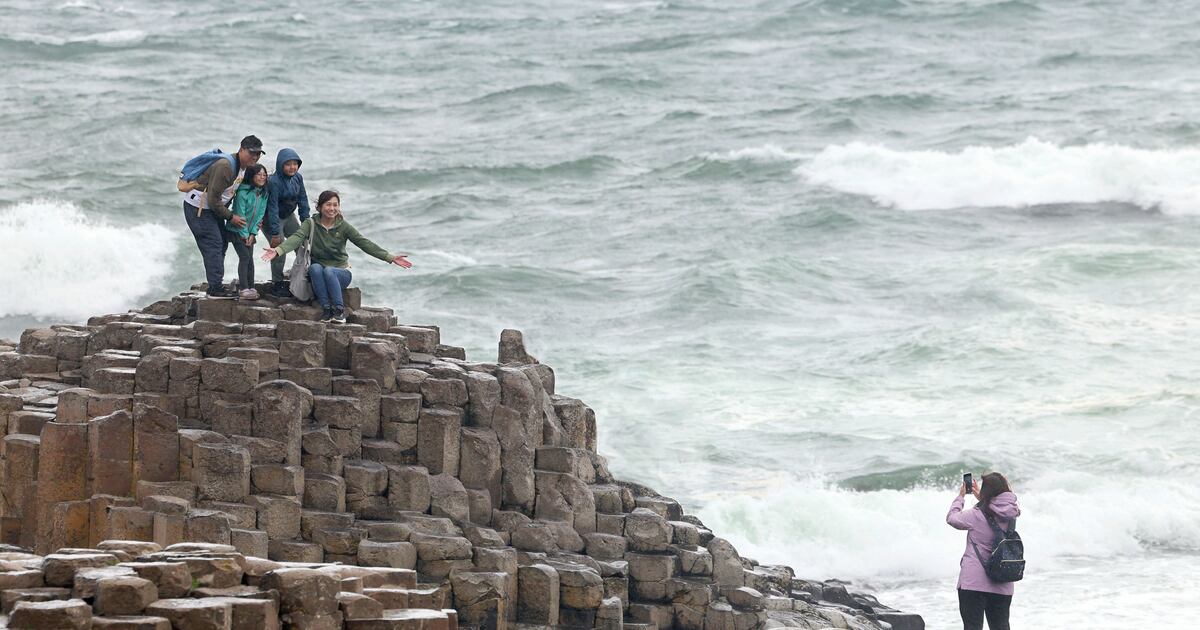
Ireland’s Coastline: Stories from our sea frontierNew and emerging threats, from climate change to security in a more politically volatile world, put greater focus on Ireland’s island status and our coastline.Stretching to more than 7,500km, the coast of Ireland’s mainland and offshore islands covers roughly the same distance across Africa at its widest point, or the path of a flight from New York to Moscow.That distance creates challenges when it comes to policing a long coastline such as Co Cork’s against drug traffickers. Elsewhere, rising sea waters and changing weather patterns pose risks to existing homes and businesses situated next to the sea, including along the Co Wexford coast.The coastline is also a vital resource for the tourism and leisure industries, bringing value to the local economies of the 19 counties that touch the Atlantic Ocean, the Irish Sea and the Celtic Sea. In this series, The Irish Times looks at lives and lifestyles around the country’s coastline along with the challenges facing some on the island’s sea frontier.It is a perfect day for the Giant’s Causeway.The rain is coming in sideways off the Atlantic, gathering in pools on top of the famous hexagonal stones while white-topped waves, stirred to a frenzy by the wind, smash against the rocks, sending spray everywhere.“I think the stormy weather really makes it,” says Matthew Roe from Liverpool. “You can stand near and see the crashing waves, and it makes it more atmospheric and enthralling.”“It adds to the drama,” says his mother, Adele Haase.“It’s special,” says Astrid Huwe from Berlin. “It’s really different to everything we’ve seen before.” She searches for the words; The Irish Times suggests impressive, rugged, wild. “All of that.” “I think the key point is unique,” adds her husband, Christoph. “It’s a very unusual formation of rock – we have been to Norway, Iceland, everywhere in the north, and I have never seen that before.“The Irish coast, obviously, is very beautiful.” They have travelled “from Kerry, all the way up here and around the island, and this is ... something you can barely see anywhere else.”Perched on the Co Antrim coast, the Giant’s Causeway is a geological wonder, a site of myth and legend, and one of the North’s most popular tourist attractions. “If you have one image that says Northern Ireland, I think it’s a Causeway column,” says Jennifer Michael, business development manager with the National Trust.[ Ireland’s coastline – erosion in Wexford: ‘There’s nobody protecting my land for me’Opens in new window ]It is the result of intense volcanic activity 60 million years ago, as lava flows cooled and cracked to create the more than 40,000 interlocking basalt columns that spill into the sea near Bushmills. Today it is the largest, and most accessible, example of this geological phenomenon across the globe, and a Unesco World Heritage Site – one of only four, alongside the Brú na Bóinne prehistoric sites, Skellig Michael, and the nearby Gracehill Moravian settlement, on the island of Ireland.“It’s a really good geological example of the Pangaea continent breaking up, so that’s one of the reasons for the Unesco designation,” says Michael. “It gives us an insight into the formation of the Earth as we know it.”A tourist struggles across the Giant's Causeway. Photograph: Stephen Davison It is special in other ways too. The Causeway holds a raft of other designations, including Special Area of Conservation and Area of Special Scientific Interest, and the only one to boast its own giant.“I started getting really interested in myths and then I read about the Giant’s Causeway and I really wanted to go here,” saysJuliette Hennessy (10), from Mornington, Co Meath. She hops down from where she has been clambering over the stones to tell the story of Finn McCool. “It’s about an Irish giant and a Scottish giant, and they had a fight, and the Irish giant made a causeway to Scotland. “Then the Scottish giant got mad and he came all the way to Ireland, and the Irish giant pretended to be a baby, so he’d be scared away because the Irish giant was massive in a little cot. “Then the Scottish giant ran away, destroying the causeway.” Has it lived up to her expectations? “I think it’s amazing,” she says. “It’s very different seeing the place through her eyes,” says her mother, Cathy. “The whole story is brought to life – you can see the magic again.” The Giant’s Causeway attracts more than 600,000 visitors per year, though it is still recovering from the impact of the Covid-19 pandemic, before which numbers topped more than a million. The stones have long brought travellers to this northern coast; among the stories told in its visitor centre are that of Susanna Drury, a Dublin painter chiefly known for her watercolours of the Causeway, which are credited with launching it as a tourist destination in the 18th century.On this weekday afternoon, the stones are packed with people; many simply stand on this ancient landscape looking out to sea, their figures silhouetted against the stormy sky. The Giant's Causeway. Photograph: Stephen Davison It is one of the top visitor attractions in the North. Almost 40 per cent of people who come to the Giant’s Causeway are from North America, with 34 per cent from Ireland (north and south) and Britain, and the remainder from Europe and the rest of the world.Visitors from the South are a “growing market” for the Causeway, says Michael. “Weeks like this week, with the Fleadh in Belfast, we do expect a lot of visitors [from the Republic] that maybe haven’t come to Northern Ireland to be visiting for the first time.” Though there are no recent figures for the Causeway’s financial contribution to the economy, it is significant; according to Tourism Northern Ireland, the wider Causeway Coast and Glens council area accounted for almost a quarter of overnight trips in the North in 2025, generating a spend of £180 million.For the National Trust, which has the guardianship of the Giant’s Causeway, the site’s popularity helps it look after other sites. “First and foremost, we are a conservation charity, and we’re here to protect these special places,” says Ciara Allen, interim general manager of the trust on the north coast.“We care for multiple places that don’t have a lot of visitors going in but still are very important and still need the upkeep, so [the Giant’s Causeway] really helps us do what is at our core as a conservation charity.”She adds: “I do it [the stones] day in and day out, and I don’t think you ever lose that appreciation.“When we are out in markets promoting the Giant’s Causeway, there’s that sense of pride, and that sense of having it on our doorstep. We’re very, very lucky.” Last in series
Drama on the Giant’s Causeway: ‘It’s a very unusual formation. I have never seen that before’
Ireland’s coastline series: The Antrim site is one of the North’s most popular tourist destinations, and it’s especially ‘atmospheric and enthralling’ in wild weather
1,127 words~5 min read