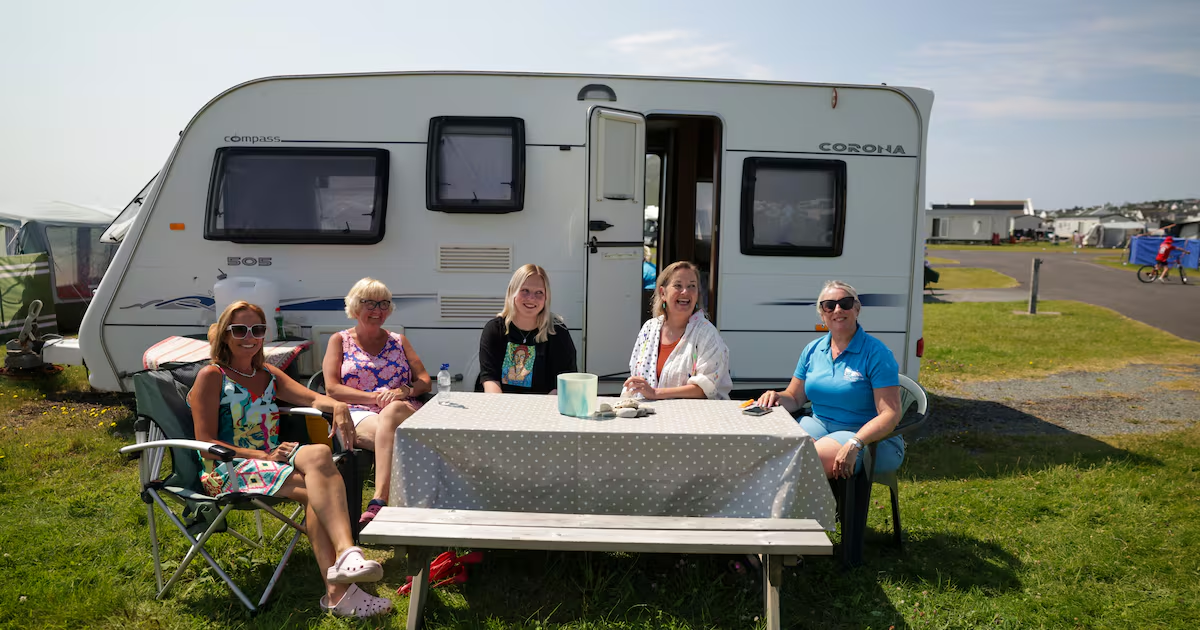
Ireland’s Coastline: Stories from our sea frontierNew and emerging threats, from climate change to security in a more politically volatile world, put greater focus on Ireland’s island status and our coastline.Stretching to more than 7,500km, the coast of Ireland’s mainland and offshore islands covers roughly the same distance across Africa at its widest point, or the path of a flight from New York to Moscow.That distance creates challenges when it comes to policing a long coastline such as Co Cork’s against drug traffickers. Elsewhere, rising sea waters and changing weather patterns pose risks to existing homes and businesses situated next to the sea, including along the Co Wexford coast.The coastline is also a vital resource for the tourism and leisure industries, bringing value to the local economies of the 19 counties that touch the Atlantic Ocean, the Irish Sea and the Celtic Sea. In this series, The Irish Times looks at lives and lifestyles around the country’s coastline along with the challenges facing some on the island’s sea frontier.From Easter to October, Dublin native and resident Edel Quinn embraces a different dimension of existence. She calls it “Achill time”.This simply involves living to the metronome of the tides, the slant of the sun, the pounding of the rain, the music of the pub and the flavour of the locally smoked salmon bought in Keel at the Saturday market.Since her two children were young, this caravaner has been crossing the Shannon every year for an extended holiday in the sandy banks of Keel Camping park.Quinn, from Clontarf, works as a special needs assistant at Dublin 7 Educate Together National School, which is a perfect job for taking extended holidays. However, her love of outdoor living began when she was much younger.“When we were teenagers we used to camp at the weekends and during holidays in Lacken in west Wicklow, where Daddy had a farm,” says Quinn. “Then, when my son Daniel was 14, back in 2003, he came here to Achill to the Gaeltacht with his two older cousins and I clearly remember visiting him with my daughter Molly, who was only nine months at the time. I pitched a little tent right over there, in the wind and the rain, and was very surprised and relieved it didn’t blow away. That was my first time in Achill.” Twenty-three years later, Daniel is living in Japan but his mammy is sitting outside her caravan with Molly, a journalism graduate from Technical University Dublin. Edel’s caravanning sister Anne Marie Brady from Rathcoole is there too, as well as their friend Caroline Commons, a primary schoolteacher from Kiltimagh.They are laughing as a passerby asks them will they be serenading the campsite again that night with Neil Diamond songs.The beach at Keel, Achill, is just 50 metres from the caravan park where Molly and Edel Quinn spend their summers. Photograph: Enda O'Dowd Meanwhile, Molly is planning a day of swimming, reading, relaxing and probably an early evening drink down the village in The Annexe or The Basking Shark with the gang.Long gone are the summers when she slept with her mammy on an airbed under the awning of auntie Anne Marie’s caravan.In 2014, after 11 years of camping, Edel left Achill and the following day bought the Compass Corona five-berth they are now sitting outside, for €7,000.Unsurprisingly, the family’s seasonal bilocation comes naturally to Molly since a few of their neighbours in Dublin also happen to be neighbours on Achill.“Some of those families have bought houses here since but we still see them, obviously. When we were teenagers we’d be out swimming and surfing and messing around. “By the time I was 15 or 16 I’d bring a friend down sometimes, but then when I reached 18, I started working down here in the food truck over on the green and here on the campsite, which was great, as I literally rolled out of bed every morning,” says Molly.Edel and Molly Quinn on Keel beach in Achill, Co Mayo. Photograph: Enda O'Dowd Keem beach on Achill Island, Co Mayo. Photograph: Enda O'Dowd Keem beach, Achill Island. Photograph: Enda O'Dowd People make their way down to Keem beach in Achill. Photograph: Enda O'Dowd Keem Beach in Achill, Co Mayo. Photograph: Enda O'Dowd That relaxed attitude works perfectly fine for Lisa Fitzsimons, who has just joined the group. She has run Keel Camping with her husband Michael since 2023 and earlier this year they renewed their lease of the park from Mayo County Council. Coincidentally, their association with the campsite also started out with family holidays.“Myself and Michael started coming here about 20 years ago. I’m from Galway and he’s from Cavan and he was a kitesurfer and we used to come with our tent and pitch it at the back ditch down there. We’d spend the day kitesurfing and then go off down the village and enjoy the craic in the pubs with everybody,” she says. “After our three children came along, we rented houses at first but then said, ‘Let’s just buy a caravan.’” So, like Quinn, they bought “a seasonal pitch” from the Nestors, the family who had run the park for three decades before their retirement.When the Fitzsimons took over in 2023 there were about 70 requests for seasonal pitches – from March to October – but they wanted to adapt such long-stays to become more economically viable.“The pandemic had led a lot of people to buy caravans, but we couldn’t have run a viable campsite if we allocated 70 pitches for seasonal use. Instead we have come up with an option that anyone staying from 29 days to 60 or 90 days receives a 15 per cent discount. So the charge for 30 days for a caravan with two adults, the awning and electricity, is €1,200,” Fitzsimons explains.People take in the view of Keem Bay in Achill, Co, Mayo. Photograph: Enda O'Dowd People enjoy the view above Keem Bay, Achill, Co, Mayo. Photograph: Enda O'Dowd Beachgoers enjoy a game at Keel in Achill, Co Mayo. Photograph: Enda O'Dowd People enjoy the sun on Keem beach in Achill, Co Mayo. Photograph: Enda O'Dowd A person walks along Keel beach in Achill, Co Mayo. Photograph: Enda O'Dowd Of the 160 pitches in the park, there are 40 caravans using the “long stay” option, with a long waiting list and 13 inherited seasonal pitches.With 20 staff working between the campsite, shop, the various facilities and The Lost Sheep Food Truck, she says they are so busy they haven’t time to answer the phones.“We just have to put a message on our phones saying sorry we are fully booked until August 3rd, please email us if it is for another time and we’ll get back to you,” she says.On the other hand, an unfortunate fallout from the pandemic is the number of wild campers.“If you look out here at the commonage and over on the sand dunes, there are about 50 or 60 tents and vans camping with absolutely no facilities. We have people arriving to our reception every day pleading that they’ve no running water, they’ve no toilets, they have no rubbish bins and could we help,” says Fitzsimons. “They might offer a fiver to empty their chemical toilets and their bins. We decline as the campsite is for our guests.” [ Camping in Ireland: Holiday for less than €500 a week for a family of fourOpens in new window ]Before her husband calls her away, she confirms that the county council is working with the owners of the commonage to try to resolve the issues, but quips she has no problem quoting the “Leave No Trace” ethos to these campers.Meanwhile, it is almost time for a swim for the others, with the sun shining high in the sky and a full tide beckoning across the sand dunes.“The weather has just been fantastic this summer,” says Edel Quinn. “But I always come with about six raincoats and my Crocs.”She loves the wet and windy days too. After all, they are an integral part of “Achill time”.“On those days we do the Deserted Village walk. It is about 12km. We do a loop up the Slievmore road and you come out in Dooagh and there is a lovely pub called Lordys where we just might stop for one, to help us get back down the road again.”Tomorrow: Sorcha Crowley with surfers on the Sligo coast
‘We rented houses at first but then said: Let’s just buy a caravan’
Ireland’s coastline: Achill is a hot spot for mobile home and caravan holidaymakers, but the growth of wild campers has raised problems
1,400 words~6 min read