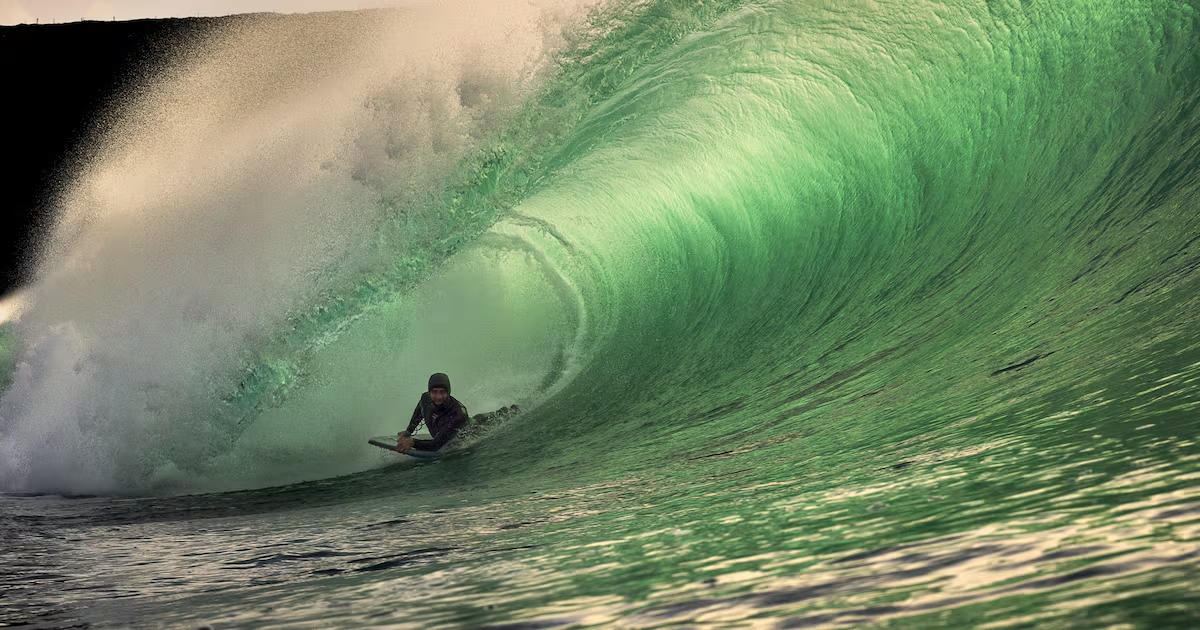
Ireland’s Coastline: Stories from our sea frontierNew and emerging threats, from climate change to security in a more politically volatile world, put greater focus on Ireland’s island status and our coastline.Stretching to more than 7,500km, the coast of Ireland’s mainland and offshore islands covers roughly the same distance across Africa at its widest point, or the path of a flight from New York to Moscow.That distance creates challenges when it comes to policing a long coastline such as Co Cork’s against drug traffickers. Elsewhere, rising sea waters and changing weather patterns pose risks to existing homes and businesses situated next to the sea, including along the Co Wexford coast.The coastline is also a vital resource for the tourism and leisure industries, bringing value to the local economies of the 19 counties that touch the Atlantic Ocean, the Irish Sea and the Celtic Sea. In this series, The Irish Times looks at lives and lifestyles around the country’s coastline along with the challenges facing some on the island’s sea frontier.At least once a month, sometimes more, Audrey Scally hops into her little camper van in the midlands and drives two hours to surf somewhere she had bypassed all her life, Strandhill in Co Sligo. Scally is a recent convert; she says it happened by “complete accident” when a friend who had booked a surf lesson couldn’t go and asked Scally to stand in for her. She didn’t even like swimming. “I was kind of dreading it. But then from the very minute I got into the water, I just loved it,” she says. “I never laughed as much since I was a child – one lesson and I was hooked.” That was 18 months ago. Sometimes she drives up and down in a single day to a women’s surf session. “It’s all the camaraderie. It’s a lovely atmosphere. When you’re walking back along that stretch and carrying your board, you’re just so happy,” Scally says. “I’m never going to be a real proper surfer, I know, but it’s such fun.” She has already gone on her first surfing holiday to Tenerife. “It was full of those lovely young girls, all tanned with long blonde hair and tiny thong bikinis – you’d swear you were in California – and then you had the likes of me in my wetsuit,” she laughs. Scally has just turned 60. The property firm accountant is one of many women of a certain age who have taken up surfing. An instinctive urge to get in the water arose during lockdown, according to her surf instructor, Melanie Kilfoyle-White. Women attend a surfing lesson. Photograph: Graham Kilfoyle Surf instructor Melanie Kilfoyle-White. Photograph: Mark Capilitan “It’s done nothing but grow since then,” she says, in her base at the new National Surf Centre, of the post-pandemic interest in jumping on a board in the Irish Atlantic. “Strandhill always had women surfing but the rest of the coastline was ‘Bro-ville’. The age and the gender spectrum have completely changed in terms of who is entering the water now.” While the north west is producing competitive surfers such as reigning European champion Gearóid McDaid and national champion Isabella O’Reilly (15) among others, Kilfoyle-White recognises “the majority of people aren’t looking for that”.Many have experienced major loss and come for the healing. “There are people that have lost parents, had miscarriages, come through breast cancer, been through a divorce, lost their job, don’t know what the hell to do with their life, whatever. Or just needing friendship. It’s a space where people make friends in a really lovely way,” she says.“We have got this new sense of self and place here in Sligo,” says national bodyboarding champion, surf instructor and soon-to-be author Seamus “Shambles” McGoldrick, who is fresh from a surfing trip to Tahiti in the south Pacific.Seamus McGoldrick in action: 'When you get a wave that feels really good, it’s like a little gift.' Photograph: Peter Martin Seamus McGoldrick: 'I’m 41 now and I still think I’m improving.' Photograph: Andrew Kilfeather “I can’t wait to go back. It was worth it,” he says with a grin. When he’s in the ocean he’s in his “blue mind”.“Whatever kind of mood or stress you’re in, when you get a wave that feels really good, it’s like a little gift. My goal is just to never stop, to keep going. I’m 41 now and I still think I’m improving,” he says.What Scally might call “real proper surfers” bide their time here during the flat seas of summer. They keep close to the coast. From Rossnowlagh in Co Donegal to Easkey down the coast in Co Sligo, champions such as McGoldrick in Strandhill, Owen Murphy in Bundoran, and other big wave riders Cillian Ryan and Barry Mottershead in Mullaghmore, quietly work among unsuspecting day-trippers.People watch a surf class at Tullan Strand, Bundoran. Photograph: Chris Maddaloni They know 18m (60ft) monsters will rise from the deep in winter. Come November and December they will follow their hearts into roaring Atlantic storms. They will drop the tow rope and soar down Benbulben-sized slabs of glassy teal at Mullaghmore Head, a 200m-long “bucking bronco” of shock and awe that has left some of the biggest names in pro-surfing shaking their heads in disbelief. “There’s plenty of hikes in the Himalayas, but there’s only one Everest. There’s only one K2. And that’s what we have here – K2. It’s huge,” says Mottershead (42). Leaning on the pier at Mullaghmore harbour, the South African looks at the sea the way farmers survey the sky. “You will get barrelled on the wave. And that’s what everyone looks for all around the world. That’s the pinnacle of surfing. Other big waves around the world might do it once or twice a season. Here it happens nearly every wave,” he says.Mottershead remembers his first time to surf “Mully”: it was a perfect day – big, clean waves, no one around.“Definitely rode the biggest waves of my life that day. Like, 10 of them in a row, in 20 minutes. It’s a real alluring spot. It captures you fully,” he recalls. Barry Mottershead in action. 'It’s unforgiving. It’s broken backs. It’s broken necks.' Photograph: Gary McCall “I enjoy the challenge, but it’s unforgiving. It’s broken backs. It’s broken necks, it’s broken legs. I’ve fished people out of the water and done CPR. I’ve carried people on spinal boards up the slope. “It really is no joke. It’s definitely a wave that can hurt you. The world’s best waves are being ridden out there and winning competitions, and there just seems to be no ceiling on what’s possible.”The serendipitous nature of reaching the swell moves him. “The waves have travelled for thousands of kilometres to get to you. You’ve pushed everything aside to make sure you’re there. And then at Mullaghmore you get to watch them wrap around the headland and there’s this refraction on them that is so ... perfect,” he says.Mottershead suddenly looks as if he might cry. “It’s hard to describe, other than like, this wave, it wasn’t like a mistake that it’s here, you know? It feels like God or whoever, whatever, put this place on the map for a reason. The wave is of that perfection,” he says softly. “It’s like looking at Everest. It gives me goosebumps talking about it.” Photographer Megan Gayda at Tullan Strand. Photograph: Chris Maddaloni At Tullan Strand, Bundoran, surf photographer Megan Gayda (30) has scrambled out of the water with her underwater camera and flippers. She’s been bobbing about like a mermaid between surfers Cillian Ryan (33) and Owen Murphy (35). “Probably the worst conditions to shoot,” she chuckles. Surf wasn’t up. They needed an offshore wind. “Like a storm in a teacup,” smiles Murphy. But they’re all beaming anyway.
‘It’s like looking at Everest. It gives me goosebumps’: Surfers seek the ultimate wave on Ireland’s west coast
A surf culture has grown up along the Donegal and Sligo coast where newcomers and seasoned wave riders alike find friendship, thrills and healing
1,295 words~6 min read