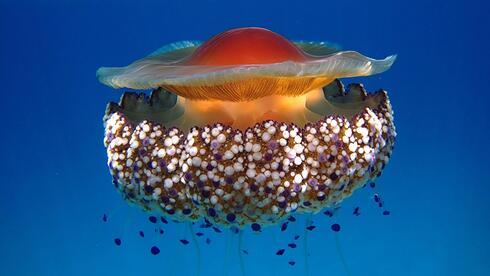
The fried egg jellyfish lives in partnership with symbiotic algae, prefers warm shallow water and usually causes little pain to humans, but extreme marine heat could threaten the relationship it depends onYael Maslaton, zavit|Among the many jellyfish found in the Mediterranean, one stands out for a reason that is immediately obvious: it looks remarkably like a fried egg.The so-called fried egg jellyfish is one of the most striking and photogenic gelatinous creatures in the region. It lives in partnership with symbiotic algae, has an unusual life cycle and, scientists now understand, a digestive system more complex than once thought.Mediterranean fried egg jellyfish off Palmachim Beach (Video: Shlomi Yitzhaki, Israel Nature and Parks Authority)To better understand the species, we spoke with Prof. Dror Angel of the Recanati Institute for Maritime Studies and the Department of Maritime Civilizations at the University of Haifa, who also serves as director general of the Meduzot Ba’am association and has studied jellyfish for decades.Why is it called the fried egg jellyfish?
“The common name ‘fried egg jellyfish’ comes from its unique appearance,” Angel said. “When you look at it from above, there is a dark yellow-orange bulge in the center that looks exactly like a yolk, surrounded by white edges that complete the appearance of egg white.”Its scientific name is Cotylorhiza tuberculata, a species common in the central and western Mediterranean. In the eastern Mediterranean, including waters off Israel, a related species called Cotylorhiza erythraea is found and tends to be less colorful.Gallery‘fried egg jellyfish’ (Photo: Fredski2013 , Wikimedia Commons, CC BY-SA 3.0)Does it sting?