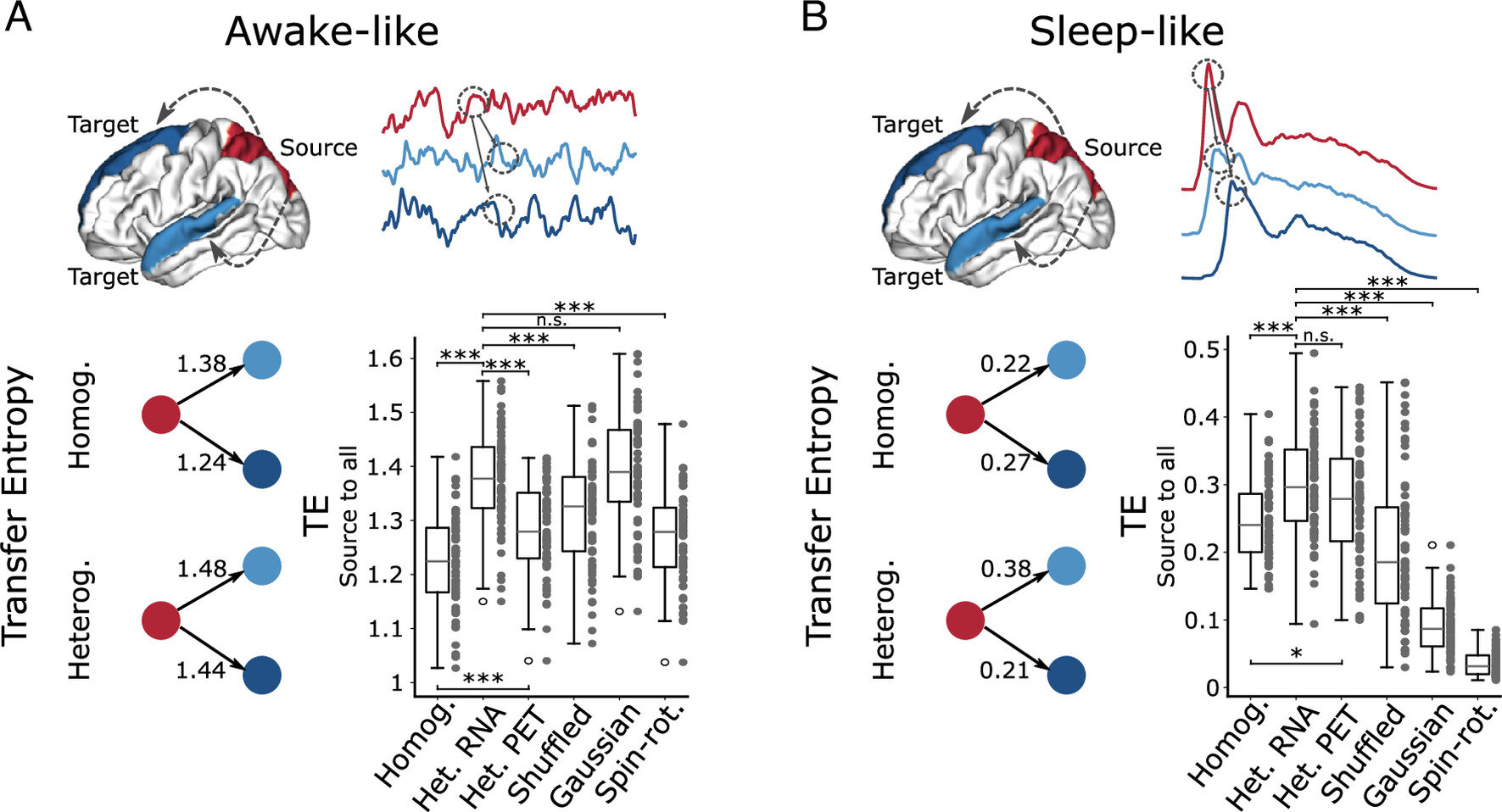
Information flow is enhanced in spatially heterogeneous large-scale cortical networks. Credit: Proceedings of the National Academy of Sciences (2026). DOI: 10.1073/pnas.2532072123
Researchers have developed a computer model of the human cortex that links its microscopic chemistry to its brain-wide patterns of activity, providing new evidence that regional differences in receptor density help shape how activity and information move across the brain.
The study was published in the Proceedings of the National Academy of Sciences. It was developed using The Virtual Brain (TVB), an open-source whole-brain simulation platform that is part of the EBRAINS research infrastructure.
"One of the central challenges in neuroscience is understanding how processes occurring at the molecular level influence the behavior of the brain as a whole," says Leonardo Dalla Porta, a researcher at the Institute of Biomedical Investigations August Pi i Sunyer (IDIBAPS) and first author of the study. "Our study provides a concrete example of how we can begin connecting these very different scales within the same computational framework."
Receptor maps change the model