Most everyday tasks need two hands. Packing a lunchbox, opening a jar, folding a shirt. That's why a lot of household robotics starts with two arms.
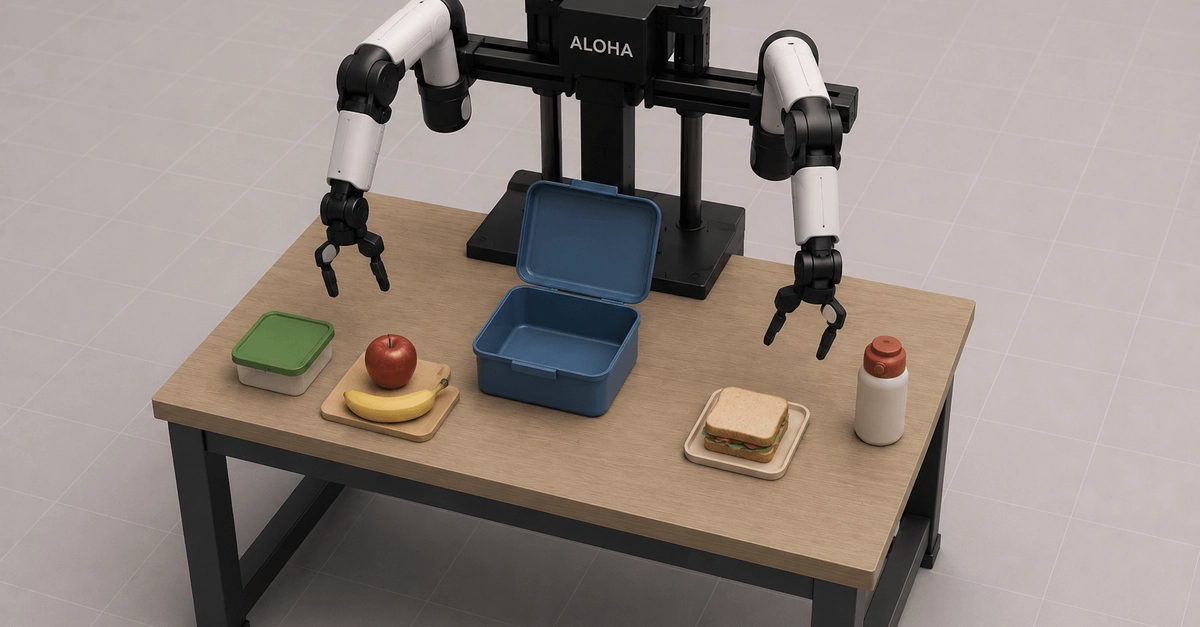
Most household robots need two arms to handle everyday tasks. A single arm can pick something up, but packing a lunchbox or steadying an object while working on it takes two limbs cooperating. This walkthrough builds a bimanual manipulation scene with the ALOHA robot in MuJoCo, using Drift to generate the whole tabletop setup from one prompt.
Why everyday tasks need two arms
Watch how you pack a lunchbox and you'll notice your hands rarely work in isolation. One holds the box open while the other places food inside. One steadies, the other acts. That coordination between two arms is called bimanual manipulation, and it's what a huge share of real household and workshop tasks actually require.
A single arm hits a wall fast on these jobs. It can't hold and place at the same time, so the moment a task needs one hand to stabilize while the other manipulates, you need a second arm. That's a real step up in difficulty from the single-arm pick-and-place we built earlier, because now the two arms have to coordinate without colliding or working against each other.