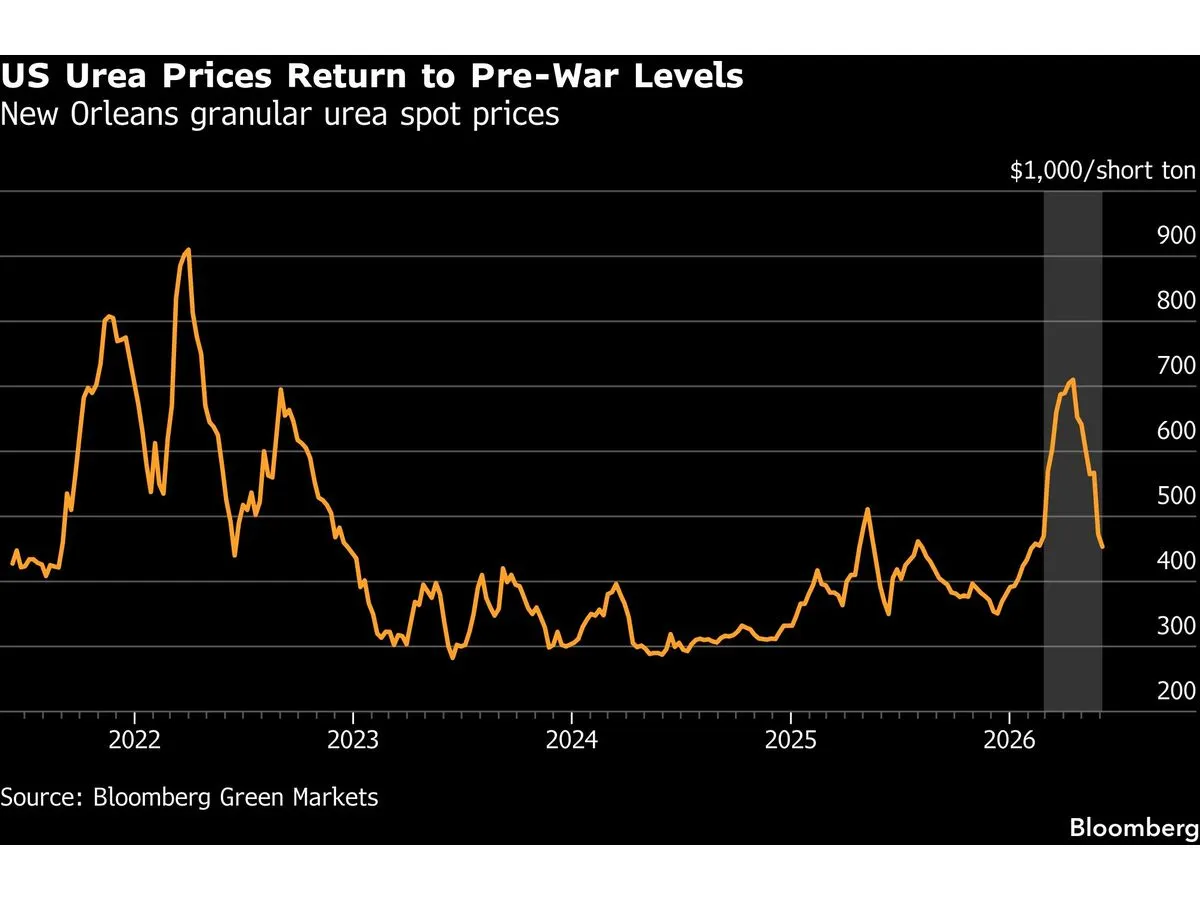
Skip to Content News Archives Economy Energy Oil & Gas Renewables Electric Vehicles Mining Commodities Agriculture Real Estate Mortgages Mortgage Rates Finance Banking Insurance Fintech Cryptocurrency Work Wealth Smart Money Wealth Management Investor Personal Finance Family Finance Retirement Taxes High Net Worth FP Comment Executive Women Puzzmo Newsletters Financial Times Business Essentials More Innovation Information Technology FP500 Podcasts Small Business Lives Told Tails Told Shopping Financial Post Store Obituaries Place a Notice Advertising Advertising With Us Advertising Solutions Postmedia Ad Manager Sponsorship Requests Classifieds Place a Classifieds ad Working Profile Settings My Subscriptions Saved Articles My Offers Newsletters Customer Service FAQ News Economy Energy Mining Real Estate Finance Work Wealth Investor FP Comment Executive Women Puzzmo Newsletters Financial Times Business Essentials HomeAgricultureMiningMiddle East war tailwinds taper off for Nutrien as ‘demand destruction’ from farmers dents earningsHigh global prices for fertilizers offset by lower sales and increased costs You can save this article by registering for free here. Or sign-in if you have an account.Nutrien Ltd. chief executive Ken Seitz at the Agriculture building on the University of Saskatchewan campus in Saskatoon, Sask. on Feb. 3, 2025. Photo by Michelle Berg/Saskatoon StarPhoenix filesNutrien Ltd. said sales of crop nutrients to farmers fell sharply this spring, even while a war in the Middle East cut off nearly one-third of globally traded fertilizer.Subscribe now to read the latest news in your city and across Canada.Exclusive articles from Barbara Shecter, Joe O'Connor, Gabriel Friedman, and others.Daily content from Financial Times, the world's leading global business publication.Unlimited online access to read articles from Financial Post, National Post and 15 news sites across Canada with one account.National Post ePaper, an electronic replica of the print edition to view on any device, share and comment on.Daily puzzles, including the New York Times Crossword.Subscribe now to read the latest news in your city and across Canada.Exclusive articles from Barbara Shecter, Joe O'Connor, Gabriel Friedman and others.Daily content from Financial Times, the world's leading global business publication.Unlimited online access to read articles from Financial Post, National Post and 15 news sites across Canada with one account.National Post ePaper, an electronic replica of the print edition to view on any device, share and comment on.Daily puzzles, including the New York Times Crossword.Create an account or sign in to continue with your reading experience.Access articles from across Canada with one account.Share your thoughts and join the conversation in the comments.Enjoy additional articles per month.Get email updates from your favourite authors.Create an account or sign in to continue with your reading experience.Access articles from across Canada with one accountShare your thoughts and join the conversation in the commentsEnjoy additional articles per monthGet email updates from your favourite authorsSign In or Create an AccountorThe Saskatoon-headquartered company reported on Wednesday that sales volumes of crop nutrients were down 11 per cent in the second quarter.Nutrien reported $1.2 billion in net earnings over the three-month stretch, a one-per-cent drop from last year's net earnings.That's in contrast to the stronger results it posted for the start of the year. Nutrien previously reported higher revenues and volumes for fertilizer, giving it a seven-fold jump in first-quarter net earnings.SUBSCRIBER EXCLUSIVE: FP West: Energy Insider brings you behind the oilpatch’s closed doors with exclusive insights from insiders every Wednesday morning.By signing up you consent to receive the above newsletter from Postmedia Network Inc.A welcome email is on its way. If you don't see it, please check your junk folder.The next issue of FP West: Energy Insider will soon be in your inbox.We encountered an issue signing you up. Please try againThat last result hinted of higher margins to come for Nutrien at a time when it could seize market share while a war in Iran disrupted industrial fertilizer supplied from the Persian Gulf.Instead, farmers saw higher prices and decided to hold off on purchases.The fertilizer giant says high global prices were "more than offset" by lower sales volumes and increased costs on inputs.Farmers were concerned about prices on their crop inputs rising this year. In spring, industry advocacy group Agricultural Producers Association of Saskatchewan estimated that more costly fuel and fertilizer could cut into farm net income by 30 per cent.“If fertilizer prices are staying high, that’s going to mean for some tough decisions to make,” Bill Prybylski, president of the farmers’ group, said in a previous interview.The fertilizer giant made four per cent more in revenue, logging $10.8 billion in the second quarter. Rising costs of fuel cut into some of the revenue, according to the company.While Nutrien is most known for its potash mines across Saskatchewan, the business was impacted by two other crop nutrients it sells.Corn crops get a growth boost from nitrogen-rich fertilizer, while canola crops favour phosphate. Both nutrients are bigger markets, and generally more expensive on a per-tonne basis, than potash. Nutrien's operations include both, for the time being.Sales revenue from nitrogen was down by three per cent and the volumes sold were cut by a quarter compared to a year ago, Nutrien reported.The company's chief executive, Ken Seitz, said on a Thursday morning earnings call that weather patterns and the run up of nitrogen prices played a part."We did see some demand deferral," said Seitz to investors. "Growers (were) stepping back and watching prices come down and delaying purchases."Underperformance in the nitrogen segment drove Nutrien to miss expectations of some analysts. The company's earnings before interest, taxes, depreciation and amortization — a type of measurement on core operating profit — came in four per cent below consensus.Some analysts think the slight miss was to be expected during an uncertain quarter."We also think buy-side expectations were tempered into the quarter given nitrogen volatility, and the miss may not be a huge surprise," said RBC Capital Markets analysts in a Wednesday note.The blockage of the Strait of Hormuz also impacted the availability of inputs to fertilizer, like natural gas and sulfer, that are used to produce different formulations of crop nutrients that get spread across farmers' fields.Overall, lower sales volumes and increased sulfur costs "more than offset" the high prices on fertilizer, the company reported.Margins to the phosphate segment were particularly hurt by the price of sulfer. It cost the company $25 million to sustain production as sales prices couldn't cover the cost of manufacturing it.Nutrien highlighted that "unsustainable pressure" on phosphate margins resulted in some producers temporarily shuttering operations.The company is reviewing options on whether it might pull away from the phosphate business.It's also determining options for its shuttered Trinidad nitrogen facility and its Brazilian retail business. Nutrien will determine its plan forward on all three later this year.Seitz said the company anticipated "demand destruction" on phosphates this quarter, and it may persist."Heading into the second half (of the) year, we expect we'll continue to see demand destruction as it relates to phosphate," he said.The Saskatoon Star Phoenix has created an Afternoon Headlines newsletter that can be delivered daily to your inbox so you are up to date with the most vital news of the day. Click here to subscribe. With some online platforms blocking access to the journalism upon which you depend, our website is your destination for up-to-the-minute news, so make sure to bookmark thestarphoenix.com and sign up for our newsletters so we can keep you informed. Click here to subscribe. Join the Conversation This website uses cookies to personalize your content (including ads), and allows us to analyze our traffic. Read more about cookies here. By continuing to use our site, you agree to our Terms of Use and Privacy Policy.
Middle East war tailwinds taper off for Nutrien as ‘demand destruction’ from farmers dents earnings
High global prices for fertilizers offset by lower sales and increased costs
TL;DRAI
Nutrien Q2: crop nutrient sales -11%, net earnings $1.2B (-1%), despite Middle East war cutting 30% of global fertilizer supply. When prices spike, customers defer purchases rather than pay more. Supply shortage doesn't protect margins if demand collapses; pricing power has hard limits.
1,251 words~6 min read