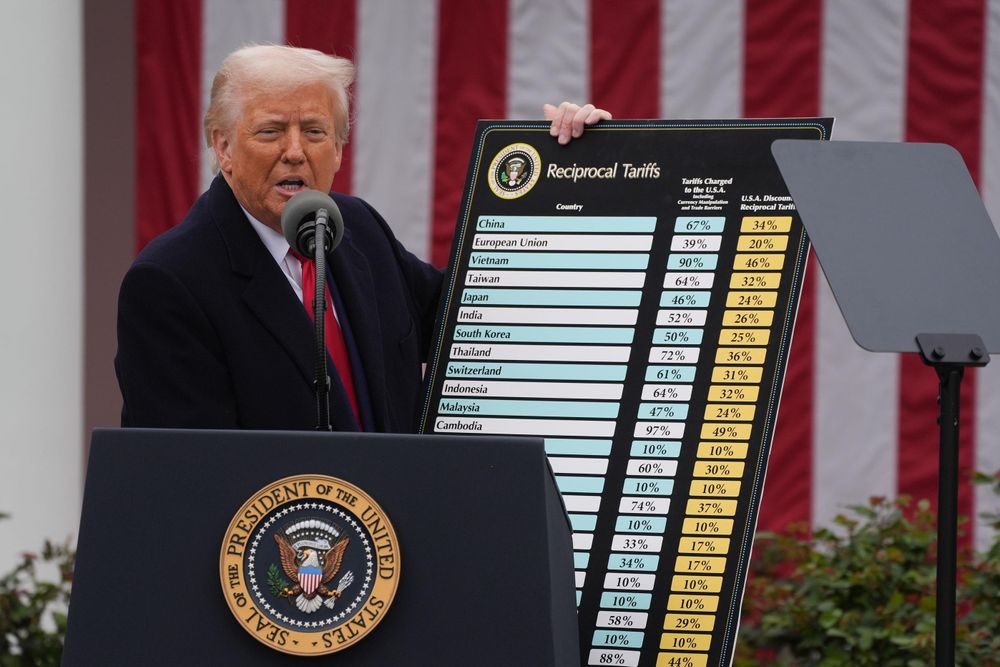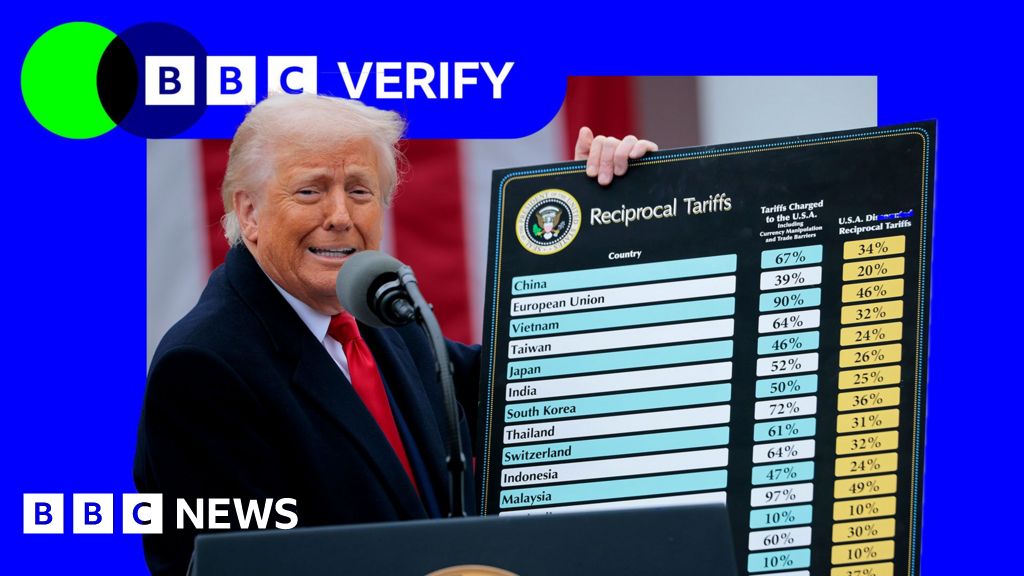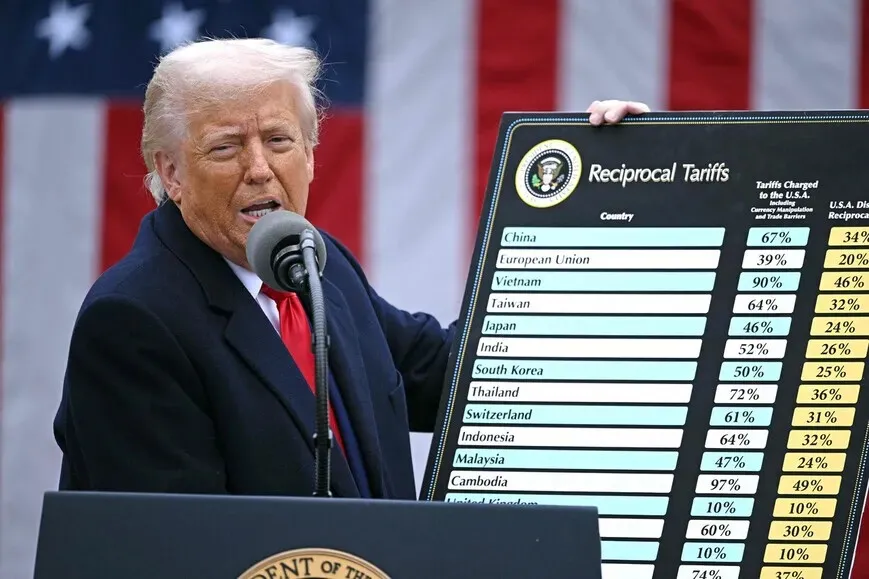
US President Donald Trump holds up a chart as he announces reciprocal tariffs on a slew of nations on April 2, 2025, from the White House Rose Garden. (AFP/Yonhap)
The trade war that was triggered by US President Donald Trump’s “Liberation Day” tariff declaration on April 2, 2025, was a classic episode in the Trump show.“For decades, our country has been looted, pillaged, raped, and plundered by nations near and far, both friend and foe alike,” Trump said while unilaterally imposing steep “reciprocal tariffs” on the entire world.A poster Trump held up for viewers was crammed with tariff rates for each country: China at 34%, the EU at 20%, Vietnam at 46%, Japan at 24% and Korea at 25%, among many others.The Trump administration had initially promised to set each country’s tariff rate based on a calculation of its unfair trade practices. But it turned out that the tariff calculation was a simplistic one based on each country’s trade surplus and total trade volume with the US. In the end, the Liberation Day tariffs were no more than high-handed behavior by a superpower that painted all trade surpluses as being the result of unfair behavior.The event, which was titled “Make America Wealthy Again,” largely functioned as a political performance designed to show the Rust Belt voters who brought Trump to the presidency that he was punishing other countries on their behalf.As usual, Trump’s brash moves weren’t backed by careful planning. Under a constant stream of threats, bluster and backpedaling, the world trade order descended into chaos.A separate issue was the ambiguous legal grounds for imposing reciprocal tariffs.When the Supreme Court struck down tariffs issued under the International Emergency Economic Powers Act, the Trump administration temporarily resorted to Section 122 of the 1974 Trade Act (which concerns emergencies in the international balance of trade). Now Trump is relying on Section 301 of the same act (which concerns unfair trade practices).These are what Nobel Prize-winning economist Paul Krugman described on his Substack as “zombie tariffs — tariffs that should be dead, because they were clearly imposed illegally, but that somehow keep shambling along.”It remains possible that Section 301 tariffs will also be struck down. The caprices of an emperor dealing with his vassalsThe pretexts offered for these tariffs have varied. The main justification has been to reduce trade deficits with trading partners. But other reasons have often been given.With Mexico and Canada, Trump imposed tariffs to punish them for not doing enough to curb smuggling of narcotics and to control illegal immigration. With Brazil, Trump voiced his grievance about former President Jair Bolsonaro’s conviction for plotting a coup. And with Switzerland, the US levied a 34% tariff because Swiss negotiators were allegedly arrogant during the negotiations.In effect, Trump has been wielding tariffs as arbitrarily as an emperor might punish vassal states that had displeased him. Tariffs came to serve as the perfect tool for the former New York real estate developer who bills himself as a master dealmaker. Trump’s typical playbook is to bludgeon his counterparts with threats and bluster while making maximum use of his own leverage.Looking back over the past year, Trump’s tariff campaign may have helped rally his hardcore base, but there is scant evidence that it has achieved the desired results.Trump’s stated objectives were lowering the US’ trade deficit, revitalizing the manufacturing sector, and boosting government revenue. But the opinion of most experts is that tariffs aren’t effective at correcting trade imbalances or boosting manufacturing.A country’s trade balance, rather like a household’s finances, depends on the ratio of spending to income. But the Trump administration has been aggressively pushing expansionary fiscal policy in the form of increased defense spending and massive tax cuts in the form of the One Big Beautiful Bill Act.Over the past year, the trade deficit has barely budged, while the manufacturing sector has, if anything, shed even more jobs. Manufacturing jobs in the US have steadily decreased since the 1980s because of automation and the economic restructuring around the service sector.Instead, the prevailing view is that Trump’s tariffs have led to higher costs for imported goods, placing a heavier burden on American consumers and companies.To be sure, tariffs, if employed strategically, can be a useful tool for protecting and nurturing domestic industry. In economics, there’s the concept of the “optimal tariff,” which can achieve such goals while minimizing the burden for domestic consumers.But that approach requires the government to strategically select specific industries and to devote years, or even decades, to shaping the business environment.Some of the best-known examples are heavy industry in Korea and manufacturing in China, but such success stories are certainly outliers. Even if the US were benchmarking such successes, the Trumpian approach wouldn’t work. American media outlets have observed that Trump’s methods are so erratic that they make it impossible for American companies to draw up normal investment plans. The limits of a show of strengthRather than demonstrating American strength, tariffs have only revealed the limits of its might.Going back to his first term in office, Trump has leaned into tariffs with the primary goal of offsetting its trade deficit with China, but his efforts have evidently come up short.When Trump raised tariffs on China up to 145% last year, Beijing retaliated by placing controls on exports of rare earths. Finding himself outmaneuvered, Trump agreed to a detente; currently, the tariff rate for Chinese goods is down to 23%.Given the competitive prices offered by Chinese products, that primes China to gain an advantage over other countries in the American market.The New York Times reported on July 29 that “for some products, the tariff rate for China is identical to the rate on exports from Southeast Asian countries, where many companies have moved their supply chains.”“Making flashlights in Thailand costs as much as 15 percent more than it does in China,” The New York Times said, leading some businesspeople wondering whether they should move operations back to China.For tariffs to be an effective weapon, access to the US market needs to be a sine qua non for trading partners. But currently, the US only accounts for 13% of global revenue.The fact is that the weaponization of an economic factor requires a dominant position in the area in question and the lack of a suitable substitute. The reason that China has been able to weaponize rare earths is that it controls 90% of the world’s rare earth refinement capacity.Edward Fishman, the author of “Chokepoints: American Power in the Age of Economic Warfare,” observes in the Financial Times that the US dollar, “which is involved in 90 percent of foreign exchange transactions,” is a chokepoint.“Tariffs do not exploit a chokepoint, making them a poor source of leverage,” he adds.Notably, China posted its highest ever trade volume and trade surplus last year, pushing exports to other countries to compensate for declining exports to the US.But countries like Korea and Japan that are wholly dependent on the US for their security are in a different position. When the US asks them for massive investments, the unspoken threat of reducing security commitments is keenly felt.In point of fact, Trump explicitly mentioned pulling troops out of Korea during his presidential campaign.Japan has taken preemptive action to forestall any such moves. Tokyo agreed to provide the US with a massive investment fund of US$550 billion in exchange for the US lowering tariffs to 15%, a deal that was reportedly proposed by Softbank Chairman Masayoshi Son.Since Koreans had been preoccupied with impeachment proceedings against disgraced former President Yoon Suk-yeol, they had little choice but to belatedly adopt the Japanese approach.But during that process, the US’ demands grew more brutal. Korea agreed to invest US$350 billion, exposing itself to a forex risk that Japan can avoid given its status as custodian of one of the world’s reserve currencies. Tariff campaign heating up ahead of midtermsTrump complains that the world doesn’t credit him for his achievements. He’s optimistic that the huge investments he’s drawn from other countries will revive American industry.But aside from a handful of cutting-edge industries, such as AI, most of the manufacturing sector remains sluggish. In the short term, increasing investment in the US will drive more imports of foreign intermediate goods, further inflating the trade deficit.If the US’ trade deficit doesn’t improve before the end of his term, Trump may well make additional demands of trading partners with a surplus.When the US was flustered by Japan’s hot economic pursuit in the 1980s, it managed to disrupt Japanese industry with the Plaza Accord in 1985 and the US-Japan Semiconductor Agreement in 1986. Perhaps that history will be repeated today.The first indication is the US’ imposition of an additional 50% tariff on a range of Canadian goods.Canada is in Trump’s sights as the only country (other than China) to impose retaliatory tariffs on the US.The US has even invoked Section 338 of the infamous Smoot-Hawley Tariff Act of 1930, marking the first ever use of a provision that authorizes the government to impose tariffs on countries that discriminate against American imports.While the US does not dare to take action against China, it’s punishing Canada, as a relatively weaker country.It remains to be seen whether the US’ imperious behavior will get results or only drive further defections among American allies. The EU has already taken steps to gain more autonomy both in terms of economics and defense.Nobody knows what surprises may await before the midterm elections in November.If the Republican Party loses its majority in Congress, the Democratic Party will organize impeachment proceedings against Trump once again.To prevent that, Trump could attempt to use either tariffs or a war to change the calculus of domestic politics.The problem is that both of those options have clear limitations.Their futility has been demonstrated by China’s control of rare earths (in the case of tariffs) and Iran’s control of the Strait of Hormuz (in the case of war).In the end, the biggest losers are likely to be American friends and allies, who may well be sacrificed on the altar of Trump’s unquenchable lust for power.All the while, the foundations of American hegemony are slowly being eroded.By Park Hyun, editorial writerPlease direct questions or comments to [english@hani.co.kr]