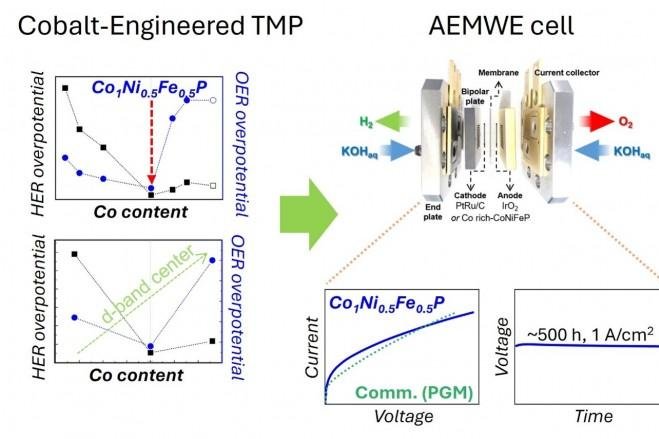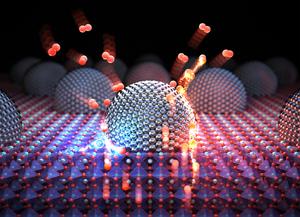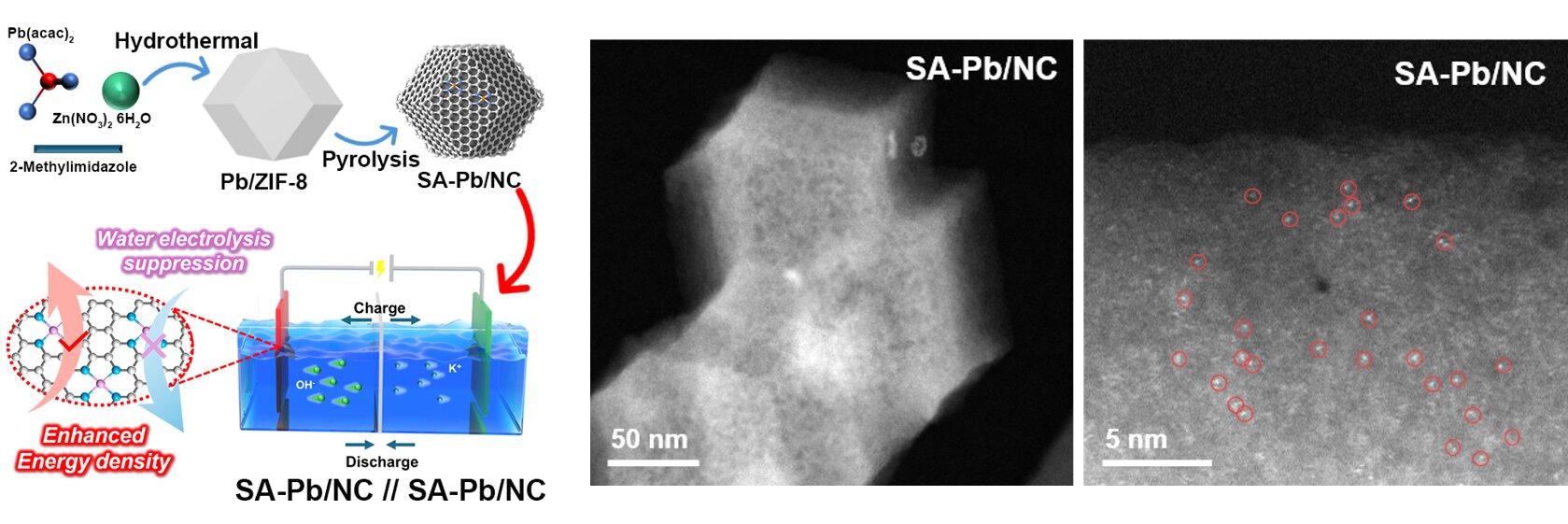
▲ Water-splitting suppression characteristics and energy storage performance of the SA-Pb/NC electrode. Credit: D. Zhang, J. H. Kim, W. T. Hong, et al. " Suppressing Water Electrolysis via Pb Single Atoms in Nitrogen-Doped Carbon for High-Energy-Density Supercapacitors." Advanced Energy Materials (2026): e70900. https://doi.org/10.1002/aenm.70900
A research team led by Jung Kyu Kim, a professor in the Department of Chemical Engineering at Sungkyunkwan University (SKKU) (co-first authors: Ph.D. candidates Dong Zhang and Jong Hun Kim), in collaboration with Min-Cheol Kim, a professor at Sookmyung Women's University, announced the development of a novel electrode material that overcomes the chronic limitation of low operating voltage in aqueous electrolyte-based supercapacitors and significantly improves their energy density.
The work is published in the journal Advanced Energy Materials.
Aqueous supercapacitors have drawn strong attention because of their eco-friendliness, lack of explosion risk, rapid charge-discharge capabilities and long cycle life. However, at voltages above a certain threshold, a water-splitting reaction occurs—water decomposes into hydrogen and oxygen instead of storing electrical energy. This behavior has constrained improvements in energy storage performance through voltage extension. Moreover, the hydrogen gas produced during this process shortens device lifespan and poses safety risks.