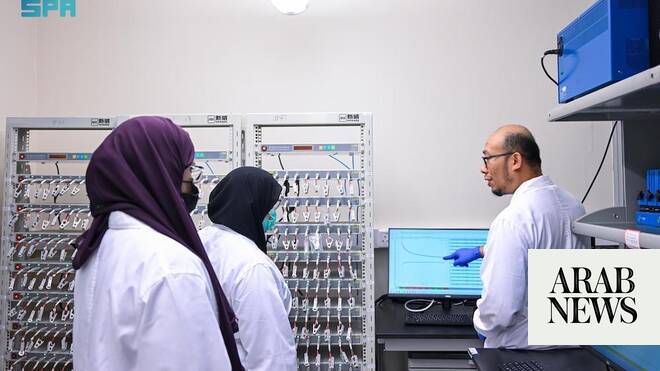
JEDDAH: Scientists at King Abdullah University of Science and Technology’s Center of Excellence for Renewable Energy and Storage Technologies have identified a key molecular barrier preventing aqueous rechargeable batteries from becoming a safer, cost-effective option for sustainable energy storage, the Saudi Press Agency reported on Saturday.
The findings, published in the peer-reviewed journal Science Advances, show how water shortens battery life and performance — and how adding low-cost salts such as zinc sulfate can counter this effect, extending battery life more than tenfold.
“A major factor in battery lifespan — aqueous or not — is the anode, where energy-generating chemical reactions occur. However, parasitic reactions at the anode degrade it over time,” the SPA reported. The study reveals that free water fuels these parasitic reactions, while zinc sulfate reduces free water levels, mitigating damage and improving performance.
Free water refers to water molecules not strongly bonded to others, making them more reactive. This state enables them to trigger unwanted reactions that consume energy and degrade the anode, according to the SPA.
“Our findings highlight the importance of water structure in battery chemistry — a key factor that has been largely overlooked,” said Husam Alshareef, KAUST professor, center chair, and the study’s principal investigator.