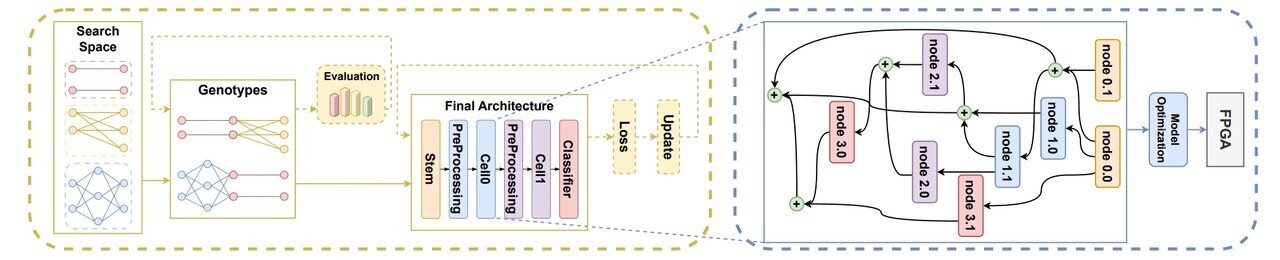
Overall framework of the proposed technology. Radio (I/Q) signals from drones are fed into a neural architecture search (NAS) process that automatically designs a lightweight AI model, which is then deployed on a low-power FPGA chip for real-time drone identification. Credit: Sungkyunkwan University
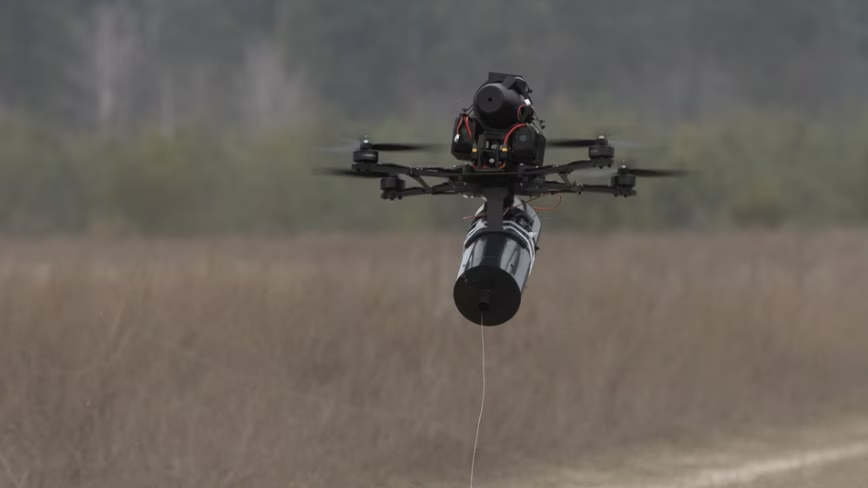
Doyeon Kim, an undergraduate researcher in the Department of Electronic and Electrical Engineering, has published a paper in an academic journal. The research focuses on implementing drone artificial intelligence (AI) identification technology through low-power semiconductors. This study could dramatically improve the battery efficiency of systems that monitor unauthorized drones in real time in military and industrial environments. The research is published in the journal IEEE Transactions on Industrial Informatics.
With drones becoming widely used globally in recent years, technology to accurately detect and identify unauthorized drones has become crucial. Previously, AI technology was used to detect drones, but it had a major drawback: It required extensive computing power and consumed large amounts of electricity. For this reason, it was challenging to directly embed AI in small, battery-powered surveillance devices or mobile equipment.