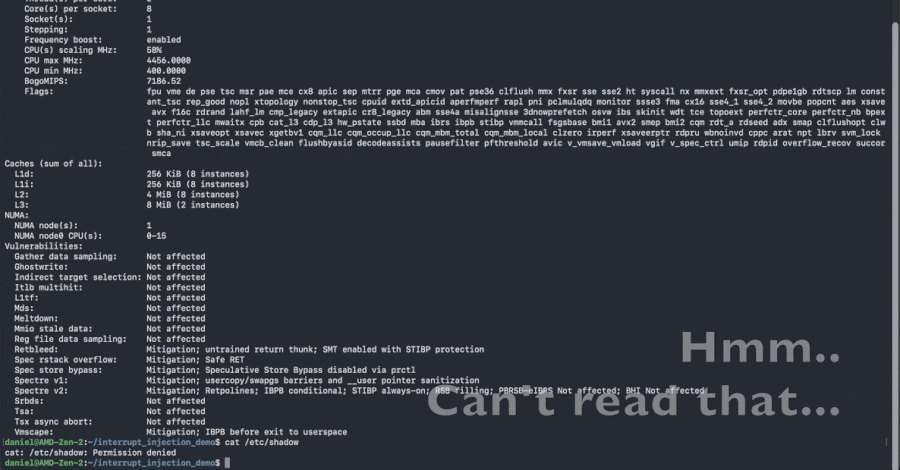
An unprivileged Linux program can time a hardware interrupt to land in the gap between a processor sanitizing its branch predictor and the kernel using it, re-poisoning the predictor after the defense has run.
MIT CSAIL researchers Daniël Trujillo and Mengjia Yan named the technique INTERRUPT INJECTION. On an AMD Zen 2 machine running Linux 6.14 with every default Spectre v2 mitigation on, their exploit leaked arbitrary kernel memory at 5.47 bytes per second with 91.97% accuracy, enough to locate and read /etc/shadow, which stores the system's password hashes, in five of ten attempts.
It needs no privileges, only local code execution, so the risk sits on shared systems running an affected processor.
The pair disclosed to AMD and Intel on February 5. AMD told them it plans a kernel patch; MIT says one has since shipped and arrives in a normal operating system update.
AMD published a bulletin on August 6, AMD-SB-7061, titled "Safe RET Interrupt Vulnerability," naming Zen 1 through Zen 4 processors as affected. Its summary says an attacker running code on an affected system "could inject an interrupt at a precise moment to disrupt Safe RET," which "could potentially weaken that protection and may result in information disclosure." AMD adds that the issue "appears to be associated with the Linux implementation of the Safe RET mitigation."